
“This is my forest. I know every stone and every root. No one can frighten me here.”
Ronja The Robber’s Daughter, Astrid Lindgren
Growing up, much of my time was spent in a centuries-old farmhouse in a moorland valley where my friend Annie lived. Outside her bedroom was a narrow landing, most of it taken up by a bookcase we’d need to shimmy past to get in and out. The shelves were so tightly packed, books would need to be prised free.
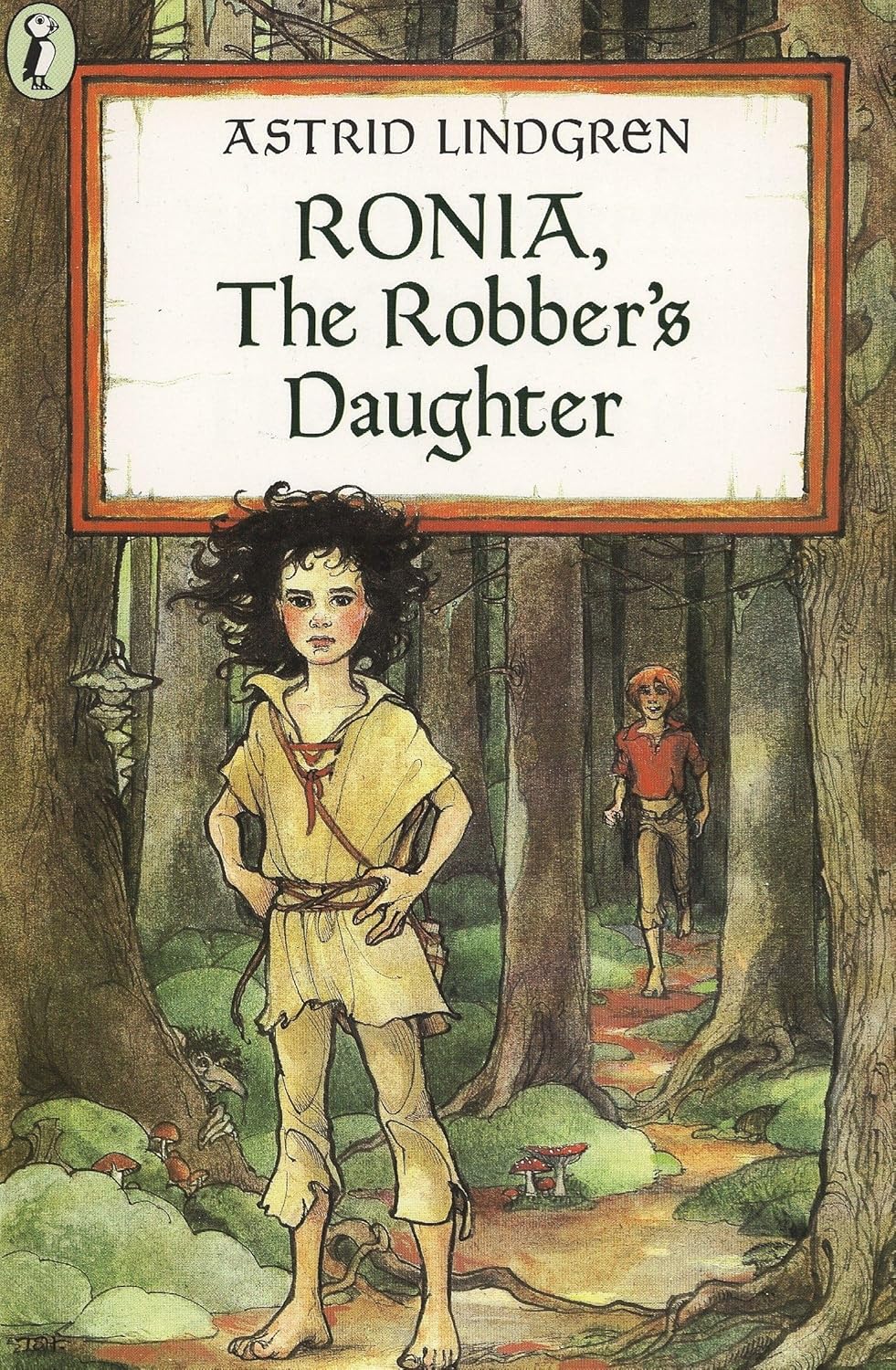
It was rare that I passed this bookcase without tugging out one book in particular – Ronja the Robber’s Daughter by Astrid Lindgren which had been read to my class at school. Usually, I wouldn’t even open the book, but just study the cover, especially the figure in the foreground: a wild-haired, barefooted Ronja, steadfast on a thin forest trail. Fearless and nature-led, she embodied everything I wanted to be.
For what was to be her final novel, (after Ronja, Lindgren shifted her focus to picture books) Lindgren drew inspiration from her densely forested home region of Småland, along with Thoreau’s Walden. City-based at the time, Lindgren ached for the forest and was inspired by Thoreau’s departure from society to lead a solitary, simple life in the woods.
Originally published in Sweden in 1981 as Ronja rövardotter and in English in 1983, the translated edition (unnecessarily) changed the spelling of Ronja to Ronia and featured a different cover by prolific children’s book illustrator Trina Schart Hyman.
I’ve always wondered why this cover had such a lasting impression, and I figure it may have something to do with Hyman’s art technique, which involved extensive layering. She began with a pencil drawing, then built layers using India ink and diluted acrylic. The result is a mesmeric, fabled atmosphere that enchants me to this day.

 Northern Fever