Holavallagarður – Reykjavik’s Forested Garden Of The Departed

In 2011, I stayed near Holavallagarður cemetery on a friend’s living room floor for a few nights. It was my first time in Iceland, and I knew nothing about Reykjavik’s ‘largest and oldest museum.’ Thus, I cruised on by its hefty iron gates and didn’t think about it again for the remainder of my three-month trip. 

Ten years later, in 2021, I finally crossed into the centuries old forested cemetery – home to over 10,000 marked graves – with my enthusiastic guides, the two wraiths from Icelandic dungeon synth band Dyfliza.

One of the first things you spot when you walk into the cemetery from the main entrance is the lychgate. In bygone times, it was where the morgue stood, used for the corpses of the poor and foreign sailors. The well-off dead remained at home until it was time for their funeral. The morgue was moved in 1950, though you can still see the bell.*

*I don’t know why there was a bell in the morgue. A speedy Google search suggested it was to keep evil spirits away from the body, though this wasn’t specifically about Icelandic morgues, so I’m none the wiser really. 

It’s easy to while away hours picking your way around the seven-and-a-half acres of gridded grounds. Narrow paths, slippery with moss, wind around jumbled graves. Drooping willows, spruces and poplars, birch and rowan all call Holavallagarður home, along with a type of snail found nowhere else in Iceland. (‘Found nowhere else in Iceland’ is a running theme.) 

Chipper birds congregate to gossip in small, gnarled trees, and they attract cats. Lots of cats. There’s also an abundance of fungi to be discovered during autumn. The most exciting of them has to be the Common Stinkhorn or Fylubollur, which amusingly (because I’m a childish buffoon) translates as ‘stinky male genitals.’ 

Its odour, akin to rotting flesh, is irresistible to flies. A Common Stinkhorn looks like a penis erupting from the ground, and it was thought, once upon a time, that it was an aphrodisiac capable of providing men with ‘powerful erections.’ Common Stinkhorns aren’t actually common at all in Iceland (the first one was documented in 1990), and yes, you guessed it, the only place they’re found is Holavallagarður.

While the cemetery was ready for occupancy in the summer of 1837, it would only be in the winter of 1838 that the first person was laid to rest. In Icelandic folklore, the first person to be buried in a cemetery is bound to be its Guardian for all time, greeting the newly deceased and keeping a watchful eye on all those who come to be buried there after them. 

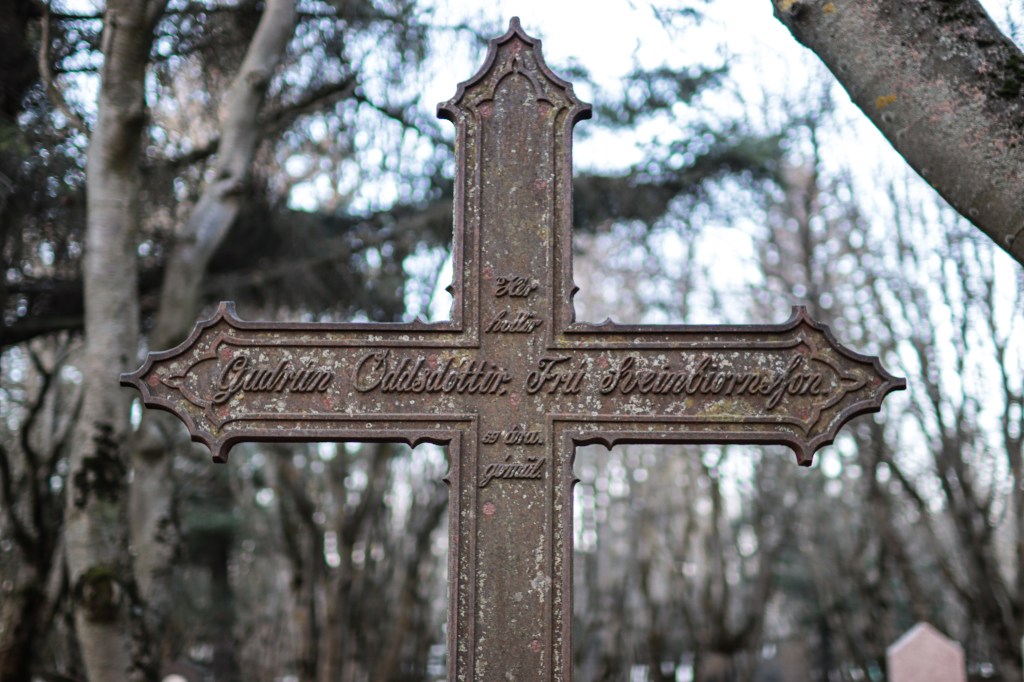
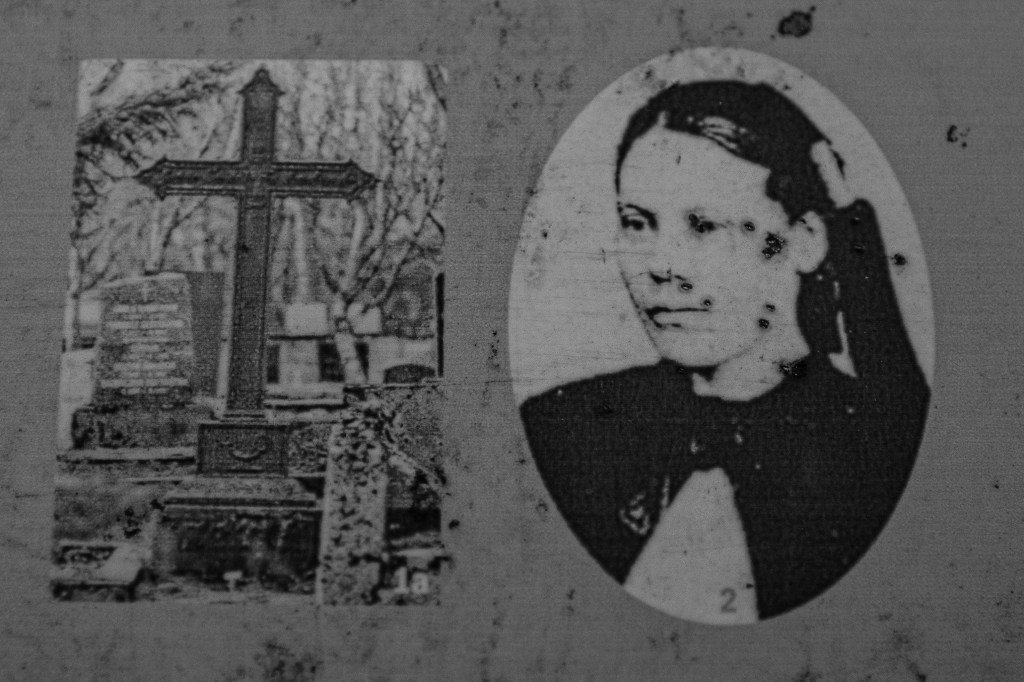
Predictably, very few people wanted to nominate their loved ones to take on this everlasting position, even if it did mean the deceased would never decay. Also, the church didn’t want just anyone to be the Guardian of Holavallagarður, and turned people down because they weren’t ‘in the right standing’ for the role. The position was eventually taken on by 59-year-old Guðrún Oddsdóttir, who was ‘offered’ to the cemetery by her husband, the Chief Justice of the National Court. 

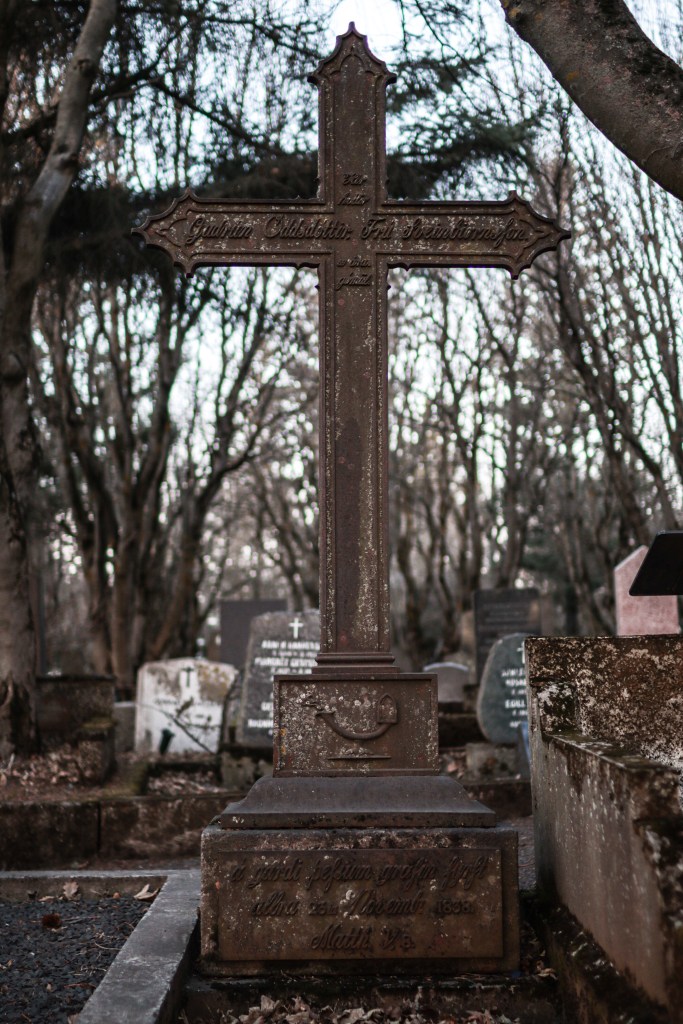
Guðrún’s imposing cast iron memorial cross (you can find it at the T-405 section of the cemetery) is the largest of its kind in Iceland. It’s engraved with a flaming lamp (the cemetery Guardian is also known as a ‘Light Bringer’ so it’s a most suitable motif) with the word Her huili husfru – Here rests the mistress of the house. The engravings remain remarkably easy to read.
Inspired by Guðrún, and the lore surrounding cemetery Guardian’s, my best friend Giorgia Sottotetti and I shot some photos in Holavallagarður. Giorgia’s dress (Ovate, in case you’re wondering) is red because, in tales of cemetery Guardians, they’re said to appear wearing red or green.  

Politicians, painters and poets are lying in Holavallagarður…as well as the notorious murderess Steinunn Sveinsdóttir. In the Summer of 1802, in a two-family ‘village’ near Rauðasandur beach in the Westfjords, Steinunn Sveinsdóttir and her lover Bjarni Bjarnason murdered their respective spouses in what would go on to become one of the best known criminal cases in Iceland. 

In May 1803, the couple were sentenced to death. But there was a problem. No executioner could be found in Reykjavik, or at least not one qualified enough to do the job. So, the couple were to be deported to Norway. 

Sveinsdóttir died in prison of unknown circumstances before she could be deported. After numerous prison breaks and re-captures, Bjarnason was sent to Kristiansand. In a style reminiscent of medieval execution, he was put on a breaking wheel and stretching bench before having his head and hands cut off and jammed on spikes. In a differing account, he had a hand cut off and was then decapitated. Dismemberment followed, with his torso and head ending up on spikes. 

Initially, Sveinsdóttir was buried where the statue of Leif Eiriksson stands today, something I learned from the excellent thesis, Haunted Reykjavik: Cultural Heritage in the form of Ghost Stories by Matthildur Hjartardóttir.

Hjartardóttir explains: ‘Since Steinunn was considered evil, she wasn’t buried in the traditional sense, and she wasn’t buried in consecrated ground, as was custom at the time. Steinunn was dysjuð, which is a grave consisting of heaped-up stones, a practice reserved for people who were not deemed worthy of a proper burial. People then started throwing rocks at the mound for various reasons. Some did it to maintain the mound; others did it because they were afraid that she would come back, and others did it so her spirit would leave them alone.’

I don’t know where she was relocated to next (I heard her remains were moved several times), but for some years, she laid in an unmarked grave in Holavallagarður. It was only in 2012 that her grave was finally given a marker, following a prolonged fight for recognition by her descendants, who were staunch in their belief in her innocence. 

Speaking to the Iceland Review in an article celebrating the cemetery’s 180th anniversary, the caretaker Heimir Janusarson said: ‘The cemetery is very unique in Europe because it has never been reorganized or dug under… We have the first grave, we have the cemetery’s developmental history. You can read its planning history. You can read its vegetation history – when a [new species of] tree arrived in the country – because they were always planted in the cemetery first [because it was an] enclosed area and there [were] no sheep or horses to eat them.’

I’ve spent much time in Holavallagarður since 2021; in theory, I should know it almost as well as the back of my hand. But it proves me wrong whenever I think I’ve figured it out. Despite how well I may have studied the map beforehand, I still find it oddly special (okay, and sometimes infuriating…) that I’m never quite sure where I’m going when stepping off the main paved footpaths and onto the trails twisting through the forested garden of the departed. 

Sources
Flickering Lamps

Iceland Review

Atlas Obscura

Iceland Mag

New Year’s Eve In Iceland

I’ve always found the frenzy of New Year’s Eve overwhelming. The relentless din of fireworks, the roaring countdown, the gargantuan pressure to have THE BEST TIME EVER. It’s just too much. Most of my New Year’s Eves have been spent in bed with my journal, picking over the past year in minute detail.  

My perfect NYE would be in a forest cabin, hours from the closest town, where I’d experience absolute stillness well before and after midnight. If there did have to be noise, I’d much prefer to hear the pattering of hail, or a tree cracking in the cold or a raven cawing rather than fireworks and the deafening screams of HAPPY NEW YEAR! 

But, this year, I was elated to be involved in the celebrations, which included fireworks and hugging at midnight, though thankfully no screaming. My Icelandic boyfriend invited me to spend the evening (though the evening lasts most of the day, with only four hours of light in Iceland at this time of year) with his family and girlfriend (our relationship is open). 

I happily jumped head first into their traditions and felt much more upbeat than usual because the weather was suitably wintery – as it should be at the end of December. It was cold (-6.5 at times), and there was plenty of snow. (In a post on my blog, A Wyrd of her Own, I wrote about how out of sync I felt with the UK’s weather and the gigantic impact this had on my mood over Christmas.) In the UK, on NYE, it was wet, cloudy and blustery, with the temperature well into double figures. 

It’s tradition in Iceland to meet for a family meal between 6pm and 7pm. (We met at 6.30pm), and our meal was made up of typical Jól fare, including caramel-glazed potatoes, red cabbage, Waldorf salad (bound together with an incredible amount of whipped cream), endless bottles of Appelsín (orange soda) and cans of Malt og Appelsín (non-alcoholic malt beer mixed with aforementioned orange soda. Apparently it’s the taste of an Icelandic Christmas in a can.) There was also Toblerone ice cream. Curiously, decades ago in Iceland it became extremely popular as a festive dessert, and after snaffling down two helpings I can absolutely understand why. 

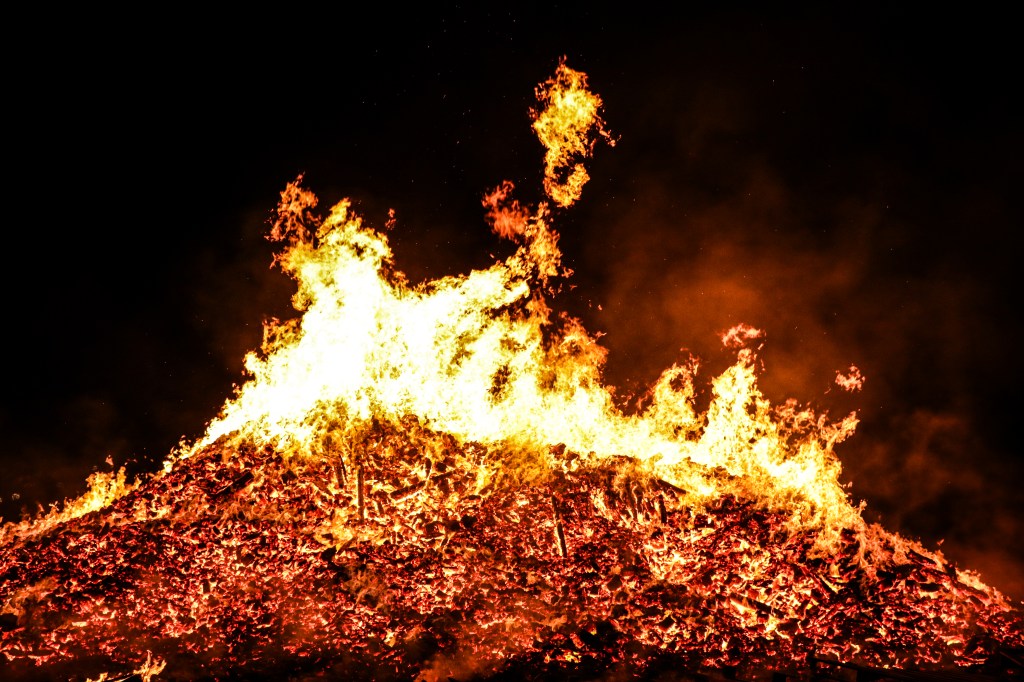
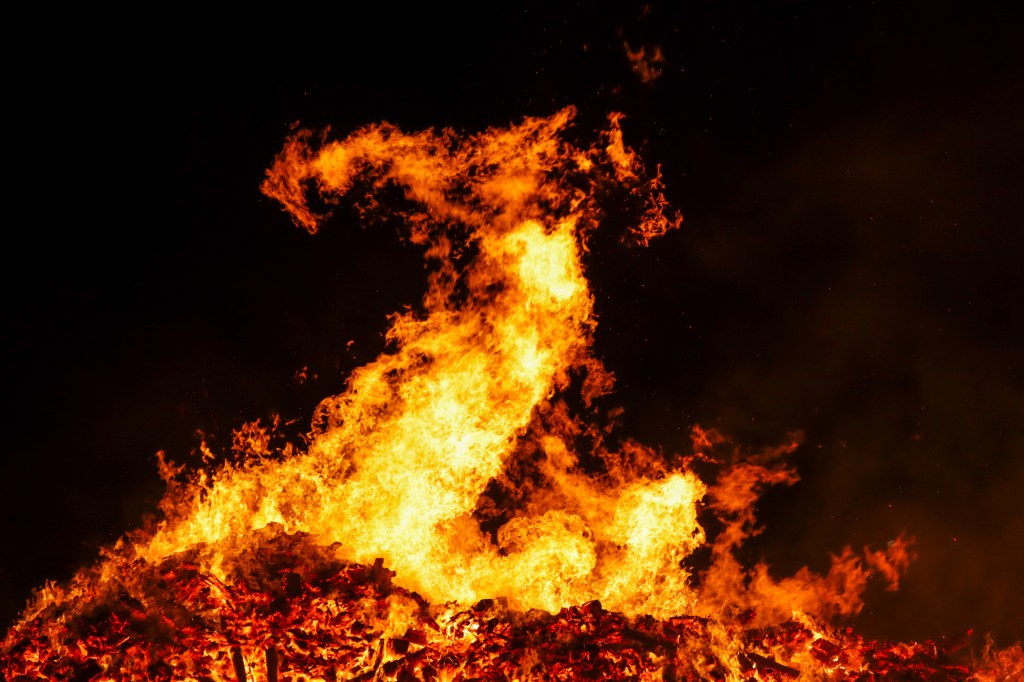
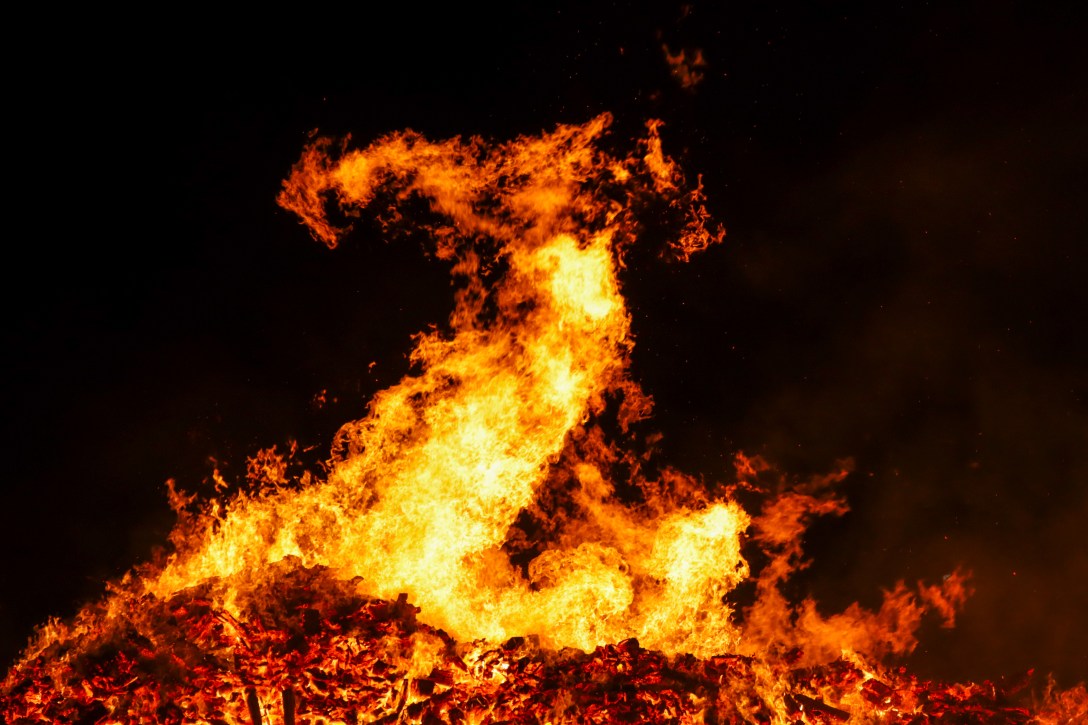
After dinner and heartfelt debates about the existence of elves (according to my boyfriend’s uncles it’s simply not true that 54% of the population believes in them), we tramped across a field of deep snow to wonder at a gigantic communal bonfire. Known as Áramótabrennur, these fires have burned on NYE in and around Reykjavik since the 18th Century and originated from the belief that to have a clean start in the new year, you had to burn away the old year and all that it represented. We went to the bonfire at Geirsnef (you can ogle some of my photographs below), though we had several places to choose from in the Greater Reykjavik area. Across Iceland, around 90 bonfires are ignited on NYE. 

There’s heaps of folklore linked to NYE in Iceland, and the folk tales of Jón Árnason, compiled in the 19th Century, talk of New Year’s Eve as the time when Hidden Folk would relocate their homes and become visible to people. Women would make the home spotless and light a candle in every corner. Once clean, the mistress of the house would walk around it and welcome any passing elves inside by saying, ‘Those who want to come may come, those who want to leave may leave, without harm to myself and my people.’ Leaving candles outside to guide the Hidden Folk was also customary.  

Following the fire, we watched the annual comedy show, Áramótaskaupið (New Year’s Spoof). Broadcast on TV since 1966, it’s become such an central part of NYE celebrations that in 2002, an estimated 95.5% of the population tuned in to watch it. 

After the show, from which I learned that Icelanders call Tenerife Tene (I find it amusing that Icelanders flee a cold volcanic island for a warm one), it was time to bring out the fireworks. Fireworks in Iceland differ from those elsewhere. They’re sold by ICE-SAR, the Icelandic Association for Search and Rescue (a volunteer-led organisation that saves upwards of 1200 people a year), who use the profits – which can reach hundreds of millions of kronur – to update their equipment. 

We watched the kaleidoscopic display from a snowy hilltop. There was no being penned in by thousands of people screaming HAPPY NEW YEAR, and, for the first time, I genuinely enjoyed watching fireworks illuminate the new year. 

There was absolutely zero pressure to have THE BEST TIME EVER, which enabled me, I’m sure, to really have fun. The evening ended with me feeling not overwhelmed but grateful, loved, and calmer than I can ever say I’ve been before on what I’d always thought of as the most highly-strung night of the year. 

The Christmas Cat Of Iceland

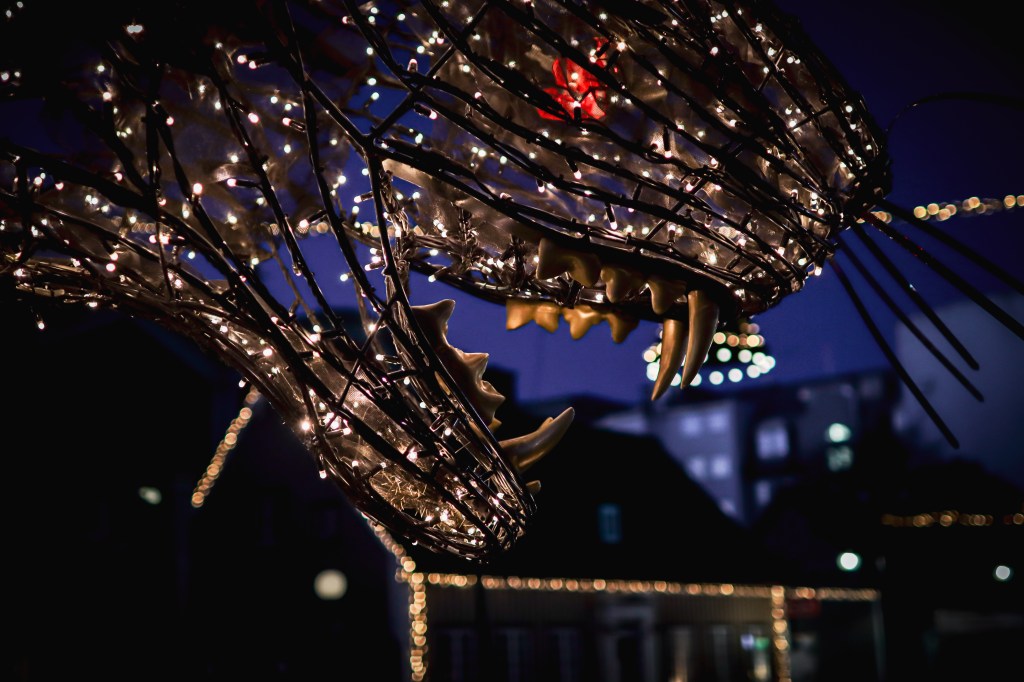
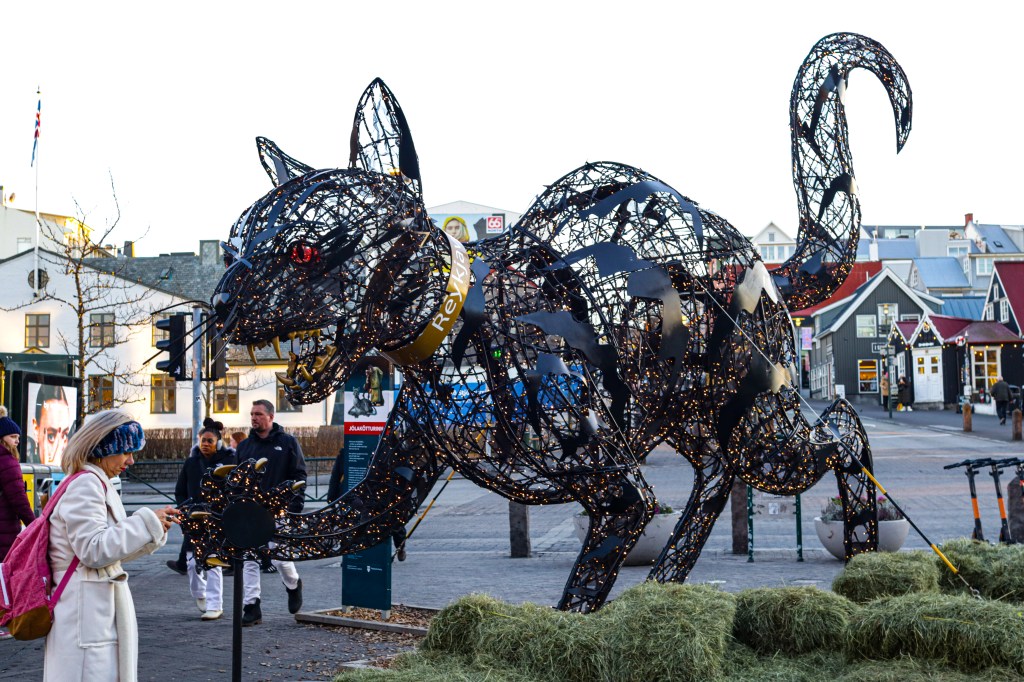
It was still dark at nine-thirty the other morning in Reykjavik (it would be well after ten before the sun shimmied up to provide the city with its scanty ration of daylight) when I bumbled outside to capture the looming Jólakötturinn (the Yule Cat) sculpture in all its ominous glory. 

Every November since 2018, a five-metre-tall iron sculpture, decked out with 6,500 LED lights, depicting Gryla’s child eating floofy familiar (some attribute the inspiration for its ‘floofiness’ from the Norwegian Forest Cat) who eats children who don’t get new clothes for Jól has materialised in the centre of Reykjavik to herald in the season the traditional Icelandic way – with foreboding.  

The sculpture cost the city a ‘sensible’ 4.4 million ISK and was fabricated by Austrian company MK Illumination. A garden centre owns it, and they lease it out each year to the city for a ‘steal’ at just over 3 million ISK.

Reykjavik’s Jól décor tends to be conventional, with the city reusing lights and garlands yearly. (Though I favour the cosy understatedness over most other cities I’ve seen ‘glowed up’ for Yuletide.) So, the sculpture’s arrival in 2018 was quite the talking point.

While the Yule Cat gathered much adoration (it was welcomed with a speech and a children’s choir), there was some backlash, too. One critic, Sanna Magdalena Mörtudóttir of the Socialists party, was critical of the city’s priorities and was furious the struggle of the city’s low-income families wasn’t brought up during the opening speech. 

While cats have held a prominent role in Nordic society since the Viking Age, it’s unknown how long the Yule Cat has been around. Though it’s theorised he’s been prowling since the Dark Ages. We do know that he’s stalked written records since the 19th Century. 

As Kathleen Hearons writes in Head Magazine, ‘Cats were the travelling companion of choice for Vikings – although not for sentimental reasons, but rather to kill mice and be skinned for their fur. Consequently, feline populations grew throughout the Nordic countries when the Vikings settled there. To this day, Reykjavik is “culturally a cat city,” according to Reykjavik Excursions. As of August 2022, there was a cat-to-human ratio of 1-to-10…

In bygone times, the threat of the Yule Cat would frighten children (and, without doubt, some adults) into finishing processing the autumn wool before Jól. By the Middle Ages, the export of wool from Iceland played a valuable role in the economy, and having a prosperous wool production was imperative. 

Though this fear-mongering technique ensured laziness was all but eradicated in the last part of the year, it was also a superb encourager of family bonding, as everyone in the family had a role to play and would gather around the fire in the evenings to prepare yarn and knit.

In an article for the Reykjavik Grapevine, Ethnologist Árni Björnsson says, ‘After 1600, there are a lot of changes in Icelandic society. Folklore often mirrors what’s happening in society. So, it makes sense that Grýla and the yuletide lads are grimmer during this difficult time for Icelanders. In 1602, the Danes banned Iceland from trading with countries other than Denmark, and this was tough because Iceland relied on many imported goods. To make matters worse, the colder period in Iceland also sets in around 1600.

 So, those things we call “jólavættir,” or supernatural beings of Christmas—including the yuletide lads, their ogress mother Grýla, and the Christmas cat—those elements were probably incorporated into the Christmas tradition to keep kids in line. Everyone was supposed to work hard to do all the things that had to be done before Christmas, and some people were lazy, you see. So it was said that if you weren’t diligent at working, the Christmas cat would come for you.’ 

In 1746, parents were banned by the King of Denmark from tormenting their children with stories of the Yule Cat, Gryla and her thirteen trouble-making lads as youngsters were becoming too afraid to leave their houses.

In 1932, a book was published by the poet Jóhannes úr Kötlum called Jólin koma (Christmas is Coming), and it featured a poem called Jólakötturinn which brings to life – though in the most family-friendly way – the goings about of the malicious moggy. An English translation was published in 2015 for the Icelandophiles out there. 

You all know the Yule Cat

And that cat was huge indeed.

People didn’t know where he came from

Or where he went.

– The first stanza from Jólakötturinn

Following the publication of Jólin koma, the Yule Cat was, in the words of Áki Guðni Karlsson, writing for Icelandicfolklore.is ‘firmly established as part of an “old Icelandic” pantheon of Christmas beings for generations of Icelanders.’

You’ve probably encountered Bjork’s dungeon synthy musical adaptation of Kötlum’s poem at some point, though I’ve only recently discovered she wasn’t the first person to put it to music. That honour lies with the late Icelandic singer Ingibjörg Þorbergs. There’s also an exquisite version created by Icelandic folk duo Ylja. 

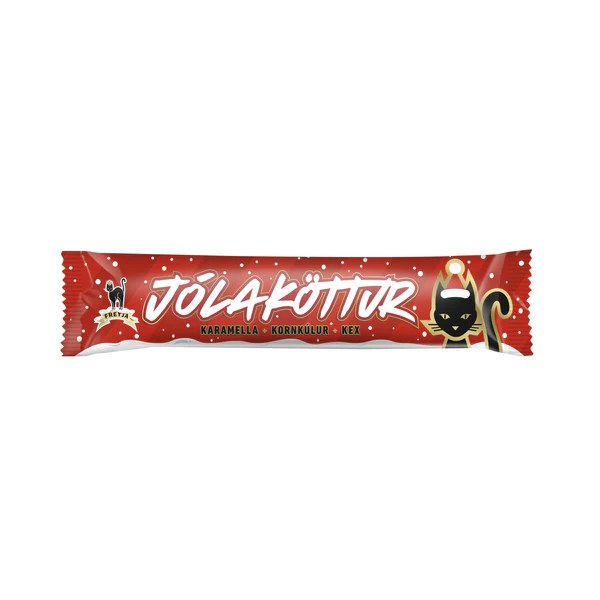
Like his mistress and her thirteen lads, the Yule Cat has long infiltrated Icelandic Christmas paraphernalia and even has his own chocolate bar, ‘Jólaköttur’ (the Christmas version of the famous chocolate bar Villiköttur), a delicious 50g beast of thick milk chocolate, caramel and biscuit all knobbled together with crisp rice.

The innovative chocolate company OmNom released a limited edition winter chocolate bar back in 2018 called Drunk Raisins + Coffee (which featured, among other things, green raisins infused with mandarin juice, cocoa beans from Tanzania, Icelandic milk and Austrian rum) in honour of the Yule Cat and in collaboration with the feral cat rescue organisation Villikettir.

On the OmNom website, Hanna Eiríksdóttir writes, ‘…stray and feral cats are neither evil nor frightening, and they definitely do not eat children. No one really knows how many cats in Iceland are feral or strays,they are thought to be in the thousands. In our minds, the Yule cat is the protector of these Icelandic stray and feral cats. The old folklore reminds us not to turn a blind eye to our little furry friends in need.’

I went back to the Yule Cat sculpture later on in the day. I saw togged-up kids catapulting themselves around in the straw pile surrounding the eternally pissed-looking puss, and now as I write this, I regret not sidling up to the parents and whispering to them, like the total weirdo I am, ‘So, do they think he eats harðfiskur now or…?’