For a few years, I had a partner who lived in Akranes, a small port town about a forty-minute drive from Reykjavík. The construction of the Hvalfjörður Tunnel (at 70 million USD, this 5.770-kilometre subsea tunnel cost less than Kristi Noem’s ad campaign) reduced travel time by a hefty forty-five minutes when it was completed in 1998.
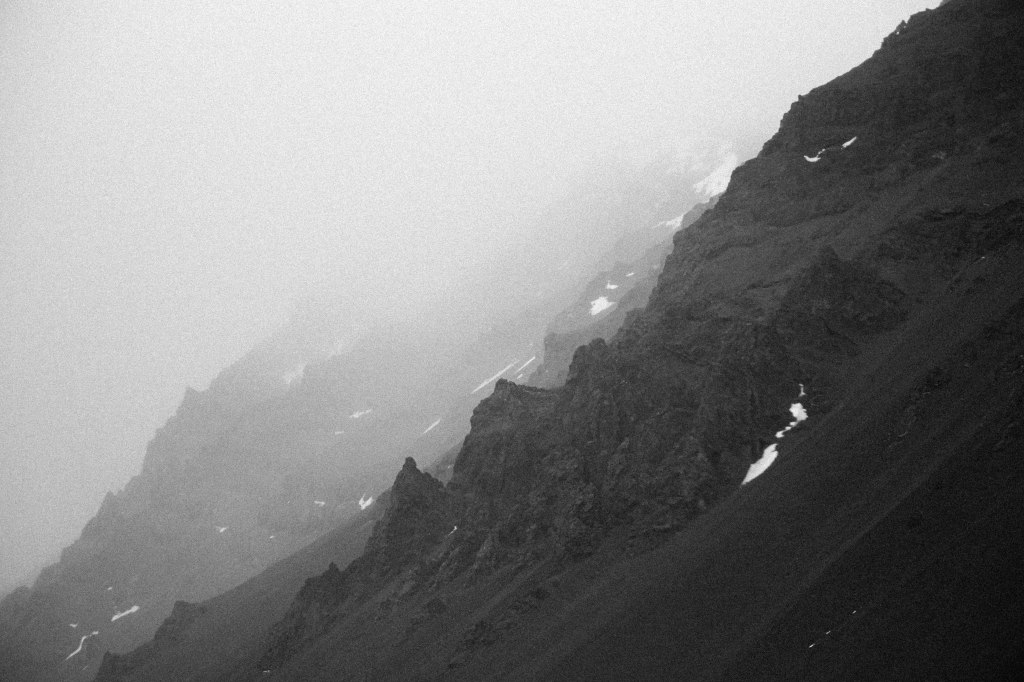
The road which we’d travel, sometimes multiple times a day, passes mountain ranges so epic, so worthy of worship, that I felt I was betraying the landscape itself by not summiting the peaks.
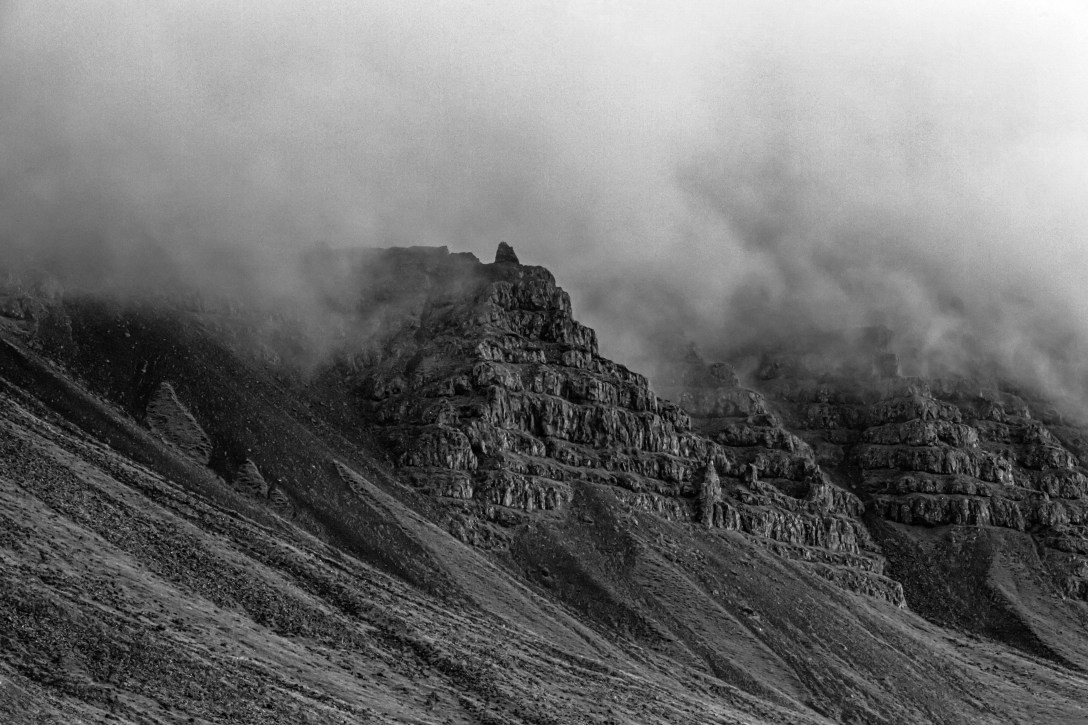
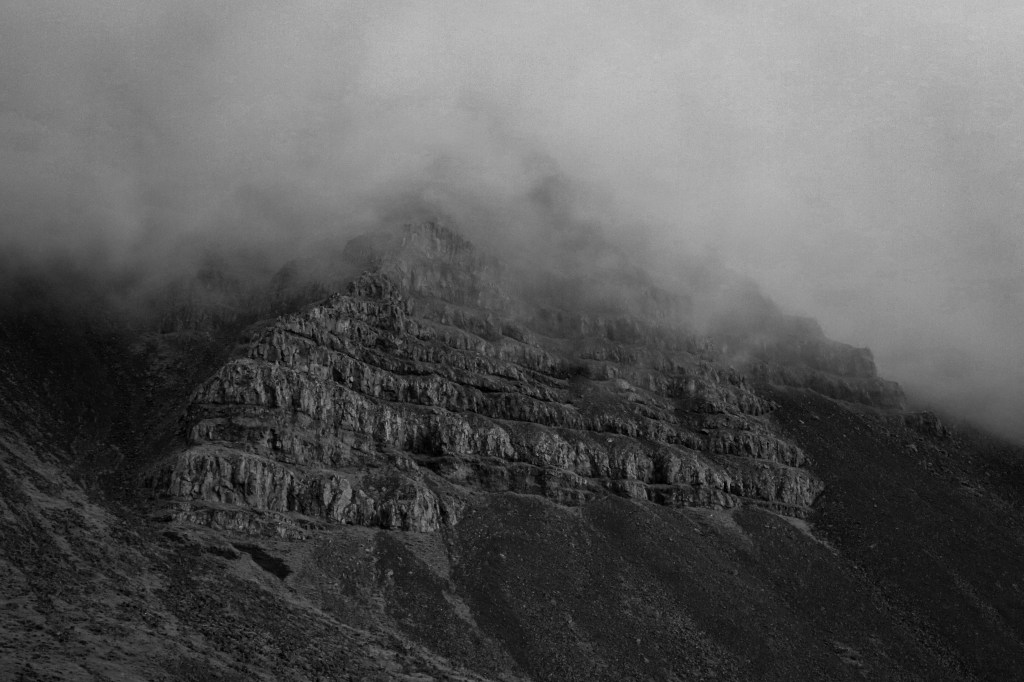
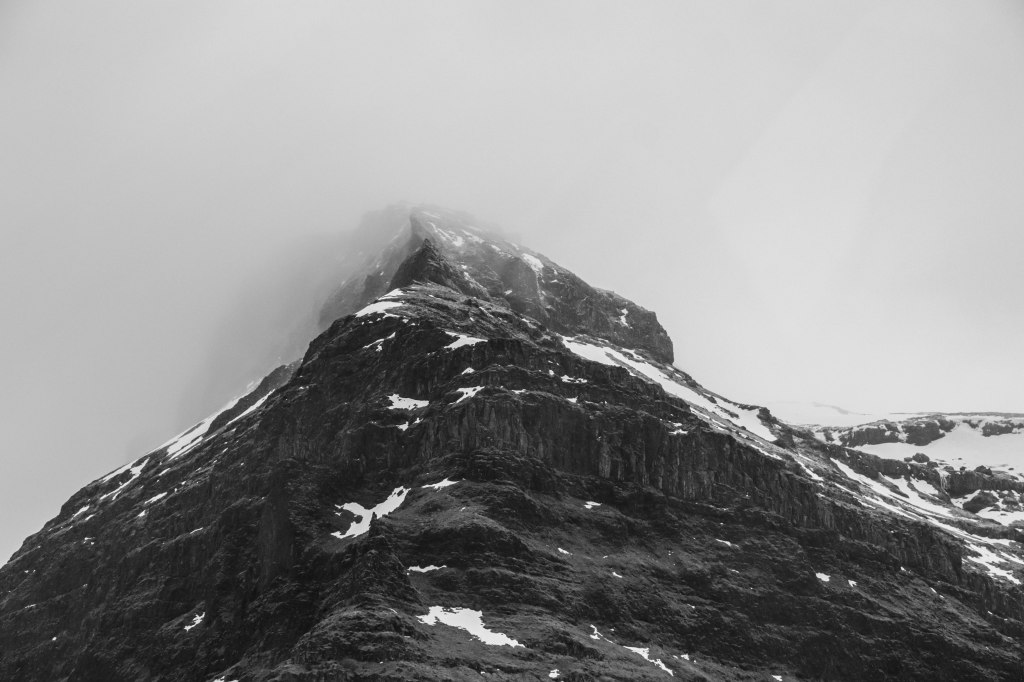
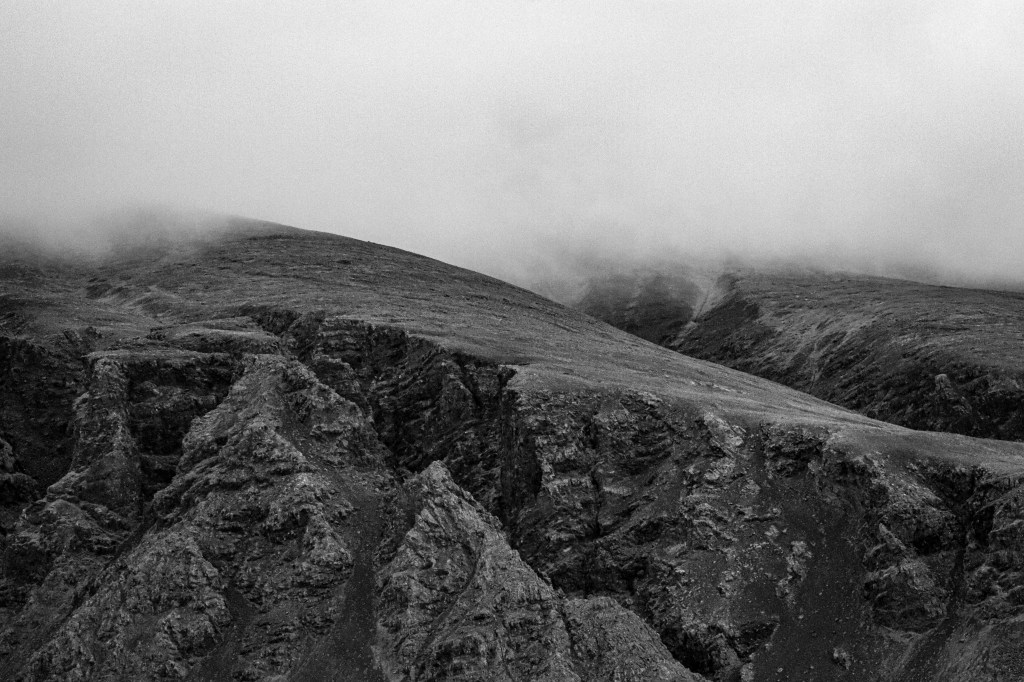
My favourite time to see the mountains was on misty days. ‘THE MOUNTAINS, THE MOUNTAINS! LOOK AT THE MIST IN THE MOUNTAINS!’ I’d yell at my partner, head whipping from the window to my partner back to the window again, aghast. ‘I can’t look, I’m driving,’ he’d patiently remind me. Abandoned by rationality, I’d forget he couldn’t appreciate the views like I, the fortunate passenger princess, could.
Autumn and its gales may be here (rejoice!), but I’m sharing this post regardless. I started writing about mosquitoes in September, but glanced away from the page, and October blew in. You know how it is, I’m sure.
A few years ago, I was celebrating Midsummer with family in Sweden. The weather was impeccable, the midsommarstång inspiring to behold, and the mosquitoes, for whatever reason (no repellent involved – I’d forgotten it), keeping a wide berth.
Well, keeping a wide berth from me. I was the only one not being savaged by summer’s least welcome players. My partner at the time – a man of Icelandic stock – was plagued worse than everyone and carries the scars to prove it.
Intriguingly, it may have been an odour in my sweat that was keeping them at bay. This lucky break was an isolated incident, though, as typically I’m swarmed and left with archipelagos of bites which swell to memorable heights.
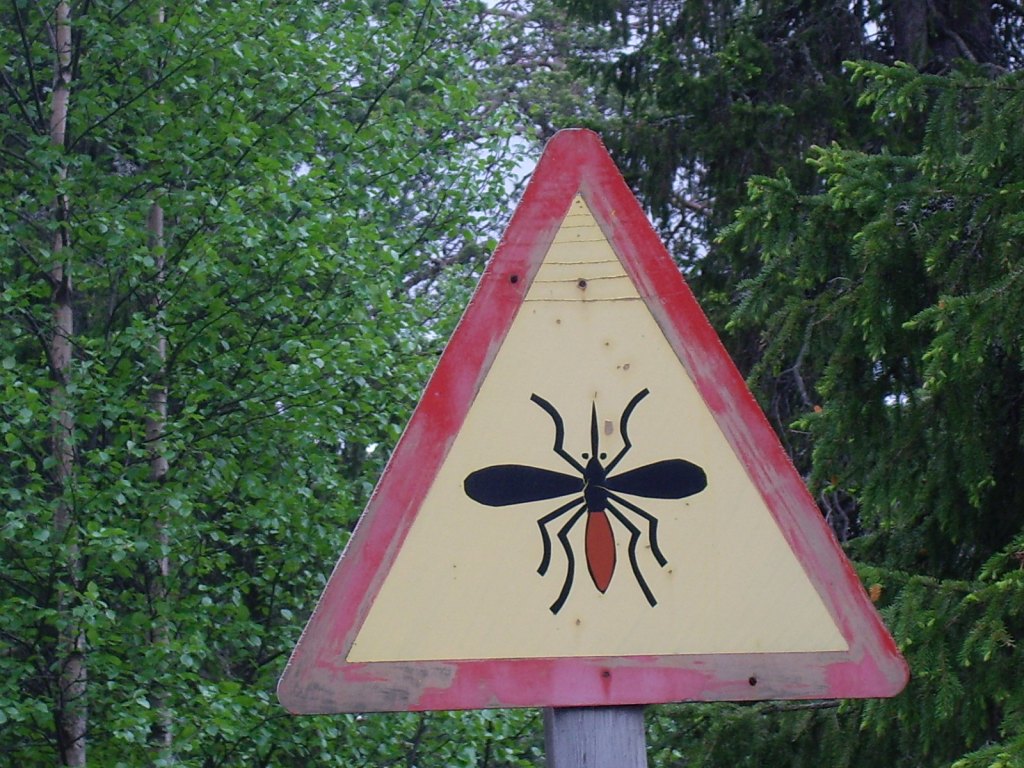
Legit mosquito sign in Finland. (Wikipedia.)
It’s a little awkward to admit that I typically try to “shoo” mosquitoes away. On the occasion I’ve been beset with rage by their assaults and have slapped them to death, I’ve felt horrible. It’s difficult to reason with yourself when your neurodivergent empathy extends to biting insects. I may have felt differently had I been in Lapland, where mosquito swarms are biblical. I read a comment on Reddit about a couple getting out of their car, only to immediately dart back inside after spotting a fast-approaching mosquito cloud.
It’s not unusual for animals to spend so much time trying to escape mosquitoes that eating becomes impossible, and they starve to death. They can also die from blood loss – a swarm can take as much as 300 ml of blood from a single caribou in a one day.
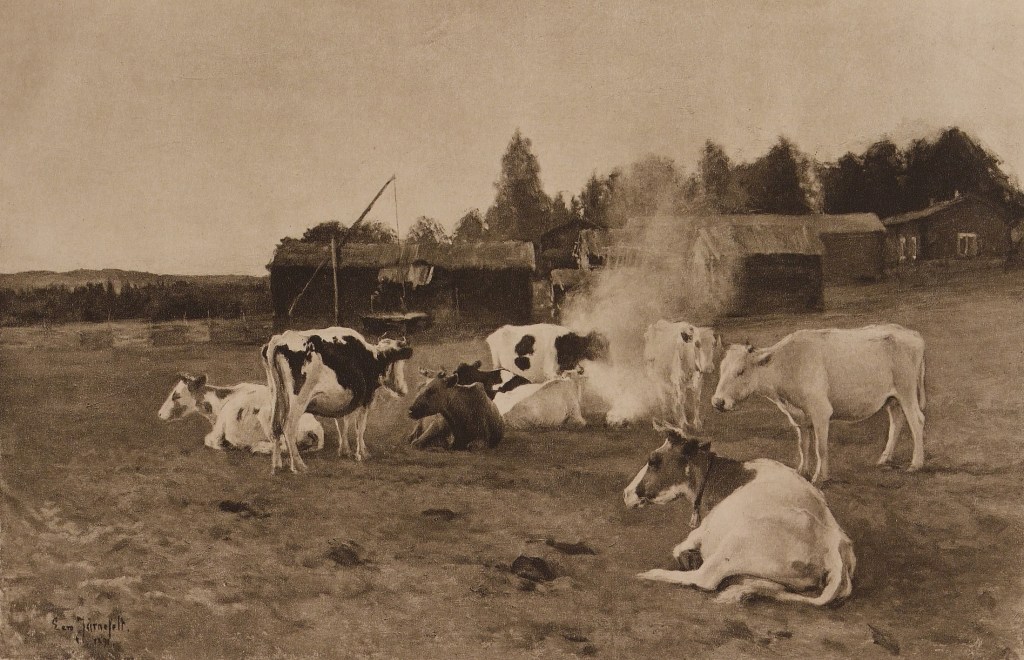
‘Smoking fire near the cows to keep off mosquitoes and other insects while the cows were milked.’ Eero Järnefelt (1891)
I’m familiar with summer in the Nordics for the most part, but I’ve only recently learned that there are 50-60 species of mosquitoes in the Nordic countries alone. (Imagine how flabbergasted I was to discover over 3,000 species of mosquitoes exist worldwide.) I was also late to learn that it’s only female mosquitoes that feed on blood, while males feed exclusively on nectar.
Any standing water – from a puddle to a gutter to a tyre track – can host a breeding ground and then a nursery for developing larvae. Iceland’s lack of standing water is one reason mosquitoes haven’t managed to get a foothold.
“…as I made my way round their boggy breeding grounds they rose up to meet me in dark, swirling clouds, insinuating themselves in my clothes, choking my mouth and smothering every inch of my skin in bites. As I saw my hands beginning to swell, I ruefully consoled myself with the thought that at least I would not contract malaria, because my tormenters belonged to the genus Aedes which, happily, are not carriers of the disease.”
Walter Marsden, Lapland: The World’s Wild Places
*Soon after reading this – bear in mind Lapland was published in 1975 – I found out that mosquito-borne diseases such as malaria are spreading across Europe due to the climate crisis.
Early explorers of the North described mosquitoes as ‘worse than the cold,’ and ‘the one serious drawback of the north.’ I’m surely not the only one who relishes the vision of fumbling English gentry being set upon by mosquitoes, which have also been called ‘a frightful curse,’ as well as, quite fabulously, ‘…devils…armed with a lancet and a blood-pump…’
“In the summertime in Iqaluit, the capital city of the Inuit-administered Canadian territory of Nunavut, swarms of insects hover above the inhabitants like cartoonish clouds of gloom as they go about their day-to-day lives.“
Kate Press, Briarpatch Magazine
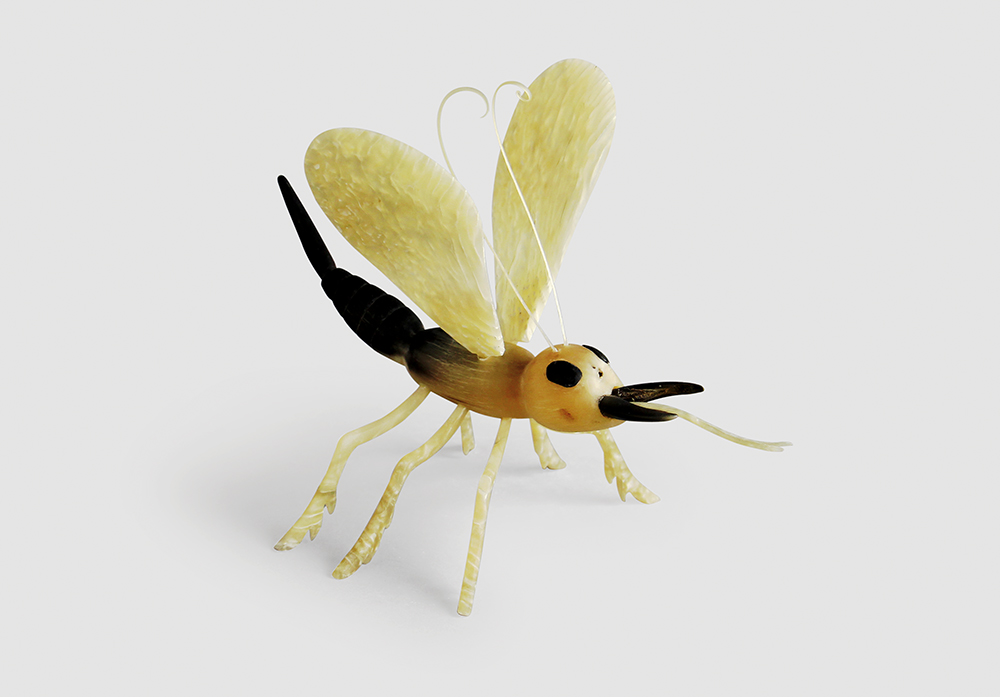
Igah Hainnu Mosquito (2016) Muskox horn, seal whiskers and seal claws
Many indigenous peoples of the Arctic viewed mosquitoes as something sent to ‘test endurance.’ For the Sámi, enduring harassment from mosquitoes was a way of proving hardiness. Young herders and hunters were expected to tolerate swarms during migration and calving season without excessive complaint. Jonna Jinton, an artist living in northern Sweden, endures the biting plague with humour, as demonstrated in this tongue-in-cheek mosquito meditation video.
In the Swedish town of Övertorneå, the community hosts the World Championship in Mosquito Catching, where the winner is the person who catches the most mosquitoes in just fifteen minutes, earning a cash prize and being crowned world champion.
In Finland, one of the Nordic countries I’ve yet to visit, these micro-predators have their own signs, and there’s a history of ‘mosquito bravado.’ Especially among the likes of fishermen and loggers who work amidst clouds of mosquitoes.
“We were breathing hard now, sweating in the afternoon haze and mobbed by a few thousand mosquitos each. Every square inch of exposed skin was smeared with Vietnam-issue jungle juice, stuff that dissolves plastic buttons and burns like acid in your eyes. It kept the actual blood loss down to a level that didn’t threaten death, but that wasn’t the real problem. It was the psychological warfare, airborne water torture. You felt the constant patter, and knew that your back was crawling with living grey fur, hundreds of relentless snouts probing for a chink in your armour. A hand wiped down a sleeve would come away sticky, smeared with corpses, and you strained them through your teeth.”
Nick Jans, The Last Light Breaking: Living Among Alaska’s Inupiat Eskimos
In the 1970s, the Inuk community leader Abe Opic wrote an essay called What it means to Be an Eskimo, where he, justifiably, compared white people to mosquitoes: “There are only very few Eskimos but millions of whites, just like the mosquitos. It is something very special and wonderful to be an Eskimo – they are like snow geese. If an Eskimo forgets his language and Eskimo ways, he will be nothing but just another mosquito.”
Michael MassieThe Endurance Game, 2016, serpentinite, bone, birch, ebony and brass
The Inuit have several stories about how mosquitoes came to be. The one you’re about to read was told to the Greenlandic/Danish explorer Knud Rasmussmun by Inugpasugjuk, a member of the Nattilingmiut Inuit community.
There was once a village where the people were dying of starvation. At last there were only two women left alive, and they managed to exist by eating each other’s lice. When all the rest were dead, they left their village and tried to save their lives. They reached the dwellings of men, and told how they had kept themselves alive simply by eating lice. But no one in that village would believe what they said, thinking rather that they must have lived on the dead bodies of their neighbours. And thinking this to be the case, they killed the two women. They killed them and cut them open to see what was inside them; and lo, not a single scrap of human flesh was there in the stomachs; they were full of lice. But now all the lice suddenly came to life, and this time they had wings, and flew out of the bellies of the dead women and darkened the sky. Thus mosquitoes first came.
If you do head to the far North, where the waters lie still and light lingers long into the night, wear long-sleeved shirts (doubling up is advised), socks, and trousers made from dense material. Wear a head net if you have access to one and remember that repellent loses its effectiveness when you begin to sweat. If you think you can escape them by going a bit further North, I should warn you that these blighters are now appearing in places where it was once too cold for them, which is, to put it lightly, worrying as fuck. We all know the North is warming, but the migration of mosquitoes makes it ever more painfully real.
I don’t want to abandon this post without attempting to lighten the mood (for you and me), so if you’re interested in seeing what it’s like to sit in a Finnish forest during summer, this gentleman can show you.
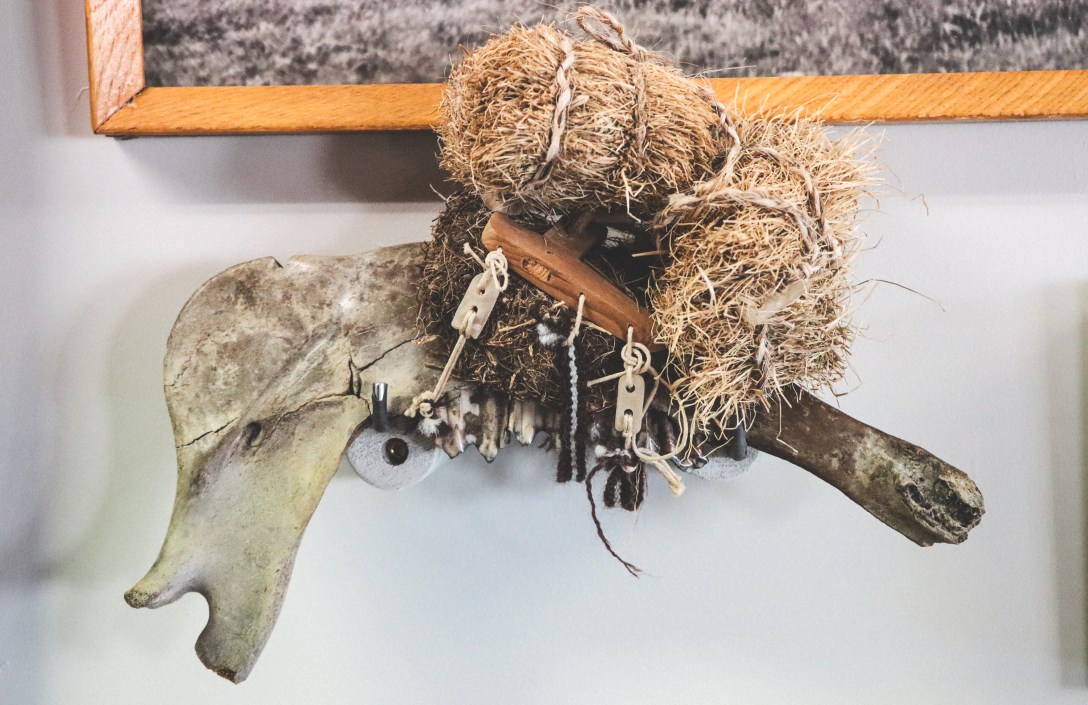
It’s just over a year since I first visited Skógar Museum in Iceland, and I’ve been thinking about one of my favourite artefacts (out of the fifteen thousand residing there) – a toy ‘horse’ made from a sheep’s jawbone by the museum’s founder, Þórður Tómasson. There’s probably not much to know about the ‘horse’; however, I’m one of those highly annoying people who feed on minute, possibly inconsequential details about things I get attached to.
In her fantastic (although sometimes challenging to get along with) book The Museum of Whales You Will Never See: Travels Among the Collections of Iceland, A. Kendra Greene writes lyrically about ‘Iceland’s biggest museum outside of Reykjavik,’ calling it ‘…a museum of old rituals, of daily chores, of things to do and things undone. This is a museum of kinship, of who we are by way of who’ve we’ve been.’
Something I appreciate about the museum, and which Greene highlighted, is that it’s ‘without sequence…you can start anywhere.’ I recall my first trip and can grin to myself, right now, as I curl over my laptop, at the memory of flitting around, bedazzled and delighted by all the curious things and stuff left behind by Icelanders of another time.
Greene writes about meeting the then 95-year-old Tómasson, but apparently, ‘the language yawned‘ between them, and there was little to say, which I found a bit sad. I was strangely affected to learn of the passing of a man I’d never met and whose museum I visited first the first time two years after his death (he died in 2022 at the age of 100). I would have loved to have met him, even just to shake his hand and say ‘I’m not often happy, but what you have built here has made me very, very happy, especially the jawbone horse.’
I regularly feel the need to downplay my delight about things that excite me, because, unrestrained, my enthusiasm can make people feel overwhelmed and awkward, especially if they’re mostly familiar with my depressed state.
It’s a good thing, then, that when I’m forest wandering, I’m almost always alone because forests bring out the best in me, especially forests in Sweden, which are heavily occupied with boulders.
Encountering boulders on my wanderings is always an ecstatic experience, and I can recall most of my meetings with remnants of ancient bedrock (or petrified trolls, as I’d prefer to believe) with gut-glass clarity. I have memories of wildly circling my Swedish ex like a border collie pup, tugging at his clothes and begging him to come to the woods and see the boulders I’d found on my daily hikes.
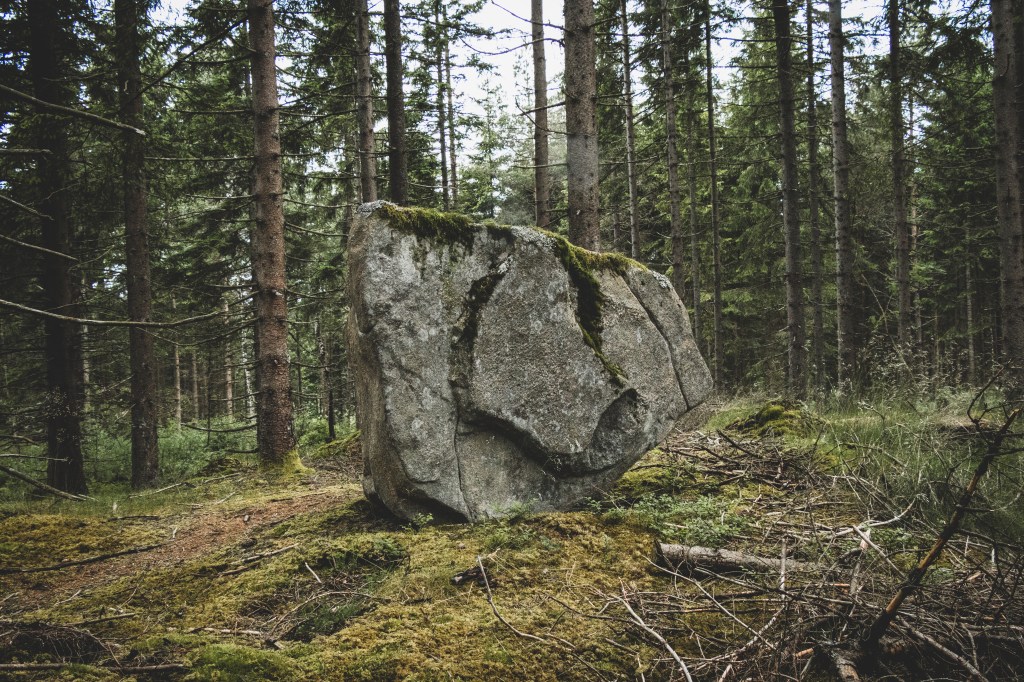
I glimpsed this boulder through the trees, and to reach it, needed to stray from the path, which I happily did. I rarely stay on any footpath for long anyway. The bliss I experienced in the presence of this, let’s admit, very beautiful rock, was something I wish I could bottle and give to people who don’t experience life as a highly sensitive neurodivergent wyrdo who gets blissed out by boulders.
Sweden was heavily glaciated in the last Ice Age, and the boulders – official title: glacial erratics* – were swept up during the advance/retreat of the glaciers and deposited where they currently sit. I don’t think this will ever cease to boggle my mind. I know I’ll probably be wondering forever about this boulder’s tale and its migration to where I found it in a serene, sun-dappled forest glade in the north.
*You may be as nerdishly thrilled as I to know that the word erratics comes from the Latin word errare, which means ‘to wander.’
I first encountered the work of Swedish artist John Bauer as a kid. I attended a Waldorf school and was immersed in books and art inspired by Nordic nature and the folkloric beings inhabiting the landscape. A quick scan on Google suggests it may have been In The Troll Wood that snagged my ever-roving attention.
It was through discovering the music of Mortiis in 2001 that I was reintroduced to Bauer’s art. I’ve been chasing the company of shadowed pines, trolls and moose ever since. Some years ago, I wrote a piece for the website Routes North following a second pilgrimage to Bauer’s home city of Jönköping and the Jönköping Läns Museum, which houses the world’s largest collection of Bauer’s art.
Since 1995, Mortiis has used Bauer’s iconic ouroboros-inspired illustration, which first featured in Bland tomtar och troll (Among Gnomes and Trolls), a children’s anthology of stories and illustrations, in 1915. However, instead of depicting a serpent consuming its tail, Bauer’s serpent is caught in mid-attack of a sword-wielding elven knight. Mortiis has modified Bauer’s illustration throughout the years, coinciding with the eras of his music.
Mortiis has also utilised several of Bauer’s artworks for album and EP covers; for instance, the 1995 album Keiser av en dimensjon ukjent features the piece Brother Saint Martin and the Three Trolls, and the 1996 EP Stjernefødt features the artwork Guldnyckeln.
In an interview with Bardo Methodology, Mortiis explained that he didn’t know about Bauer’s art until he randomly discovered it in a Red Cross shop in Sweden. He managed to buy several framed paintings for a few euros each. I was dead set on getting the ouroboros as my first tattoo in 2007, in homage to Bauer and Mortiis. It wouldn’t be long until I regretted it though – the intricate details haven’t aged well, and the ‘great idea’ to incorporate bats into the design was an epic fail on my part.
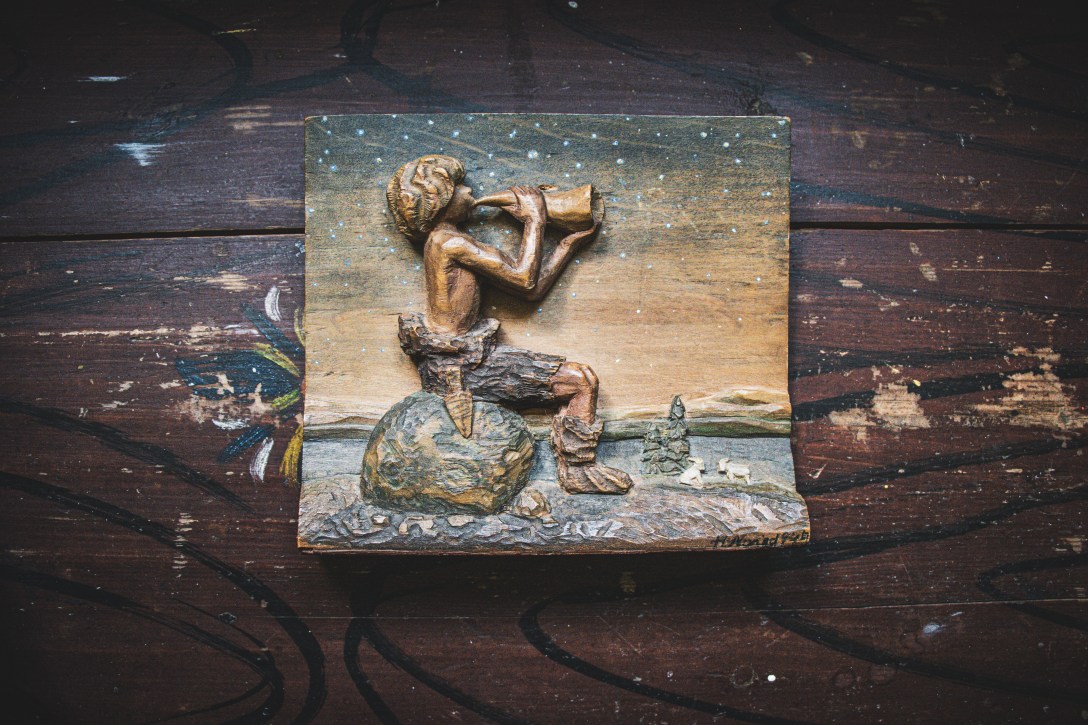
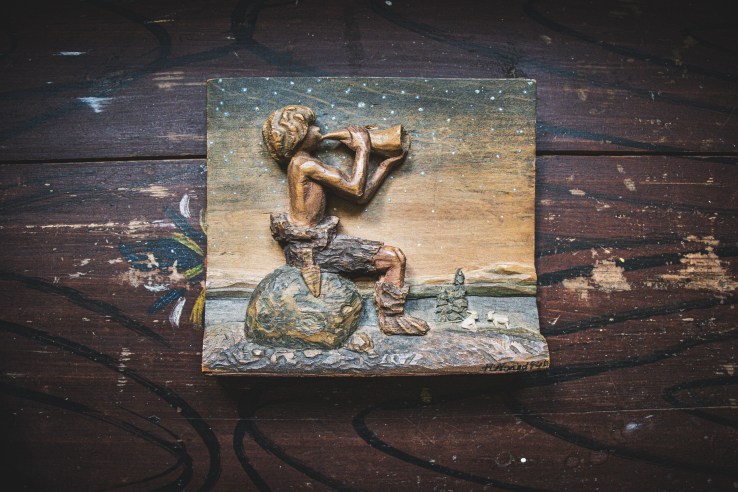
As someone deeply influenced by Bauer’s work, you can imagine how elated I was to find this painstakingly carved wooden art piece inspired by Bauer’s 1910 painting Vill Vallareman (A Fairy Shepherd) at an Airbnb I was staying at in Sweden.
When I was taking the recycling down to the bin on my final day, I saw the house owner, Maria, and asked her about the origin of the 81-year-old carving. If I’m remembering right, she said her uncle was the creator. She asked me, in an almost surprised tone, if I liked the carving. I told her I loved it. Casually and without pause, she said I could have it. Reader, my knees almost buckled.
I swaddled Vill Vallaremaneffter John Bauer like a newborn, checking on it repeatedly during my journey back to the UK, petrified it would get cracked or chipped. Blessedly, it made it back in one piece, and while I have more questions about it and its creator than I know what to do with, I’m grateful (though remain in disbelief) it’s with me. I live with the hope it’s not long until I can swaddle it up again and take it back across the sea to a forever home in a forest perhaps not too great a distance from those Bauer once wandered.







 Northern Fever