Roadtrip Around The South Of Iceland : Part One

I don’t live within easy reach of nature at the moment. What I mean by this is I need to take a train or snag a lift to get somewhere wild. These days, soothing my soul in the countryside is a whole endeavour. Because of the ADHD burnout I’m currently experiencing, ‘ a whole endeavo­ur’ isn’t doable every time I need to connect with the land.

When I visit my partner in Iceland, the sentence he hears most is, ‘Can we go on a hike?’ When I’m there, on that almost uninhabited island (the population is under 400,000, with around 60% based in the capital Reykjavik), my tense, terse, tired soul is nurtured by its wildness. I don’t fully understand the surreal place that is Iceland, but I know what healing feels like, and healing is what the nature of the Far North gifts me in droves. 

I was teetering on the edge a few days before visiting my partner earlier this month. Finnbjörn had promised we’d go on a road trip around the South, and as I sobbed down the phone, he kept reminding me to think of our journey and the landscapes we’d see.

The plan was simple – to stop wherever we thought looked interesting (within reason), overnight in his uncle’s Tesla and exhaust our camera batteries by capturing the landscape around us. One of Finnbjörn’s strengths is planning trips. As I flipped through a Lonely Planet guidebook, trying to re-familiarize myself with places I hadn’t seen in years but not really having the attention span to do so, he gently suggested locations we might stop at and logged the places in his phone whenever a place piqued my interest.

We didn’t know how long we’d be on the road. Finnbjörn optimistically estimated three or four nights and waxed lyrical about how comfortable we would be sleeping in the Tesla: ‘We have air conditioning and a mattress and a blackout blanket to cover the windows… it’ll be just like a cosy hotel room!’ he enthused.

Spoiler: it was not like a cosy hotel room—not for him. We slept in the car for one night. It was fine for me at my dinky height of 5ft 5, but it was less than ideal for Finnbjörn, who has the height and shoulder width of his berserker ancestors.

***

It was hot and hazy (pollution from the nearby-ish volcano likely contributed to the haze) when we set off from Akranes, a petite harbour town about a forty-minute drive from Reykjavik. The weather felt more Mediterranean than sub-Arctic. But I was feeling, for the first time in a painfully long time, excited and a touch happy. The weather would continue to be (mostly and unusually) glorious for our two-day trip.

The last time I visited tourist sights in the South of the island was in 2011. I spent three months as a conservation volunteer, passing by much time in a minibus, going from place to place. But I was heavily medicated on quetiapine and slept away many, many hours with my head on my then boyfriend’s lap when I should have been drinking in the views. But this time, no longer on pills that knocked me out, it was different – my face was pressed to the window.

Now, I struggle to define my relationship with the Icelandic landscape. So much of it captivates me to the point that it’s almost unbearable. Experiencing the places I feel connected to – even if those experiences aren’t as complete as I crave them to be – fills me with ecstatic energy that it would be idiotic to try to contain. (In other words, I can be quite the nightmare to travel with.)

But there are also parts of Iceland, particularly the flat, barren lands, which bring up many complicated feelings and with which I don’t feel much connection. It could be because the openness of the land makes me feel exposed and vulnerable, though mostly to the thoughts in my head and truths which I find difficult to confront.

Our two-day trip around and about the South of Iceland revived my passion for photography, a passion which had been languishing at death’s door. It hadn’t been part of the road trip plan to bring it back to life, but the old magick of the Icelandic landscape made it so, and fuck am I’m grateful it did.

It’s probably come to your attention that this post isn’t a ‘typical’ road trip blog – if there even is such a thing – but I’ve tried to capture some of the ‘feeling’ of the trip. If I got too much in my head about making this post too tidy and relaying every move we made, it would never get finished. But I hope I can engage you enough over the following photos and few thousand words about some of the places we stopped by at that you’ll feel stopping here awhile was worth it.

*Turns out this behemoth of a post is going to be in two parts because I’d like to go to bed at a godly hour and I don’t want to give you even a smattering of writing that I’ve rushed.

Reynisfjara

At the Southernmost tip of Iceland, 112 miles from Reykjavik (about a two-and-a-half-hour drive), is Reynisfjara, also known as ‘that beach where Solstafir shot some of the Fjara video,’ also known as The Black Beach and also known as one of the most dangerous places in Iceland.

The reason it’s one of the most dangerous places? People believe they can outwit the infamous sneaker waves, colossal coastal waves that appear suddenly amid a train of smaller waves. They rise faster than anyone can run, and the currents are brutal.

There are no lifeguards (rescue missions are too risky) or security measures at Raynisfjara – other than the gigantic signage at the entrance down to the beach, which is impossible to miss unless you’re registered blind. Above the signage depicting the ‘zones’ of the beach are three lights, and the colour of the lights indicates the conditions of the beach and instructs visitors on which ‘zone’ they’re able to enter.

Many people were ignoring the zone system, and despite the mentioned sign saying BE CAREFUL, DON’T GO NEAR THE WATER, people did, like the two women I watched skimming stones across the frothing surf. I’m under the impression that many people think that following safety guidelines will diminish their experience of the Icelandic nature they’ve flown however many thousands of miles to experience.

I felt tense at Rynisfjara, overwhelmed by the bustle of people and anxious about the recklessness of the folk wandering too damn close to the water. Finnbjörn took a photo of me and said he’d edit it so it looked like I was there alone. ‘It’ll confuse people when they see a picture of this place so quiet,’ he chuckled. Spoiler: Nobody on Facebook noticed. The few photos I captured were of the sea stacks which folklore says aren’t sea stacks at all but trolls caught out by the sun.

In the Fjara video there’s a young woman barefoot on the sand, and whenever I re-watch it, I wince because that sand – actually lava from nearby Katla’s historic eruptions – is sharp. The sharpness is a sign of how ‘geologically young’ the sand is, as it’s yet to be smoothed by the sea. For those who like deep diving into THE MOST RANDOM THINGS, there’s more about Reynisfraja’s sand – including magnified sand grains because tell me who doesn’t want to see magnified grains of sand – here.

A few days after I arrived back in the UK, there was a report about a man who had swum in the sea at Reynisfjara, which is, of course, forbidden. Photos of him emerged on the Facebook page Stupid Things People Do In Iceland, and, honestly, I think he probably did it to see if he’d end up there.  

Seljalandafoss

I have no doubt you remember Eyjafjallajökull, the volcano – whose name I’m now able to pronounce after years of practice – whose eruption closed Europe’s air space for a while. Well, it’s from here – Eyjafjallajökull is technically an ice cap covering a volcano – the water of Seljalandafoss originates.

It is the only waterfall in Iceland you can circle completely (to my knowledge, feel free to correct me). Finnbjörn did the walk. I did not. He was overheated – his name translates to polar bear, and he very much embodies the king of the north – and needed a refresher. I was content with keeping my camera dry. When he came out from behind the falls, he was more alive than at any other time during the trip.

However, what with it being a popular stop for bus tours and basically anyone on the Southern Ring Road, there was a lot, a lot of people and walking anywhere near the waterfall without getting in the way of someone was nigh on impossible. There was a lengthy queue to stand in the spot where I’m standing in this photo. Waiting to take my place in front of the waterfall felt all kinds of unnatural, however for the briefest moment when I wasn’t fanatically worrying about the other people waiting for the spot, a rainbow and then another bloomed from the mist, and I felt euphoric.

For those who’d like another random deep dive, in the 1986 film The Juniper Tree, a young Bjork is seen walking behind Seljalandafoss.

Skógafoss

Skógafoss, astonishingly, wasn’t as peopled as Seljalandafoss, and it was easier to be in its presence and power. As a Pagan, I find the divine in nature, and when there are too many distractions—most often in the form of people—it can be challenging to connect with the landscape in the truest sense.

Skógafoss has quite the presence in popular culture and is, unsurprisingly, one of the most photographed waterfalls in Iceland. You’ve likely seen it somewhere, even if you still need to visit the country. It’s the waterfall in the TV show Vikings that led Floki to believe he’d discovered the home of the gods and it also appeared in the aforementioned Solstafir video. You might also recognize it from Game Of Thrones where it was a main feature in this scene with Jon Snow and Daenerys Targaryen.

I wanted to climb the 527 steps up the side of the falls to an observation platform, but we still had a way to go and much to see and it’s a good job we did leave because if we’d arrived at the following destination too late, the disappointment would have destroyed me.

Skógar Museum

We arrived at Skógar Museum an hour before closing time. After thirty minutes of excitedly darting about, trying to see as much as I could, I knew it would become my favourite museum in Iceland, trumping even The National Museum of Iceland and absolutely trumping The Icelandic Phallological Museum.

Founded in 1949 the museum initially occupied one room at Skógar Regional School, with exhibitions in classrooms during the summer holidays. Today, it’s made up several buildings, including ten old houses, and is home to more than 18,000 artifacts. I wasn’t in the least bit surprised to discover that it’s considered one of Southern Iceland’s most treasured cultural attractions.

A jawbone toy ‘horse.’
Tobacco pouch made from a ram’s scrotum.
Skulls were typically used as milking stools.

Among the old houses – from various places in the South of Iceland that were taken down and reassembled at the museum – is a house from 1878 made entirely from driftwood.

The displays of artefacts – which you can get up close to – felt so carefully considered and lovingly arranged. There was no air of pretentiousness or surveillance. The ambience was so warm and so welcoming, to the point where I whispered, ‘I’ll come back soon and spend hours here with all of you,’ after mere minutes. I felt inspired, gleeful and kept having the urge to laugh.

Interestingly, just this afternoon, I watched a documentary about the museum featuring its founder, Þórður Tómasson, who curated the museum until his retirement at 92 in 2013. Seeing how he engaged with the artefacts and the visitors in the documentary made me think he had been spiriting around the museum by my side.

Holavallagarður – Reykjavik’s Forested Garden Of The Departed

In 2011, I stayed near Holavallagarður cemetery on a friend’s living room floor for a few nights. It was my first time in Iceland, and I knew nothing about Reykjavik’s ‘largest and oldest museum.’ Thus, I cruised on by its hefty iron gates and didn’t think about it again for the remainder of my three-month trip. 

Ten years later, in 2021, I finally crossed into the centuries old forested cemetery – home to over 10,000 marked graves – with my enthusiastic guides, the two wraiths from Icelandic dungeon synth band Dyfliza.

One of the first things you spot when you walk into the cemetery from the main entrance is the lychgate. In bygone times, it was where the morgue stood, used for the corpses of the poor and foreign sailors. The well-off dead remained at home until it was time for their funeral. The morgue was moved in 1950, though you can still see the bell.*

*I don’t know why there was a bell in the morgue. A speedy Google search suggested it was to keep evil spirits away from the body, though this wasn’t specifically about Icelandic morgues, so I’m none the wiser really. 

It’s easy to while away hours picking your way around the seven-and-a-half acres of gridded grounds. Narrow paths, slippery with moss, wind around jumbled graves. Drooping willows, spruces and poplars, birch and rowan all call Holavallagarður home, along with a type of snail found nowhere else in Iceland. (‘Found nowhere else in Iceland’ is a running theme.) 

Chipper birds congregate to gossip in small, gnarled trees, and they attract cats. Lots of cats. There’s also an abundance of fungi to be discovered during autumn. The most exciting of them has to be the Common Stinkhorn or Fylubollur, which amusingly (because I’m a childish buffoon) translates as ‘stinky male genitals.’ 

Its odour, akin to rotting flesh, is irresistible to flies. A Common Stinkhorn looks like a penis erupting from the ground, and it was thought, once upon a time, that it was an aphrodisiac capable of providing men with ‘powerful erections.’ Common Stinkhorns aren’t actually common at all in Iceland (the first one was documented in 1990), and yes, you guessed it, the only place they’re found is Holavallagarður.

While the cemetery was ready for occupancy in the summer of 1837, it would only be in the winter of 1838 that the first person was laid to rest. In Icelandic folklore, the first person to be buried in a cemetery is bound to be its Guardian for all time, greeting the newly deceased and keeping a watchful eye on all those who come to be buried there after them. 

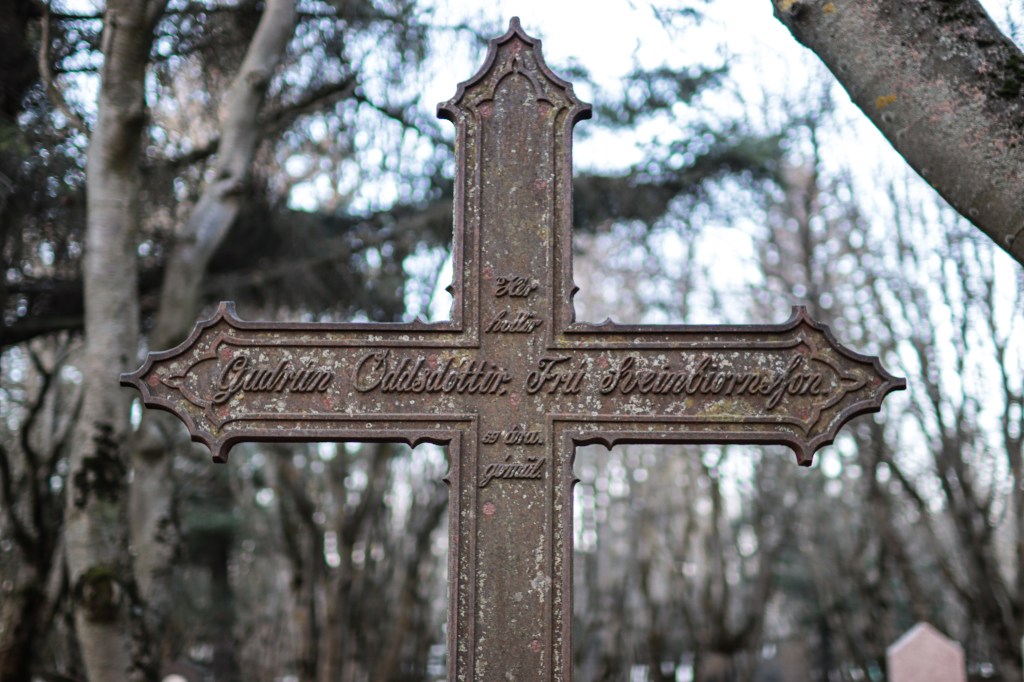
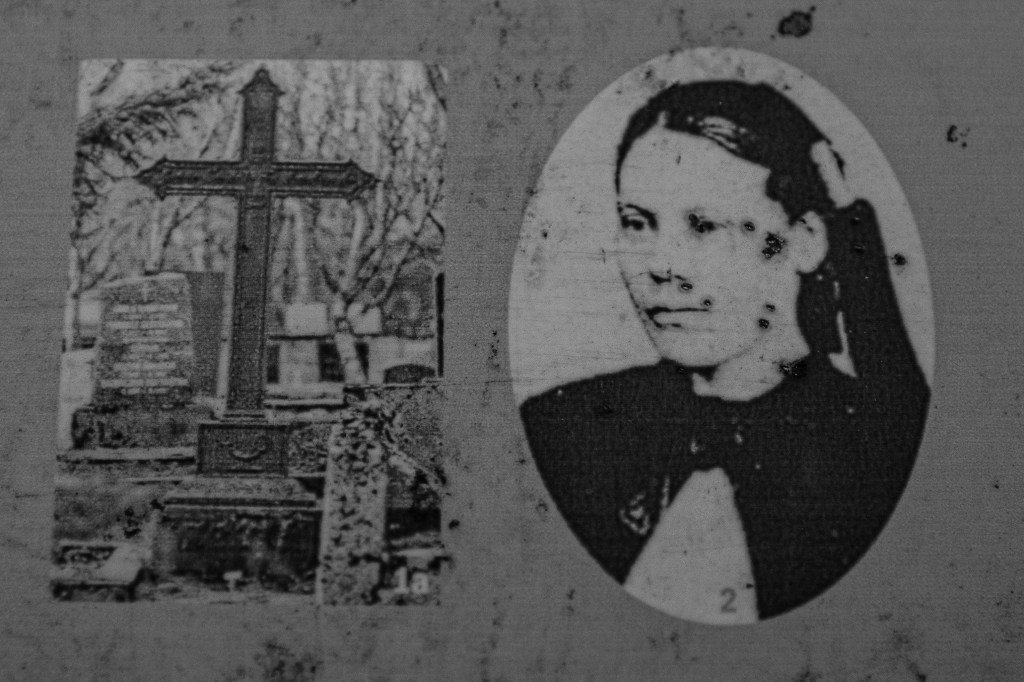
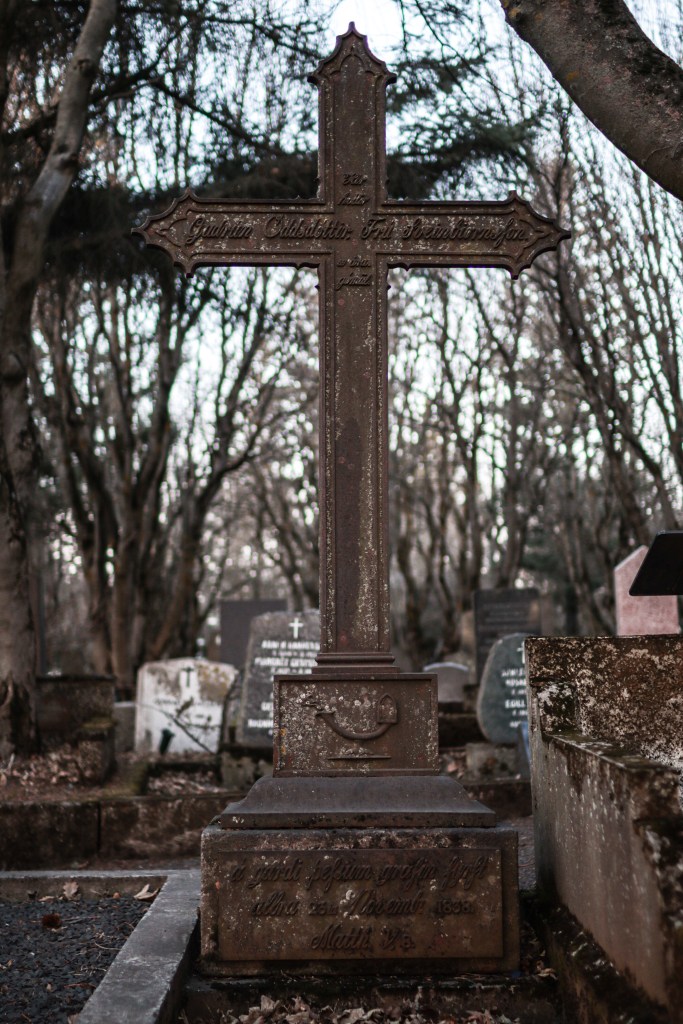
Predictably, very few people wanted to nominate their loved ones to take on this everlasting position, even if it did mean the deceased would never decay. Also, the church didn’t want just anyone to be the Guardian of Holavallagarður, and turned people down because they weren’t ‘in the right standing’ for the role. The position was eventually taken on by 59-year-old Guðrún Oddsdóttir, who was ‘offered’ to the cemetery by her husband, the Chief Justice of the National Court. 

Guðrún’s imposing cast iron memorial cross (you can find it at the T-405 section of the cemetery) is the largest of its kind in Iceland. It’s engraved with a flaming lamp (the cemetery Guardian is also known as a ‘Light Bringer’ so it’s a most suitable motif) with the word Her huili husfru – Here rests the mistress of the house. The engravings remain remarkably easy to read.

Inspired by Guðrún, and the lore surrounding cemetery Guardian’s, my best friend Giorgia Sottotetti and I shot some photos in Holavallagarður. Giorgia’s dress (Ovate, in case you’re wondering) is red because, in tales of cemetery Guardians, they’re said to appear wearing red or green.  

Politicians, painters and poets are lying in Holavallagarður…as well as the notorious murderess Steinunn Sveinsdóttir. In the Summer of 1802, in a two-family ‘village’ near Rauðasandur beach in the Westfjords, Steinunn Sveinsdóttir and her lover Bjarni Bjarnason murdered their respective spouses in what would go on to become one of the best known criminal cases in Iceland. 

In May 1803, the couple were sentenced to death. But there was a problem. No executioner could be found in Reykjavik, or at least not one qualified enough to do the job. So, the couple were to be deported to Norway. 

Sveinsdóttir died in prison of unknown circumstances before she could be deported. After numerous prison breaks and re-captures, Bjarnason was sent to Kristiansand. In a style reminiscent of medieval execution, he was put on a breaking wheel and stretching bench before having his head and hands cut off and jammed on spikes. In a differing account, he had a hand cut off and was then decapitated. Dismemberment followed, with his torso and head ending up on spikes. 

Initially, Sveinsdóttir was buried where the statue of Leif Eiriksson stands today, something I learned from the excellent thesis, Haunted Reykjavik: Cultural Heritage in the form of Ghost Stories by Matthildur Hjartardóttir.

Hjartardóttir explains: ‘Since Steinunn was considered evil, she wasn’t buried in the traditional sense, and she wasn’t buried in consecrated ground, as was custom at the time. Steinunn was dysjuð, which is a grave consisting of heaped-up stones, a practice reserved for people who were not deemed worthy of a proper burial. People then started throwing rocks at the mound for various reasons. Some did it to maintain the mound; others did it because they were afraid that she would come back, and others did it so her spirit would leave them alone.’

I don’t know where she was relocated to next (I heard her remains were moved several times), but for some years, she laid in an unmarked grave in Holavallagarður. It was only in 2012 that her grave was finally given a marker, following a prolonged fight for recognition by her descendants, who were staunch in their belief in her innocence. 

Speaking to the Iceland Review in an article celebrating the cemetery’s 180th anniversary, the caretaker Heimir Janusarson said: ‘The cemetery is very unique in Europe because it has never been reorganized or dug under… We have the first grave, we have the cemetery’s developmental history. You can read its planning history. You can read its vegetation history – when a [new species of] tree arrived in the country – because they were always planted in the cemetery first [because it was an] enclosed area and there [were] no sheep or horses to eat them.’

I’ve spent much time in Holavallagarður since 2021; in theory, I should know it almost as well as the back of my hand. But it proves me wrong whenever I think I’ve figured it out. Despite how well I may have studied the map beforehand, I still find it oddly special (okay, and sometimes infuriating…) that I’m never quite sure where I’m going when stepping off the main paved footpaths and onto the trails twisting through the forested garden of the departed. 

Sources

Flickering Lamps

Iceland Review

Atlas Obscura

Iceland Mag

Grýla – The Child-Eating Ogress of Christmas (And a poem about her)

I initially wrote about Iceland’s child-eating ogress of Christmas in 2009, two years before I even set foot on the island. It was a mild, one-page poem for university which featured in my first poetry collection. 

But Grýla never strayed far from my consciousness, so I wrote another poem about her for my upcoming collection themed on winter in Iceland. And it’s considerably more unsettling than the one I penned while still a fledgling poet. 

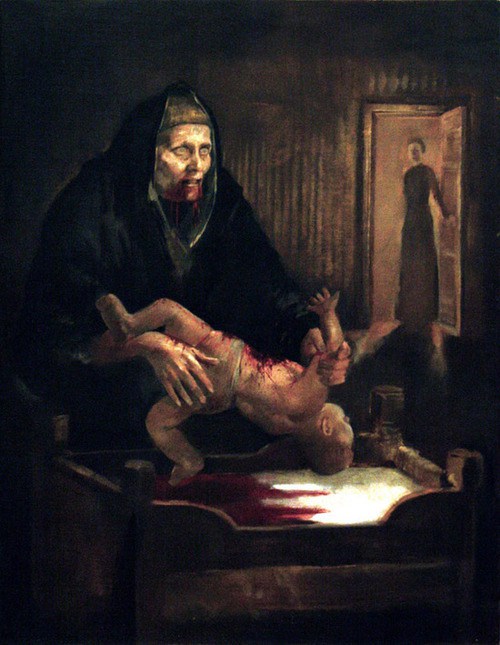
Of all the creepy Nordic folkloric beings, Grýla is, without doubt, one of THE creepiest, with her insatiable appetite for the flesh of children. Another aspect of her legend which unnerves me, and really quite profoundly, is the reaction parents were said to have about her eating their kids. Basically, they accepted it as a fact of life, something which Þrándur Þórarinsson illustrated brilliantly in his chilling painting. 

I’ll readily admit that until recently, I thought this painting was OLD, so old I was confident it would be within the public domain. But it isn’t old. Not at all. Þórarinsson was born in 1978.

When a photograph of the then relatively unknown (outside of Iceland) painting was put online in 2009, it went viral and was viewed by 620,000 people thereabouts in a single day. I wouldn’t be surprised if, nowadays, it’s the best-known image of Grýla on the web.

Another artwork that depicts her in a most gloriously grim way is this inked piece* by Norwegian artist Kim Holm.

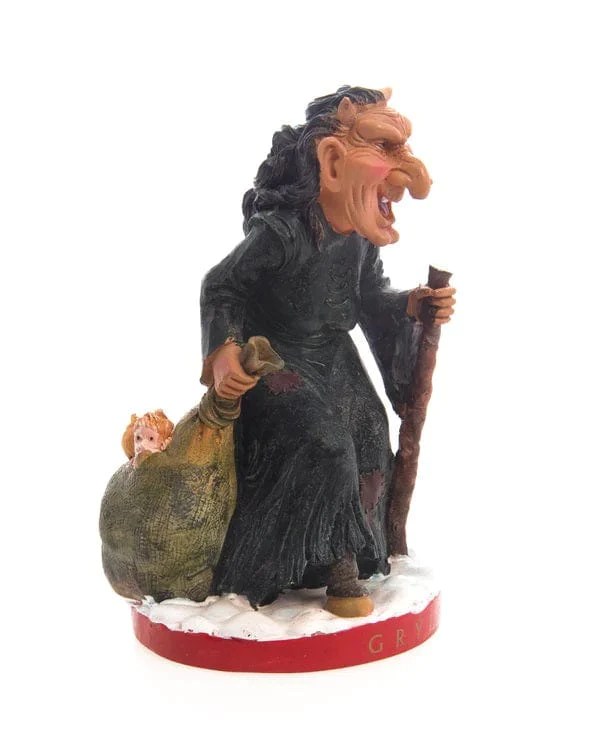
Grýla has a ‘special’ place in the hearts of Icelanders, and I’ve spoken to several about how genuinely scared they were as kids that Grýla would turn up at their home, abduct them and haul them away to the mountains where they’d end up being boiled alive in her cauldron. Though she seems to be ‘much tamer’ these years and is known mainly for being the mother of the Yule Lads. Though some keep the legend alive, as with this popular Icelandic Store sculpture of her, gleefully dragging her sack of children.

But Grýla hasn’t always been associated with Christmas. The first mentions of her appeared in The Saga of Icelanders and Sverris Saga, both 13th-century texts. She would only become connected to the festive season in the 17th Century through the Poem of Grýla.

How Grýla looks depends on who you ask, though 300 heads, fifteen tails, claws and cloven hooves are usually mentioned. Sometimes, she has a beard, sometimes she has horns. Though if you ask whoever directed the episode of Sabrina The Teenage Witch that featured Grýla, she’s quite the babe and, from what I understand about the episode (I’ve never seen it), only eats one child.

But are kids still scared of Grýla today? There is a story going around Iceland that she died of starvation. But not every parent goes along with it. The headmaster of the Elf School (an institution based in Reykjavik, devoted to Icelandic folklore), Magnus H. Skarphedinsson, told Vice in 2017 that he called home and pranked his daughter by pretending to be a Yule Lad. 

He told her his mother, Grýla, was furious with her for being badly behaved. After that phone call, his daughter hid under her bed and you can guess the rest.

Terry Gunnell, a professor in Folkloristics at the University of Iceland, said in a Smithsonian Magazine article that Grýla was ‘…a personification of the winter and the darkness and the snow getting closer and taking over the land again…’ Grýla represented the threat of winter and controlled the landscape, which, way back when, the Icelandic people believed they were only ‘tenants’ of. ‘You don’t mess with Grýla,’ Gunnell went on to say. ‘She rules the roost up in the mountains.’

Below, you’ll find my poem, Grýla. I hope it does what it’s supposed to and harks back to the days when the child-eating ogress of Iceland still chilled the blood of children when Christmas came around, and they weren’t sure if they’d been well enough behaved not to be taken from their beds and boiled up for stew.

Gryla

There's not one man, woman or child 
on this sterile, far-flung isle whose smile
doesn't waver at the growl of my name.

Generations of wicked children have pleaded
to uproot from houses they were born to,
bed down Skyr pale limbs and buttery heads
in places no one roams but the dead.

Pity those young minds that don't comprehend
- nowhere is safe from me.

I said, nowhere is safe from me.

Even the aged, with their crumbled minds,
and murk-filled, frightened eyes, remember Grýla.

They shit in their clothes saved for Jól,
and piss in their soft chairs and beds.

The stench overpowers the lamb and cardamom,
festivities are disrupted with thin cries for help.

Hjálpaðu mér mamma, Grýla kemur!
Help me mamma, Grýla is coming!

But their mammas are gone long ago,
their rib bones timber for Huldufólk homes.

The flames beneath my cauldron were spitting
well before Snorri dashed ink on calf vellum.

I've been watching this unclad land as long as Esja has.

Above my head, it's cooled lava dark.
Below, Reykjavík sparkles like a whore
who has stolen every star.

I remember turf houses. How easily I could
make those soft walls fall, pluck up children
crawling between the debris.

Now, I run my claws against corrugated iron walls.
This time of year, children's ears are the keenest.
They hear the slow and steady clattering
from several streets away.

Some parents appreciate my coming.
Many have seen me take their offspring.
It's how life is; I often hear them thinking.

Last Jól, a child said to me you're not real.

Boy, I replied, you're about to die in my hands,
and I'll see to it your skin is flayed off and tanned.

Then I lowered my mouth over his bobbing head,
chomped through his bird bone neck,
stuffed him, headless and silent, into my sack.

I always need a thread to sew Leppalúði's socks.
I need girls with long hair, though, if I don't take enough,
tendons do the job almost as well.

Tonight, children are waiting in terrible silence.

Some whisper, Grýla, we hail you, clutch lava stone effigies
of me, hoping I'll pass by, gift them more time.

This year, there's an odd little child,
a child so very…other.

He's gone so far as to scratch HAIL GRÝLA
on the floorboards beneath his bed.

I can read the startling thoughts he has
tied so neatly in his head.

He wants to join me, trail my gory path,
stir to the great depths of my cauldron, taste
his schoolmate's meat, pick splinters of their bones
from between his fence-like teeth.

He wants to run about after my lads,
become known for creating carnage of his own.

He wants to dig out the crusted human blood
stuck between my cat's sweet toe pads.

He's waiting in a white house
within sight of Hallgrímskirkja.

He's waiting to hear my hooves on stone,
my claws on iron. He's waiting for my face
to loom around the door to his room where he sits,
quiet as a lamb, hands in lap, patient as can be.

He'll drop to his knees. There'll be no dread,
no fear, not even a shred.

I'll beckon for him to follow me out.
Reykjavík's foundations will quake as we walk.

With my forefingers and thumbs,
I'll pinch out each maddening light.

I'll bring Jól to an end and greet again
the merciless Icelandic winter night.

*I used this artwork as the front cover for my pamphlet The Darkest Days which features my Grýla poem along with work about Jack Frost and Swiftrunner.

Related: Art of Grýla

The Christmas Cat Of Iceland

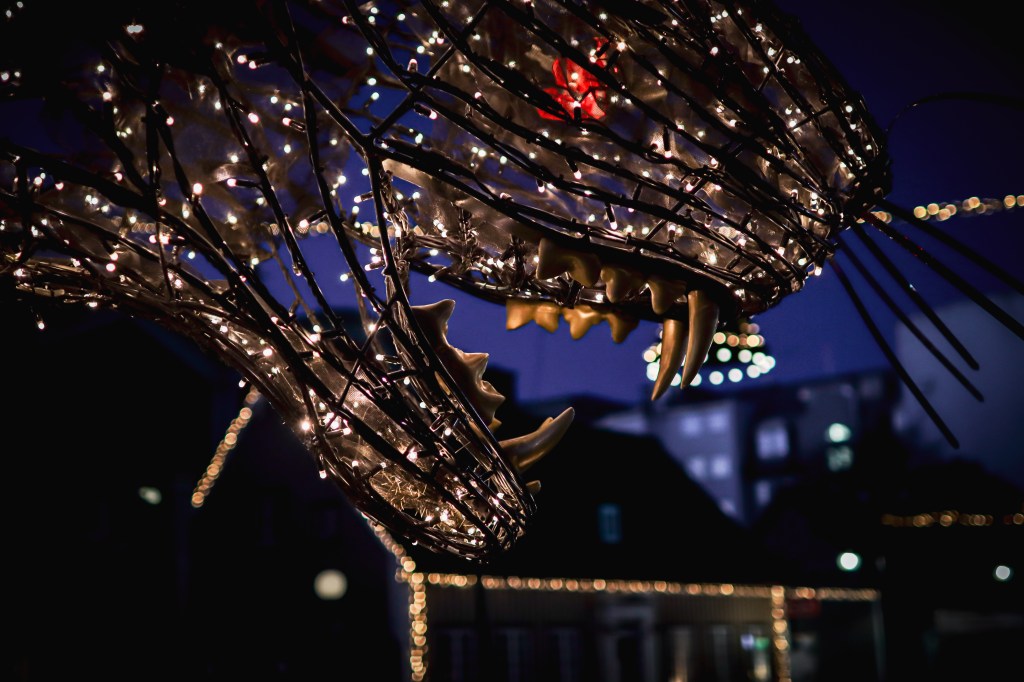
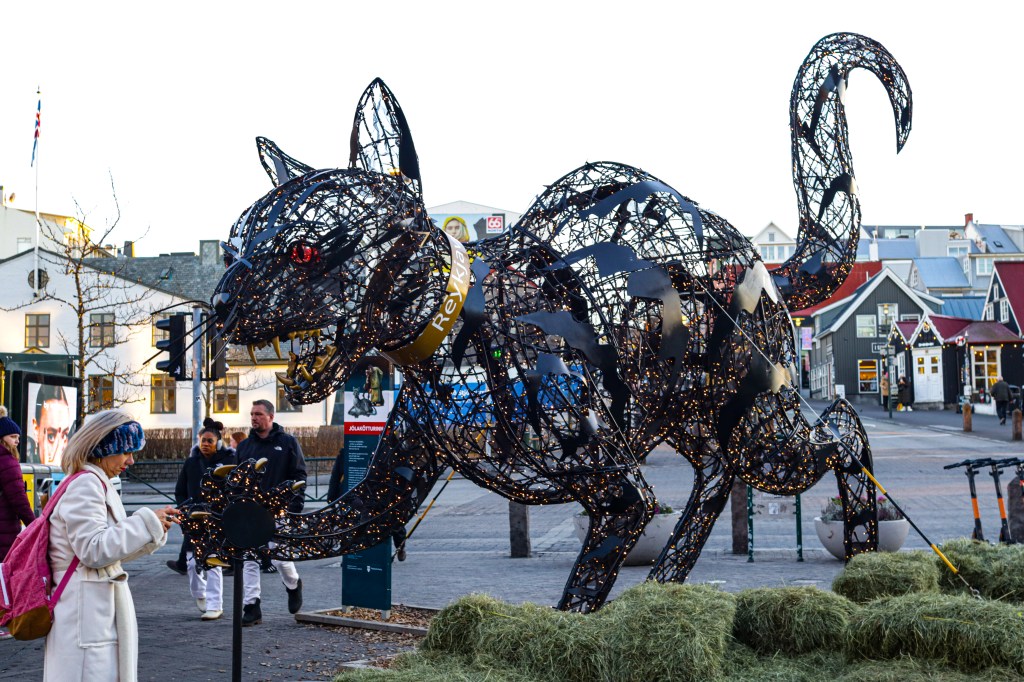
It was still dark at nine-thirty the other morning in Reykjavik (it would be well after ten before the sun shimmied up to provide the city with its scanty ration of daylight) when I bumbled outside to capture the looming Jólakötturinn (the Yule Cat) sculpture in all its ominous glory. 

Every November since 2018, a five-metre-tall iron sculpture, decked out with 6,500 LED lights, depicting Gryla’s child eating floofy familiar (some attribute the inspiration for its ‘floofiness’ from the Norwegian Forest Cat) who eats children who don’t get new clothes for Jól has materialised in the centre of Reykjavik to herald in the season the traditional Icelandic way – with foreboding.  

The sculpture cost the city a ‘sensible’ 4.4 million ISK and was fabricated by Austrian company MK Illumination. A garden centre owns it, and they lease it out each year to the city for a ‘steal’ at just over 3 million ISK.

Reykjavik’s Jól décor tends to be conventional, with the city reusing lights and garlands yearly. (Though I favour the cosy understatedness over most other cities I’ve seen ‘glowed up’ for Yuletide.) So, the sculpture’s arrival in 2018 was quite the talking point.

While the Yule Cat gathered much adoration (it was welcomed with a speech and a children’s choir), there was some backlash, too. One critic, Sanna Magdalena Mörtudóttir of the Socialists party, was critical of the city’s priorities and was furious the struggle of the city’s low-income families wasn’t brought up during the opening speech. 

While cats have held a prominent role in Nordic society since the Viking Age, it’s unknown how long the Yule Cat has been around. Though it’s theorised he’s been prowling since the Dark Ages. We do know that he’s stalked written records since the 19th Century. 

As Kathleen Hearons writes in Head Magazine, ‘Cats were the travelling companion of choice for Vikings – although not for sentimental reasons, but rather to kill mice and be skinned for their fur. Consequently, feline populations grew throughout the Nordic countries when the Vikings settled there. To this day, Reykjavik is “culturally a cat city,” according to Reykjavik Excursions. As of August 2022, there was a cat-to-human ratio of 1-to-10…

In bygone times, the threat of the Yule Cat would frighten children (and, without doubt, some adults) into finishing processing the autumn wool before Jól. By the Middle Ages, the export of wool from Iceland played a valuable role in the economy, and having a prosperous wool production was imperative. 

Though this fear-mongering technique ensured laziness was all but eradicated in the last part of the year, it was also a superb encourager of family bonding, as everyone in the family had a role to play and would gather around the fire in the evenings to prepare yarn and knit.

In an article for the Reykjavik Grapevine, Ethnologist Árni Björnsson says, ‘After 1600, there are a lot of changes in Icelandic society. Folklore often mirrors what’s happening in society. So, it makes sense that Grýla and the yuletide lads are grimmer during this difficult time for Icelanders. In 1602, the Danes banned Iceland from trading with countries other than Denmark, and this was tough because Iceland relied on many imported goods. To make matters worse, the colder period in Iceland also sets in around 1600.

 So, those things we call “jólavættir,” or supernatural beings of Christmas—including the yuletide lads, their ogress mother Grýla, and the Christmas cat—those elements were probably incorporated into the Christmas tradition to keep kids in line. Everyone was supposed to work hard to do all the things that had to be done before Christmas, and some people were lazy, you see. So it was said that if you weren’t diligent at working, the Christmas cat would come for you.’ 

In 1746, parents were banned by the King of Denmark from tormenting their children with stories of the Yule Cat, Gryla and her thirteen trouble-making lads as youngsters were becoming too afraid to leave their houses.

In 1932, a book was published by the poet Jóhannes úr Kötlum called Jólin koma (Christmas is Coming), and it featured a poem called Jólakötturinn which brings to life – though in the most family-friendly way – the goings about of the malicious moggy. An English translation was published in 2015 for the Icelandophiles out there. 

You all know the Yule Cat

And that cat was huge indeed.

People didn’t know where he came from

Or where he went.

– The first stanza from Jólakötturinn

Following the publication of Jólin koma, the Yule Cat was, in the words of Áki Guðni Karlsson, writing for Icelandicfolklore.is ‘firmly established as part of an “old Icelandic” pantheon of Christmas beings for generations of Icelanders.’

You’ve probably encountered Bjork’s dungeon synthy musical adaptation of Kötlum’s poem at some point, though I’ve only recently discovered she wasn’t the first person to put it to music. That honour lies with the late Icelandic singer Ingibjörg Þorbergs. There’s also an exquisite version created by Icelandic folk duo Ylja. 

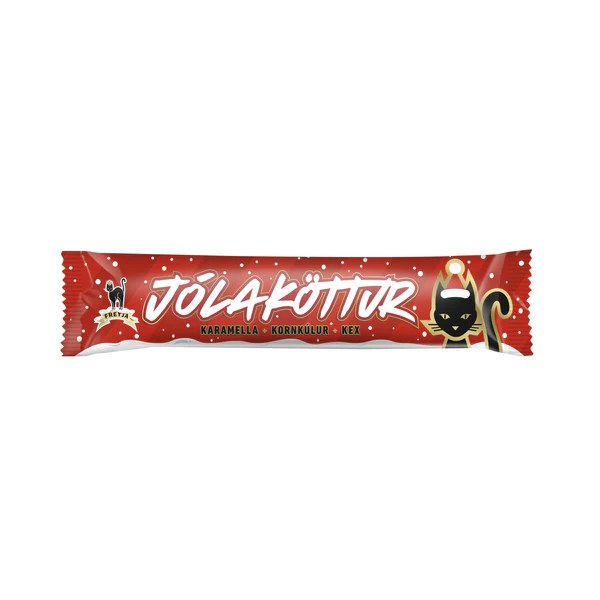
Like his mistress and her thirteen lads, the Yule Cat has long infiltrated Icelandic Christmas paraphernalia and even has his own chocolate bar, ‘Jólaköttur’ (the Christmas version of the famous chocolate bar Villiköttur), a delicious 50g beast of thick milk chocolate, caramel and biscuit all knobbled together with crisp rice.

The innovative chocolate company OmNom released a limited edition winter chocolate bar back in 2018 called Drunk Raisins + Coffee (which featured, among other things, green raisins infused with mandarin juice, cocoa beans from Tanzania, Icelandic milk and Austrian rum) in honour of the Yule Cat and in collaboration with the feral cat rescue organisation Villikettir.

On the OmNom website, Hanna Eiríksdóttir writes, ‘…stray and feral cats are neither evil nor frightening, and they definitely do not eat children. No one really knows how many cats in Iceland are feral or strays,they are thought to be in the thousands. In our minds, the Yule cat is the protector of these Icelandic stray and feral cats. The old folklore reminds us not to turn a blind eye to our little furry friends in need.’

I went back to the Yule Cat sculpture later on in the day. I saw togged-up kids catapulting themselves around in the straw pile surrounding the eternally pissed-looking puss, and now as I write this, I regret not sidling up to the parents and whispering to them, like the total weirdo I am, ‘So, do they think he eats harðfiskur now or…?’ 

Living North : My Nordic ‘To Read’ List

I haven’t been able to read much recently. Depression made the thing I enjoy doing most in the world an agonizing challenge. But now my concentration is slowly returning to some sort of normality and I’ve been spending massive amounts of time on Amazon, hunting down literature about the Nordics that I haven’t read yet. I thought you might like to see what I’ve found!

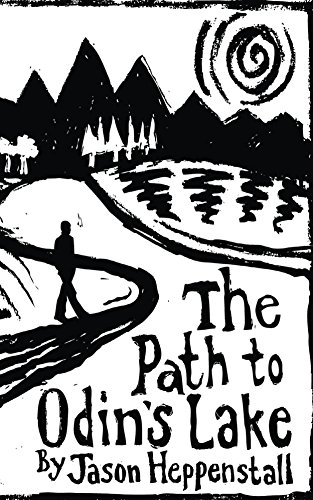
The Path To Odin’s Lake By Jason Heppenstall

51SNJvTCNXL

“Ex-newspaper editor Jason Heppenstall, worn down by the constant drumbeat of dire news in the world, decides to set out on a journey in search of some answers. With not much more than some walking boots, a notebook and a wooden staff, he sets off from his old home in Copenhagen with a vague idea to “head north”. It isn’t long before a series of bizarre coincidences leads him to believe that his journey is being guided towards an ancient lake in Sweden where the Norse god Odin was once worshipped.

Along the way he falls foul of the authorities, endures the wettest weather in living memory and meets a peculiar man of the forest who gives him a special gift. He discovers a modern day Sweden caught between a desire to do good in the world and one struggling to come to terms with the refugees from war-torn Syria and beyond.” – Amazon

Buy it here.

Blond Roots: A Cross-Cultural Journey of Identity By Marilyn E Fowler

“The Western world insists on following rational dictates, but there is freedom in allowing our deeper intuition to show the way forward. By surrendering to the heart, we can navigate the unknown world to come to a new understanding of ourselves.

51qfmFZSEdL

Author Marilyn E. Fowler, PhD, begins her journey with very little information about her cultural heritage. A family search uncovers an old picture of her great-grandmother Karoline, who was born somewhere in the northern reaches of Scandinavia among the indigenous Sámi people.

Fowler’s inner compass and a sequence of powerful, metaphysical events push her to venture alone to this distant territory. On this journey she has the honor of meeting Elina, a Sámi elder, who provides more clues to Fowler’s ancestral heritage.

Slowly, guided by intuition, she begins putting the pieces together, discovering the identity of her ancestors. She wants to understand them, and what she finds is a completely fresh perspective on life. As Fowler slowly learns about Sámi culture, she allows herself to let go of conventional reasoning and discover a new understanding of who she is and a new sense of connection with the earth. When she finally returns home, she finds that her perspectives on life have forever changed.” – Amazon

Buy it here.

On Time And Water By Andri Snær Magnason

41jcbqVzN0L

“Icelandic author and activist Andri Snær Magnason’s ‘Letter to the Future’, an extraordinary and moving eulogy for the lost Okjökull glacier, made global news and was shared by millions. Now he attempts to come to terms with the issues we all face in his new book On Time and Water. Magnason writes of the melting glaciers, the rising seas and acidity changes that haven’t been seen for 50 million years. These are changes that will affect all life on earth.

Taking a path to climate science through ancient myths about sacred cows, stories of ancestors and relatives and interviews with the Dalai Lama, Magnason allows himself to be both personal and scientific. The result is an absorbing mixture of travel, history, science and philosophy.” – Amazon

Buy it here.

Wild Horses of the Summer Sun: A Memoir of Iceland By Tory Bilski

“Each June, Tory Bilski meets up with fellow women travelers in Reykjavik where they head to northern Iceland, near the Greenland Sea. They escape their ordinary lives to live an extraordinary one at a horse farm perched at the edge of the world. If only for a short while.51mCiBg78jL

When they first came to Thingeyrar, these women were strangers to one another.  The only thing they had in common was their passion for Icelandic horses. However, over the years, their relationships with each other deepens, growing older together and keeping each other young. Combining the self-discovery Eat, Pray, Love, the sense of place of Under the Tuscan Sun, and the danger of Wild, Wild Horses of the Summer Sun revels in Tory’s quest for the “wild” inside her.

These women leave behind the usual troubles at home: illnesses, aging parents, troubled teenagers, financial worries–and embrace their desire for adventure.

Buoyed by their friendships with each other and their growing attachments and bonds with the otherworldly horses they ride, the warmth of Thingeyrar’s midnight sun carries these women through the rest of the year’s trials and travails.” – Amazon.

Buy it here.