I recently visited Borås Museum with a friend, but due to missed buses and a long overdue catch-up (seven years overdue) in the museum café, we had only minutes to zip around before it closed.
My friend was especially eager to look inside Ramnakyrken. This quint red church had originally stood in Kinnarumma, a village about 15 kilometres from Borås. It was dismantled in 1912 and rebuilt in its current location in 1914. However, our time was up, and the church doors had been locked. An especially considerate museum employee took pity on us and offered to open the church, which she did with a key so gigantic I was, for a moment, convinced it was fake.
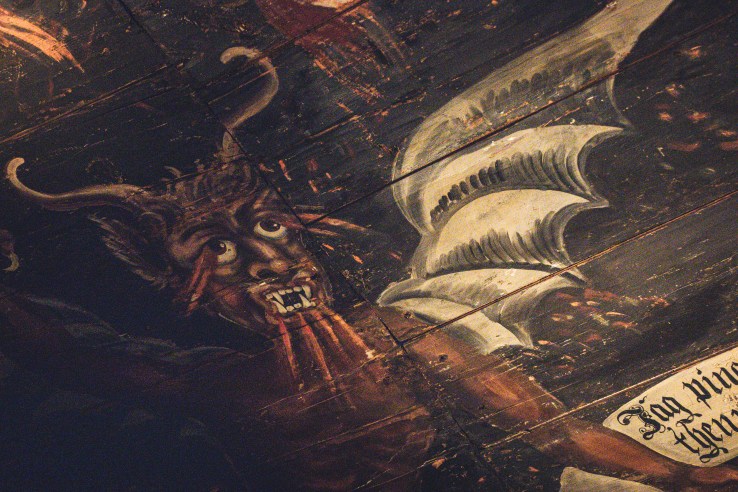
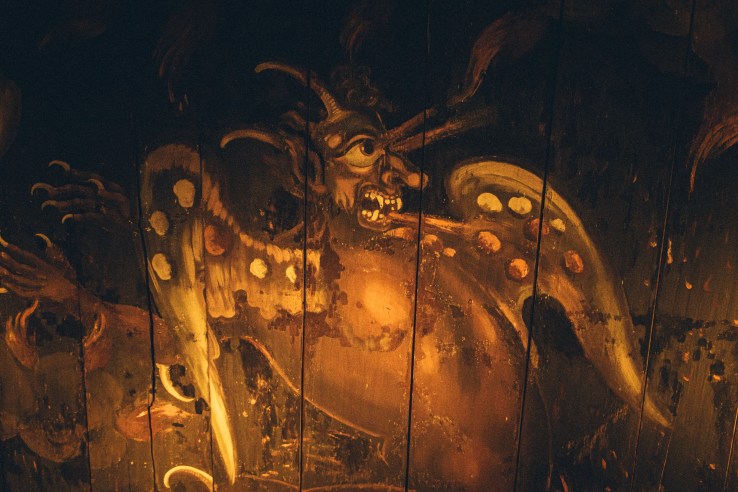
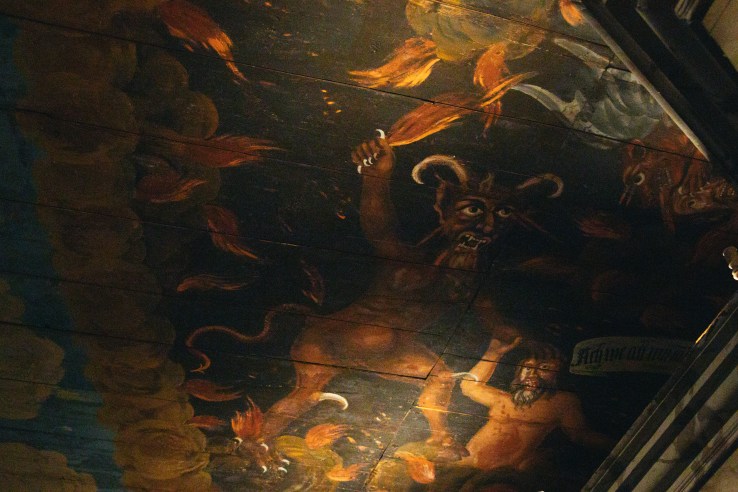
While the church was interesting, I kept my camera switched off, that was until we were making our way back out and I looked up. There was only time to snap a few shots of impressively vibrant demons before ducking back outside.
The ceiling was originally painted, with lesser diabolical depictions, in 1706 by Nicklas Berg. It was painted over (rude) between 1752 and 1753 by a man called Ditlof Ross, though you can still make out ‘echoes’ of Berg’s original work. The ceiling was whitewashed in 1869-70 during a restoration (I’d love to know who ordered that job); however, in 1930, when the church was re-consecrated due to a need for additional church spaces in Borås, the paintings were uncovered and restored. It’s been a popular church for weddings and baptisms ever since. Are you also wondering how many children have been traumatised over the years by innocently looking upwards and making eye contact with these decorative servants of Satan?
I had a beautiful comment left on my last post by a reader called Eivor, who wrote that what I’d said about the forests in Sweden resonated and that trees boost their mood and give them hope. They said they were always struck by how much they missed the trees when they were away from them, something I’m feeling ever more intensely myself these days when all I want to do is be forest wandering from sun up to sun down.
Eivor’s comment made me think of when I was living in Sweden and how lost I’d have been without the forest. I had little clue about anything when I wasn’t among the trees. I was the epitome of anxiety. In the forest, though, rambling, scrambling, slipping amidst the moss and pine, I was empowered, eager, excited. I was different from the fretful woman who would watch through the peephole before going out.
For me, the forest was my workspace and sanctuary. It was more my home than the apartment I’d return to. The forest inspired me, it nourished my exhausted soul, and, of course, it provided hope. It always provided hope.
The forest and its expanse thrilled me. I’d almost always go alone, but on the odd occasion I could show a friend my favourite haunts, I’d be giddy as a child on their birthday.
I took my camera with me most days, and while I mainly created self-portraits, I’d sometimes have a companion to shoot with. In this photo, my friend Martina is captured on a darkening autumn afternoon. Sometime after I shared it online, the Swedish-based artist Alessia Brusco @skogens.rymd.art – who I’d recently struck up a friendship with – contacted me to ask if she could recreate it in a painting.
She recreated this photo, too.
I still remember the day I took this shot and how delightedly I drank up that sunlight and then watched, rooted to the path, as the sun blazed down behind the trees and the evening crept in from all directions.
One of our last stops on our first day—after realising that we were still four and a half hours away* from the campsite where we were supposed to be spending the night—was a man-made cave which neither of us knew existed until we were sailing on by it.
*Finnbjörn had said to me, ‘Say stop whenever you want and I will stop…within reason.’ I took advantage of his giving nature, so accepted the blame for the sluggishness of the trip. We ended up not driving to where we were supposed to go and instead wrangled a place in a field in another, much closer, campsite.
Rútshellir Cave
Not far from Skógafoss, by the Eyjafjöll mountains and literally right off the Ring Road, is one of the largest man-made caves in Iceland. We didn’t have Rútshellir Cave on our itinerary, but it was free and not featured on any tours, so there was only a smattering of other people.
After walking through the stone and wood sheepcote, which was built at some point in the 20th century, there are two caves to explore. The first is about twenty metres long and used to store hay and stockfish (fish air-dried on wooden racks outdoors). People may have lived in it at some point. (I like to believe they did.) The second, smaller cave is thought to have been used as a smithy, though there’s also mention of it being a heathen temple. One of the earliest accounts of the cave dates to 1714, and its name is from its alleged first inhabitant, Rutur. Some think Rutur was an evil chieftain or a thief. Others, like me, suspect he was a troll.
We didn’t, but somebody else did and was loudly scolded by their law-abiding child.
Intriguingly, Rútshellir Cave was of great interest to the Nazis, and in 1936, it was thoroughly searched by the SS troops Ahnenerbem who were under the command of Viking fanboy Heinrich Himmler. Fixated on the idea of a pure Nordic race, they were in Iceland looking for evidence of old temples and were convinced that was indeed an advanced heathen temple.
*As I am wont to do, I went down a rabbit hole about the Nazis and their obsession with Iceland. I found an article in the Reykjavik Grapevine where Helgi Hrafn Guðmundsson writes about how Iceland and the Icelandic people disappointed the German diplomat Dr Werner Gerlach.
Day Two
I thought camping in the car was fine because I’m essentially impish in size, but Finnbjörn (whose name translates to polar bear) was too long to be comfortable and so didn’t sleep. So, we agreed to keep going to the Glacier Lagoon and then return to Akranes. The weather was too hot to be comfortable, and I was radically overstimulated. As it turns out, I’d forgotten how wearing road trips could be, considering my last lengthy one was when I was still in my maiden years.
The Glacier Lagoon
This was, undoubtedly, the busiest place on our road trip. Tourism has reached unprecedented heights in Iceland; about a million people visit the lagoon yearly, and we saw many of them on this blistering Monday in June.
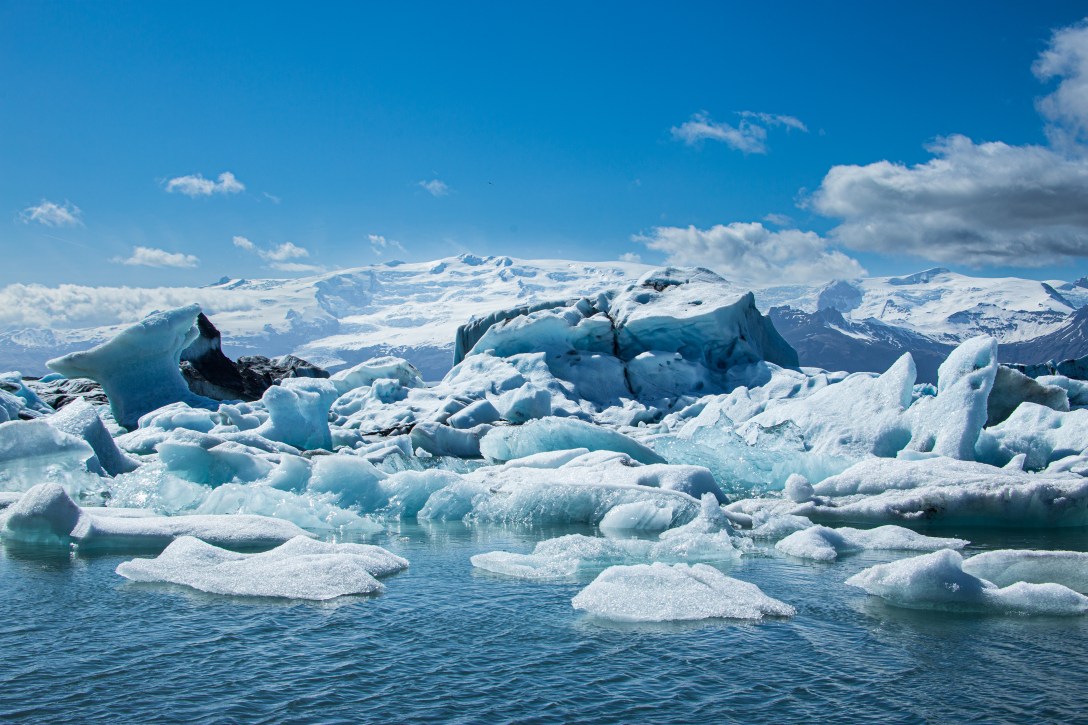
The Glacier Lagoon b.1935 is made up of meltwater and at 932 feet, it’s the deepest lake in Iceland. The ice in the lagoon breaks away from the glacier Breiðamerkurjökull, an outlet of Vatnajökull glacier – the largest ice cap in Europe. (It wasn’t until I arrived home that it dawned on me that there are humans alive right now who are older than this body of water.)
I was childishly manic at the lagoon…but famished, so we headed first for the café. Finnbjörn supped at a double espresso, and I, afraid I was somehow going to miss out on seeing the icebergs, wolfed a piece of white bread and pesto marketed as ‘vegan pizza,’ then bounced up and raced on ahead of my weary boyfriend.
I watched the icebergs intently, bewitched by the glassiness and the zingy blue hues conjured by compression and the dance of light and ice crystals. Some stay in the lagoon for up to five years before drifting the short distance to the Atlantic Ocean. When he joined me by the shore, Finnbjörn pointed out a seal. Nobody else noticed it. It was likely sheltering from the scores of orcas that patrol the waters of Southeast Iceland.
Before reluctantly heading back to the car, I Facetimed my daughter Saga. ‘Are you at the North Pole, mummy?’ I told her we weren’t that far away. She asked if I’d seen reindeer or Santa and what the black on the ice was. I told her it was centuries-old ash from a volcano. She said okay and went back to the picture she was drawing.
Optimistically, I thought I’d ride my good feelings all the long way back to Akranes. I rode them for around forty-five minutes of the five-hour drive before losing it with the midnight sun and wrapping my head in a blanket. But the light was relentless and hounded us all the way home.
From Along The Way
A handful of tips if you’re road-tripping in Iceland during Summer:
If you’re over 6 feet tall and in your mid-forties, sleeping in the back of a car may be a rough ordeal. I recommend a test run of your sleeping arrangements.
Yes, the sun is up all night, and yes, it can be tempting to keep going because time feels infinite but don’t.
If you’re driving electric, know where the charging stations are before your trip begins.
Always keep an eye on the weather. So many apps exist for this.
Watch out for sheep and their lambs as well as oystercatchers and their chicks.
Take more water than you think you’ll need.
Pack more snacks than you think you’ll need.
Be wary of speed cameras.
You will need much more time than you think you’ll need. For example, taking a photo of horses with wind-ruffled manes will not take the sixty seconds you imagine it will.
Have an itinerary—Finnbjörn made ours using suggestions from Trip Advisor—but make it somewhat flexible.
I don’t live within easy reach of nature at the moment. What I mean by this is I need to take a train or snag a lift to get somewhere wild. These days, soothing my soul in the countryside is a whole endeavour. Because of the ADHD burnout I’m currently experiencing, ‘ a whole endeavour’ isn’t doable every time I need to connect with the land.
When I visit my partner in Iceland, the sentence he hears most is, ‘Can we go on a hike?’ When I’m there, on that almost uninhabited island (the population is under 400,000, with around 60% based in the capital Reykjavik), my tense, terse, tired soul is nurtured by its wildness. I don’t fully understand the surreal place that is Iceland, but I know what healing feels like, and healing is what the nature of the Far North gifts me in droves.
I was teetering on the edge a few days before visiting my partner earlier this month. Finnbjörn had promised we’d go on a road trip around the South, and as I sobbed down the phone, he kept reminding me to think of our journey and the landscapes we’d see.
The plan was simple – to stop wherever we thought looked interesting (within reason), overnight in his uncle’s Tesla and exhaust our camera batteries by capturing the landscape around us. One of Finnbjörn’s strengths is planning trips. As I flipped through a Lonely Planet guidebook, trying to re-familiarize myself with places I hadn’t seen in years but not really having the attention span to do so, he gently suggested locations we might stop at and logged the places in his phone whenever a place piqued my interest.
We didn’t know how long we’d be on the road. Finnbjörn optimistically estimated three or four nights and waxed lyrical about how comfortable we would be sleeping in the Tesla: ‘We have air conditioning and a mattress and a blackout blanket to cover the windows… it’ll be just like a cosy hotel room!’ he enthused.
Spoiler: it was not like a cosy hotel room—not for him. We slept in the car for one night. It was fine for me at my dinky height of 5ft 5, but it was less than ideal for Finnbjörn, who has the height and shoulder width of his berserker ancestors.
***
It was hot and hazy (pollution from the nearby-ish volcano likely contributed to the haze) when we set off from Akranes, a petite harbour town about a forty-minute drive from Reykjavik. The weather felt more Mediterranean than sub-Arctic. But I was feeling, for the first time in a painfully long time, excited and a touch happy. The weather would continue to be (mostly and unusually) glorious for our two-day trip.
The last time I visited tourist sights in the South of the island was in 2011. I spent three months as a conservation volunteer, passing by much time in a minibus, going from place to place. But I was heavily medicated on quetiapine and slept away many, many hours with my head on my then boyfriend’s lap when I should have been drinking in the views. But this time, no longer on pills that knocked me out, it was different – my face was pressed to the window.
Now, I struggle to define my relationship with the Icelandic landscape. So much of it captivates me to the point that it’s almost unbearable. Experiencing the places I feel connected to – even if those experiences aren’t as complete as I crave them to be – fills me with ecstatic energy that it would be idiotic to try to contain. (In other words, I can be quite the nightmare to travel with.)
But there are also parts of Iceland, particularly the flat, barren lands, which bring up many complicated feelings and with which I don’t feel much connection. It could be because the openness of the land makes me feel exposed and vulnerable, though mostly to the thoughts in my head and truths which I find difficult to confront.
Our two-day trip around and about the South of Iceland revived my passion for photography, a passion which had been languishing at death’s door. It hadn’t been part of the road trip plan to bring it back to life, but the old magick of the Icelandic landscape made it so, and fuck am I’m grateful it did.
It’s probably come to your attention that this post isn’t a ‘typical’ road trip blog – if there even is such a thing – but I’ve tried to capture some of the ‘feeling’ of the trip. If I got too much in my head about making this post too tidy and relaying every move we made, it would never get finished. But I hope I can engage you enough over the following photos and few thousand words about some of the places we stopped by at that you’ll feel stopping here awhile was worth it.
*Turns out this behemoth of a post is going to be in two parts because I’d like to go to bed at a godly hour and I don’t want to give you even a smattering of writing that I’ve rushed.
Reynisfjara
At the Southernmost tip of Iceland, 112 miles from Reykjavik (about a two-and-a-half-hour drive), is Reynisfjara, also known as ‘that beach where Solstafir shot some of the Fjara video,’ also known as The Black Beach and also known as one of the most dangerous places in Iceland.
The reason it’s one of the most dangerous places? People believe they can outwit the infamous sneaker waves, colossal coastal waves that appear suddenly amid a train of smaller waves. They rise faster than anyone can run, and the currents are brutal.
There are no lifeguards (rescue missions are too risky) or security measures at Raynisfjara – other than the gigantic signage at the entrance down to the beach, which is impossible to miss unless you’re registered blind. Above the signage depicting the ‘zones’ of the beach are three lights, and the colour of the lights indicates the conditions of the beach and instructs visitors on which ‘zone’ they’re able to enter.
Many people were ignoring the zone system, and despite the mentioned sign saying BE CAREFUL, DON’T GO NEAR THE WATER, people did, like the two women I watched skimming stones across the frothing surf. I’m under the impression that many people think that following safety guidelines will diminish their experience of the Icelandic nature they’ve flown however many thousands of miles to experience.
I felt tense at Rynisfjara, overwhelmed by the bustle of people and anxious about the recklessness of the folk wandering too damn close to the water. Finnbjörn took a photo of me and said he’d edit it so it looked like I was there alone. ‘It’ll confuse people when they see a picture of this place so quiet,’ he chuckled. Spoiler: Nobody on Facebook noticed. The few photos I captured were of the sea stacks which folklore says aren’t sea stacks at all but trolls caught out by the sun.
In the Fjara video there’s a young woman barefoot on the sand, and whenever I re-watch it, I wince because that sand – actually lava from nearby Katla’s historic eruptions – is sharp. The sharpness is a sign of how ‘geologically young’ the sand is, as it’s yet to be smoothed by the sea. For those who like deep diving into THE MOST RANDOM THINGS, there’s more about Reynisfraja’s sand – including magnified sand grains because tell me who doesn’t want to see magnified grains of sand – here.
A few days after I arrived back in the UK, there was a report about a man who had swum in the sea at Reynisfjara, which is, of course, forbidden. Photos of him emerged on the Facebook page Stupid Things People Do In Iceland, and, honestly, I think he probably did it to see if he’d end up there.
Seljalandafoss
I have no doubt you remember Eyjafjallajökull, the volcano – whose name I’m now able to pronounce after years of practice – whose eruption closed Europe’s air space for a while. Well, it’s from here – Eyjafjallajökull is technically an ice cap covering a volcano – the water of Seljalandafoss originates.
It is the only waterfall in Iceland you can circle completely (to my knowledge, feel free to correct me). Finnbjörn did the walk. I did not. He was overheated – his name translates to polar bear, and he very much embodies the king of the north – and needed a refresher. I was content with keeping my camera dry. When he came out from behind the falls, he was more alive than at any other time during the trip.
However, what with it being a popular stop for bus tours and basically anyone on the Southern Ring Road, there was a lot, a lot of people and walking anywhere near the waterfall without getting in the way of someone was nigh on impossible. There was a lengthy queue to stand in the spot where I’m standing in this photo. Waiting to take my place in front of the waterfall felt all kinds of unnatural, however for the briefest moment when I wasn’t fanatically worrying about the other people waiting for the spot, a rainbow and then another bloomed from the mist, and I felt euphoric.
For those who’d like another random deep dive, in the 1986 film The Juniper Tree, a young Bjork is seen walking behind Seljalandafoss.
Skógafoss
Skógafoss, astonishingly, wasn’t as peopled as Seljalandafoss, and it was easier to be in its presence and power. As a Pagan, I find the divine in nature, and when there are too many distractions—most often in the form of people—it can be challenging to connect with the landscape in the truest sense.
Skógafoss has quite the presence in popular culture and is, unsurprisingly, one of the most photographed waterfalls in Iceland. You’ve likely seen it somewhere, even if you still need to visit the country. It’s the waterfall in the TV show Vikings that led Floki to believe he’d discovered the home of the gods and it also appeared in the aforementioned Solstafir video. You might also recognize it from Game Of Thrones where it was a main feature in this scene with Jon Snow and Daenerys Targaryen.
I wanted to climb the 527 steps up the side of the falls to an observation platform, but we still had a way to go and much to see and it’s a good job we did leave because if we’d arrived at the following destination too late, the disappointment would have destroyed me.
Founded in 1949 the museum initially occupied one room at Skógar Regional School, with exhibitions in classrooms during the summer holidays. Today, it’s made up several buildings, including ten old houses, and is home to more than 18,000 artifacts. I wasn’t in the least bit surprised to discover that it’s considered one of Southern Iceland’s most treasured cultural attractions.
A jawbone toy ‘horse.’ Tobacco pouch made from a ram’s scrotum. Skulls were typically used as milking stools.
Among the old houses – from various places in the South of Iceland that were taken down and reassembled at the museum – is a house from1878 made entirely from driftwood.
The displays of artefacts – which you can get up close to – felt so carefully considered and lovingly arranged. There was no air of pretentiousness or surveillance. The ambience was so warm and so welcoming, to the point where I whispered, ‘I’ll come back soon and spend hours here with all of you,’ after mere minutes. I felt inspired, gleeful and kept having the urge to laugh.
Interestingly, just this afternoon, I watched a documentary about the museum featuring its founder, Þórður Tómasson, who curated the museum until his retirement at 92 in 2013. Seeing how he engaged with the artefacts and the visitors in the documentary made me think he had been spiriting around the museum by my side.
In 2011, I stayed near Holavallagarður cemetery on a friend’s living room floor for a few nights. It was my first time in Iceland, and I knew nothing about Reykjavik’s ‘largest and oldest museum.’ Thus, I cruised on by its hefty iron gates and didn’t think about it again for the remainder of my three-month trip.
Ten years later, in 2021, I finally crossed into the centuries old forested cemetery – home to over 10,000 marked graves – with my enthusiastic guides, the two wraiths from Icelandic dungeon synth band Dyfliza.
One of the first things you spot when you walk into the cemetery from the main entrance is the lychgate. In bygone times, it was where the morgue stood, used for the corpses of the poor and foreign sailors. The well-off dead remained at home until it was time for their funeral. The morgue was moved in 1950, though you can still see the bell.*
*I don’t know why there was a bell in the morgue. A speedy Google search suggested it was to keep evil spirits away from the body, though this wasn’t specifically about Icelandic morgues, so I’m none the wiser really.
It’s easy to while away hours picking your way around the seven-and-a-half acres of gridded grounds. Narrow paths, slippery with moss, wind around jumbled graves. Drooping willows, spruces and poplars, birch and rowan all call Holavallagarður home, along with a type of snail found nowhere else in Iceland. (‘Found nowhere else in Iceland’ is a running theme.)
Chipper birds congregate to gossip in small, gnarled trees, and they attract cats. Lots of cats. There’s also an abundance of fungi to be discovered during autumn. The most exciting of them has to be the Common Stinkhorn or Fylubollur, which amusingly (because I’m a childish buffoon) translates as ‘stinky male genitals.’
Its odour, akin to rotting flesh, is irresistible to flies. A Common Stinkhorn looks like a penis erupting from the ground, and it was thought, once upon a time, that it was an aphrodisiac capable of providing men with ‘powerful erections.’ Common Stinkhorns aren’t actually common at all in Iceland (the first one was documented in 1990), and yes, you guessed it, the only place they’re found is Holavallagarður.
While the cemetery was ready for occupancy in the summer of 1837, it would only be in the winter of 1838 that the first person was laid to rest. In Icelandic folklore, the first person to be buried in a cemetery is bound to be its Guardian for all time, greeting the newly deceased and keeping a watchful eye on all those who come to be buried there after them.
Predictably, very few people wanted to nominate their loved ones to take on this everlasting position, even if it did mean the deceased would never decay. Also, the church didn’t want just anyone to be the Guardian of Holavallagarður, and turned people down because they weren’t ‘in the right standing’ for the role. The position was eventually taken on by 59-year-old Guðrún Oddsdóttir, who was ‘offered’ to the cemetery by her husband, the Chief Justice of the National Court.
Guðrún’s imposing cast iron memorial cross (you can find it at the T-405 section of the cemetery) is the largest of its kind in Iceland. It’s engraved with a flaming lamp (the cemetery Guardian is also known as a ‘Light Bringer’ so it’s a most suitable motif) with the word Her huili husfru – Here rests the mistress of the house. The engravings remain remarkably easy to read.
Inspired by Guðrún, and the lore surrounding cemetery Guardian’s, my best friend Giorgia Sottotetti and I shot some photos in Holavallagarður. Giorgia’s dress (Ovate, in case you’re wondering) is red because, in tales of cemetery Guardians, they’re said to appear wearing red or green.
Politicians, painters and poets are lying in Holavallagarður…as well as the notorious murderess Steinunn Sveinsdóttir. In the Summer of 1802, in a two-family ‘village’ near Rauðasandur beach in the Westfjords, Steinunn Sveinsdóttir and her lover Bjarni Bjarnason murdered their respective spouses in what would go on to become one of the best known criminal cases in Iceland.
In May 1803, the couple were sentenced to death. But there was a problem. No executioner could be found in Reykjavik, or at least not one qualified enough to do the job. So, the couple were to be deported to Norway.
Sveinsdóttir died in prison of unknown circumstances before she could be deported. After numerous prison breaks and re-captures, Bjarnason was sent to Kristiansand. In a style reminiscent of medieval execution, he was put on a breaking wheel and stretching bench before having his head and hands cut off and jammed on spikes. In a differing account, he had a hand cut off and was then decapitated. Dismemberment followed, with his torso and head ending up on spikes.
Initially, Sveinsdóttir was buried where the statue of Leif Eiriksson stands today, something I learned from the excellent thesis, Haunted Reykjavik: Cultural Heritage in the form of Ghost Stories byMatthildur Hjartardóttir.
Hjartardóttir explains: ‘Since Steinunn was considered evil, she wasn’t buried in the traditional sense, and she wasn’t buried in consecrated ground, as was custom at the time. Steinunn was dysjuð, which is a grave consisting of heaped-up stones, a practice reserved for people who were not deemed worthy of a proper burial. People then started throwing rocks at the mound for various reasons. Some did it to maintain the mound; others did it because they were afraid that she would come back, and others did it so her spirit would leave them alone.’
I don’t know where she was relocated to next (I heard her remains were moved several times), but for some years, she laid in an unmarked grave in Holavallagarður. It was only in 2012 that her grave was finally given a marker, following a prolonged fight for recognition by her descendants, who were staunch in their belief in her innocence.
Speaking to the Iceland Review in an article celebrating the cemetery’s 180th anniversary, the caretaker Heimir Janusarson said: ‘The cemetery is very unique in Europe because it has never been reorganized or dug under… We have the first grave, we have the cemetery’s developmental history. You can read its planning history. You can read its vegetation history – when a [new species of] tree arrived in the country – because they were always planted in the cemetery first [because it was an] enclosed area and there [were] no sheep or horses to eat them.’
I’ve spent much time in Holavallagarður since 2021; in theory, I should know it almost as well as the back of my hand. But it proves me wrong whenever I think I’ve figured it out. Despite how well I may have studied the map beforehand, I still find it oddly special (okay, and sometimes infuriating…) that I’m never quite sure where I’m going when stepping off the main paved footpaths and onto the trails twisting through the forested garden of the departed.