I regularly feel the need to downplay my delight about things that excite me, because, unrestrained, my enthusiasm can make people feel overwhelmed and awkward, especially if they’re mostly familiar with my depressed state.
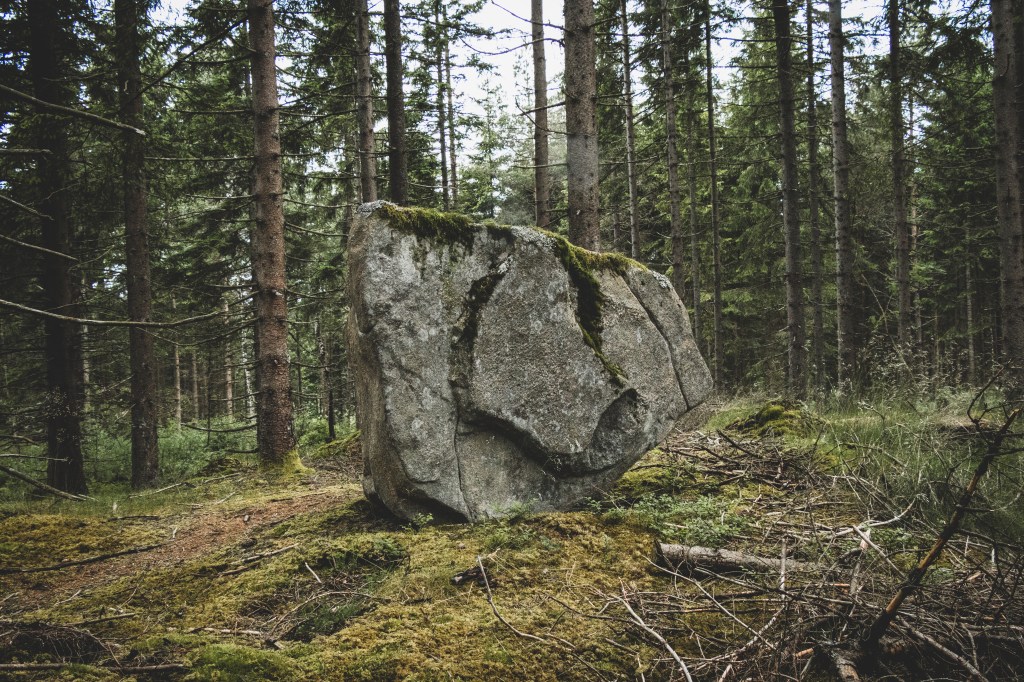
It’s a good thing, then, that when I’m forest wandering, I’m almost always alone because forests bring out the best in me, especially forests in Sweden, which are heavily occupied with boulders.
Encountering boulders on my wanderings is always an ecstatic experience, and I can recall most of my meetings with remnants of ancient bedrock (or petrified trolls, as I’d prefer to believe) with gut-glass clarity. I have memories of wildly circling my Swedish ex like a border collie pup, tugging at his clothes and begging him to come to the woods and see the boulders I’d found on my daily hikes.
I glimpsed this boulder through the trees, and to reach it, needed to stray from the path, which I happily did. I rarely stay on any footpath for long anyway. The bliss I experienced in the presence of this, let’s admit, very beautiful rock, was something I wish I could bottle and give to people who don’t experience life as a highly sensitive neurodivergent wyrdo who gets blissed out by boulders.
Sweden was heavily glaciated in the last Ice Age, and the boulders – official title: glacial erratics* – were swept up during the advance/retreat of the glaciers and deposited where they currently sit. I don’t think this will ever cease to boggle my mind. I know I’ll probably be wondering forever about this boulder’s tale and its migration to where I found it in a serene, sun-dappled forest glade in the north.
*You may be as nerdishly thrilled as I to know that the word erratics comes from the Latin word errare, which means ‘to wander.’
I recently visited Borås Museum with a friend, but due to missed buses and a long overdue catch-up (seven years overdue) in the museum café, we had only minutes to zip around before it closed.
My friend was especially eager to look inside Ramnakyrken. This quint red church had originally stood in Kinnarumma, a village about 15 kilometres from Borås. It was dismantled in 1912 and rebuilt in its current location in 1914. However, our time was up, and the church doors had been locked. An especially considerate museum employee took pity on us and offered to open the church, which she did with a key so gigantic I was, for a moment, convinced it was fake.
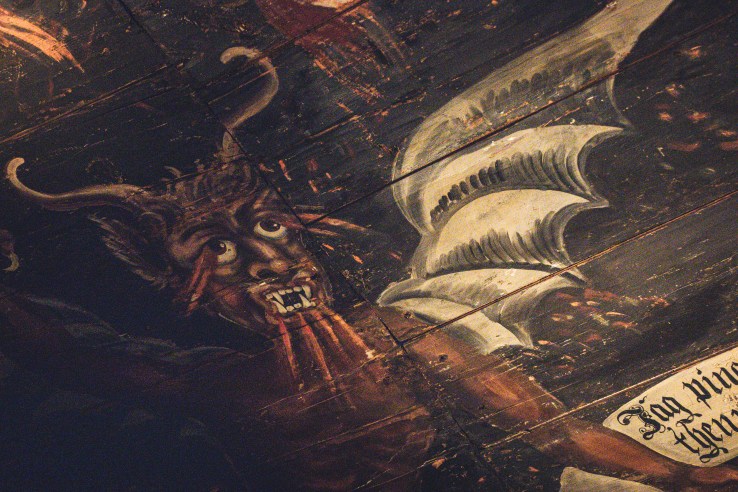
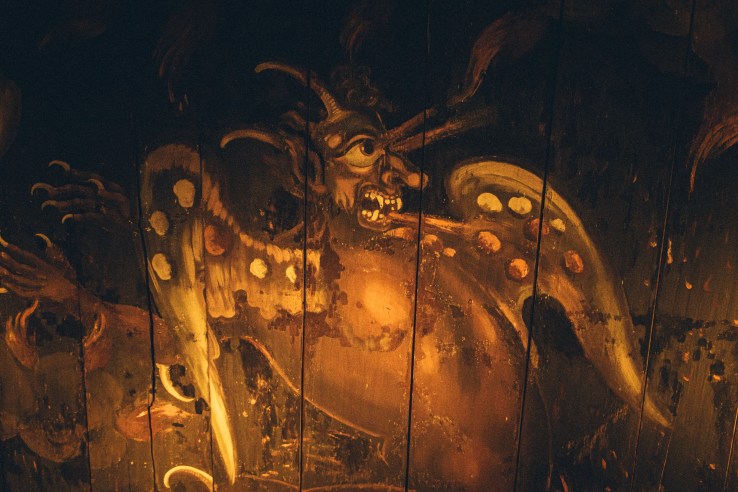
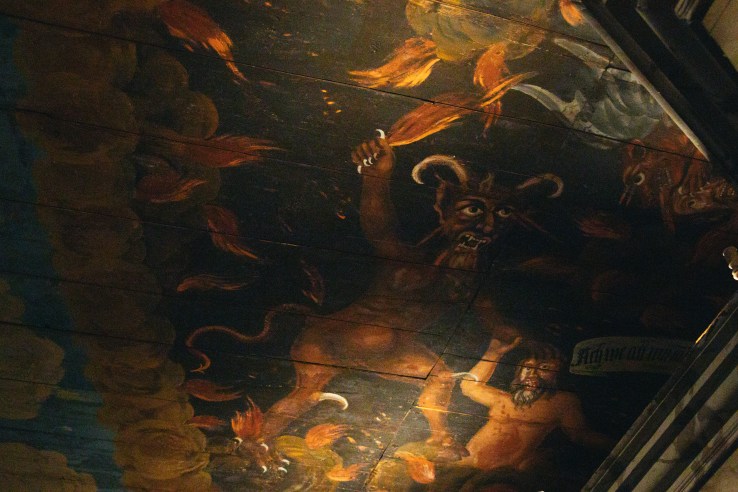
While the church was interesting, I kept my camera switched off, that was until we were making our way back out and I looked up. There was only time to snap a few shots of impressively vibrant demons before ducking back outside.
The ceiling was originally painted, with lesser diabolical depictions, in 1706 by Nicklas Berg. It was painted over (rude) between 1752 and 1753 by a man called Ditlof Ross, though you can still make out ‘echoes’ of Berg’s original work. The ceiling was whitewashed in 1869-70 during a restoration (I’d love to know who ordered that job); however, in 1930, when the church was re-consecrated due to a need for additional church spaces in Borås, the paintings were uncovered and restored. It’s been a popular church for weddings and baptisms ever since. Are you also wondering how many children have been traumatised over the years by innocently looking upwards and making eye contact with these decorative servants of Satan?
I had a beautiful comment left on my last post by a reader called Eivor, who wrote that what I’d said about the forests in Sweden resonated and that trees boost their mood and give them hope. They said they were always struck by how much they missed the trees when they were away from them, something I’m feeling ever more intensely myself these days when all I want to do is be forest wandering from sun up to sun down.
Eivor’s comment made me think of when I was living in Sweden and how lost I’d have been without the forest. I had little clue about anything when I wasn’t among the trees. I was the epitome of anxiety. In the forest, though, rambling, scrambling, slipping amidst the moss and pine, I was empowered, eager, excited. I was different from the fretful woman who would watch through the peephole before going out.
For me, the forest was my workspace and sanctuary. It was more my home than the apartment I’d return to. The forest inspired me, it nourished my exhausted soul, and, of course, it provided hope. It always provided hope.
The forest and its expanse thrilled me. I’d almost always go alone, but on the odd occasion I could show a friend my favourite haunts, I’d be giddy as a child on their birthday.
I took my camera with me most days, and while I mainly created self-portraits, I’d sometimes have a companion to shoot with. In this photo, my friend Martina is captured on a darkening autumn afternoon. Sometime after I shared it online, the Swedish-based artist Alessia Brusco @skogens.rymd.art – who I’d recently struck up a friendship with – contacted me to ask if she could recreate it in a painting.
She recreated this photo, too.
I still remember the day I took this shot and how delightedly I drank up that sunlight and then watched, rooted to the path, as the sun blazed down behind the trees and the evening crept in from all directions.
Thus far, 2024 has been disorientating, exhausting, painful, maddening and swift. So swift. Too swift. Since doing my initial ADHD assessment over a year ago, I’ve been struggling to come to grips with the reality that I’ve been living with this condition my entire life, and it’s only just coming to light as I hurtle towards my 40s. I’ve also been grieving everything that ‘could have been.’ But I’ll write more about this on my other blog awyrdofherown.blog when possible.
Around midnight last night, too tired to read, I flickered around on Pinterest, looking for… I’m not even sure what. At some point, I landed on this knitted cape, leading me toLittle Scandinavian, where I ended up on a post about The Scandinavian School in London, which looked like everything I would want for my daughter in a school, but whose gigantic fees were painful to read. It’s ridiculous, laughable even, that I let the fees of a school in a city where I don’t even live upset me.
I should have gone to bed then but didn’t. My mood was wounded. So I decided to scout out an image for the cover of my next book and ended up on The Public Domain Review – a treasury for the insatiably curious creative – which I combed through for Nordic bounty.
While I furiously bookmarked articles and added, to my already gridlocked desktop, old photographs of Norwegian fjords and Icelandic fishermen, I thought about producing an art appreciation post of some of the stuff I unearthed.
For the longest time, ‘art appreciation posts’ and ‘I-saw-these-things-and-thought-you-might-like-them-too’ posts were the lifeblood of my blogs. But then I gradually stopped making them, and I’ve missedmaking them, and am now on a mission to eradicate the idea from my head that making them ‘is not a good use of my time.’
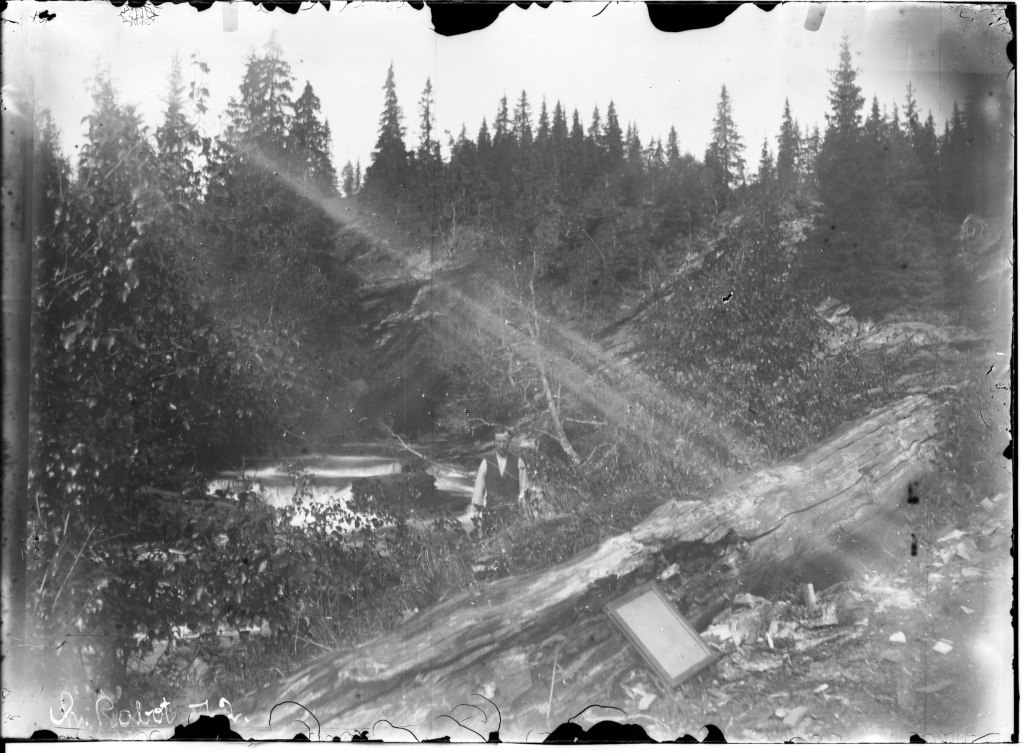
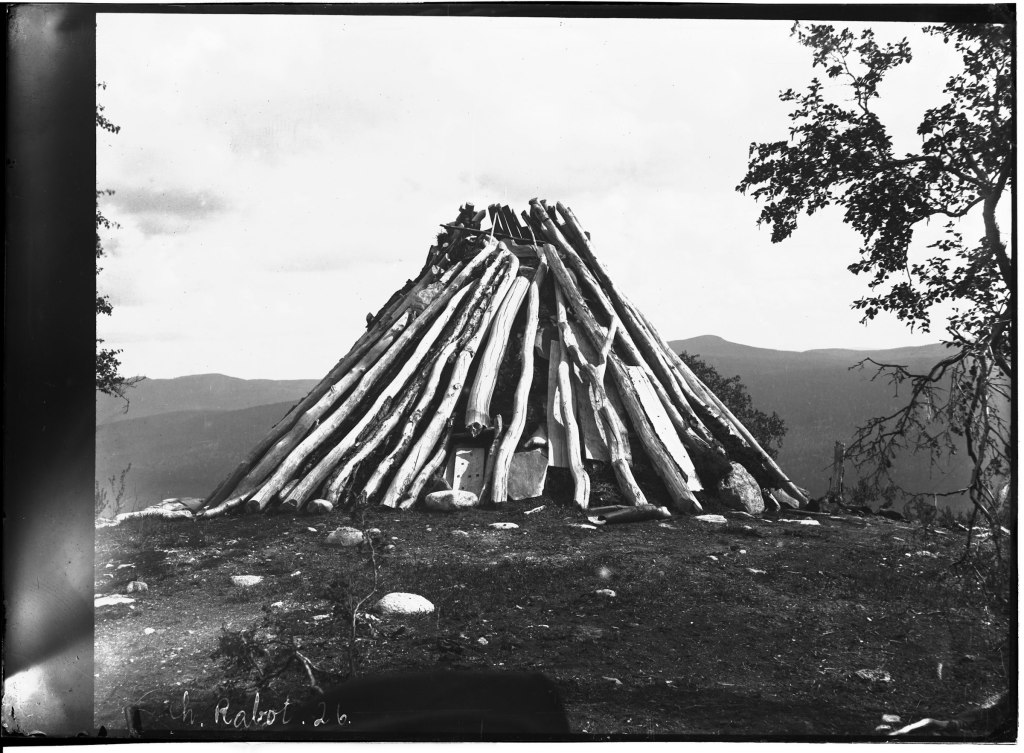
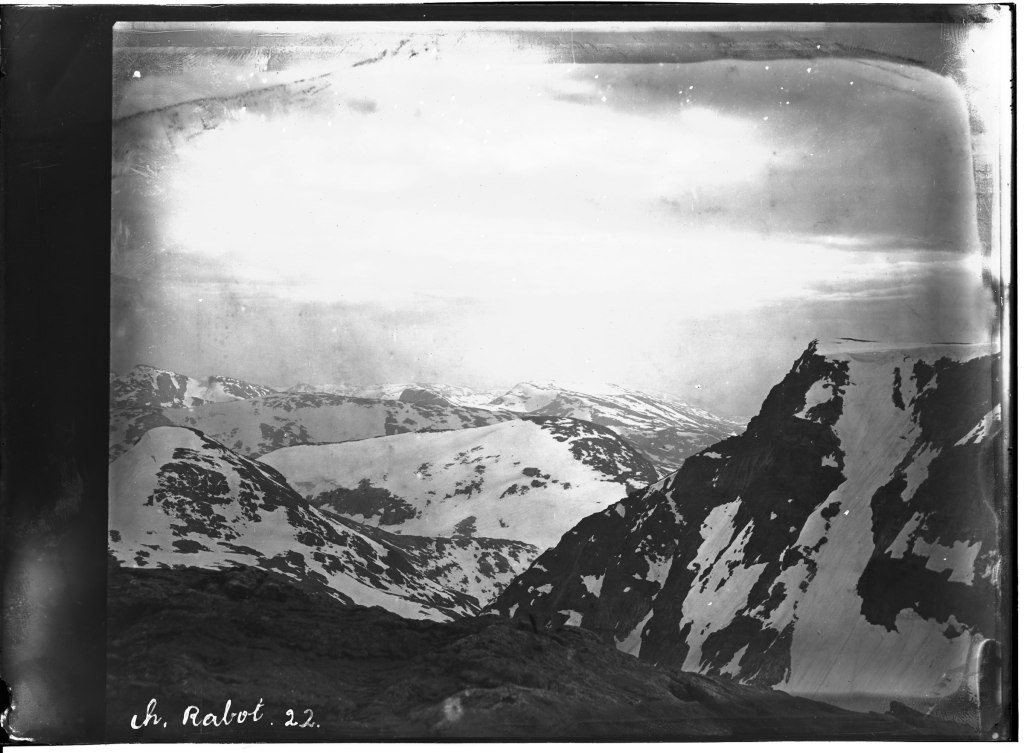
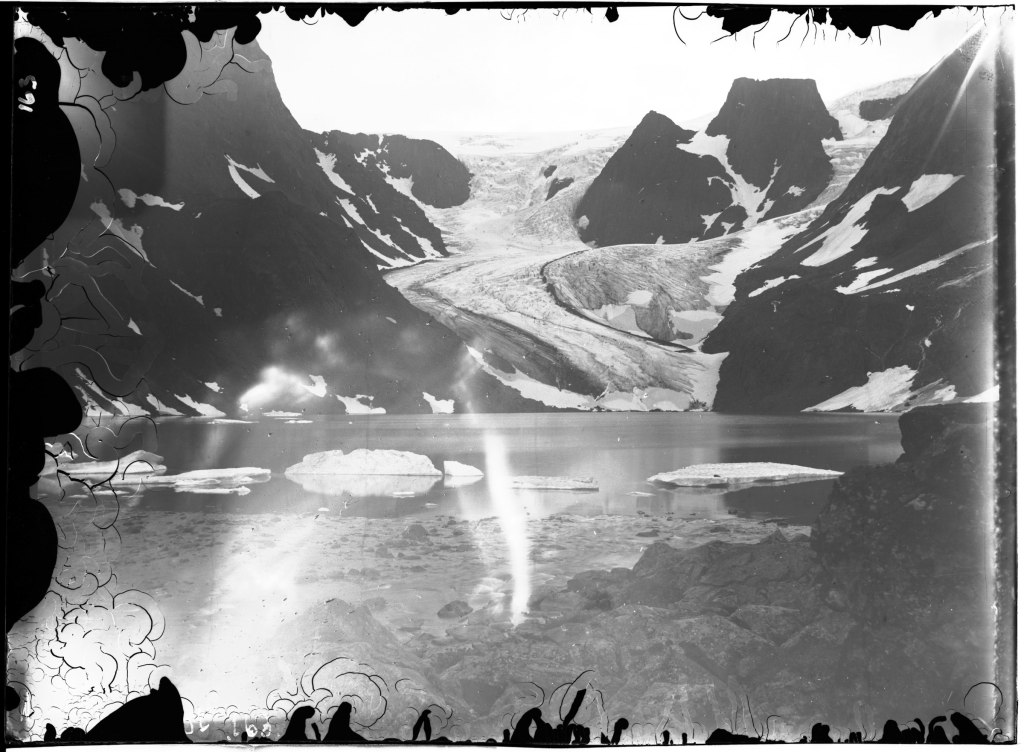
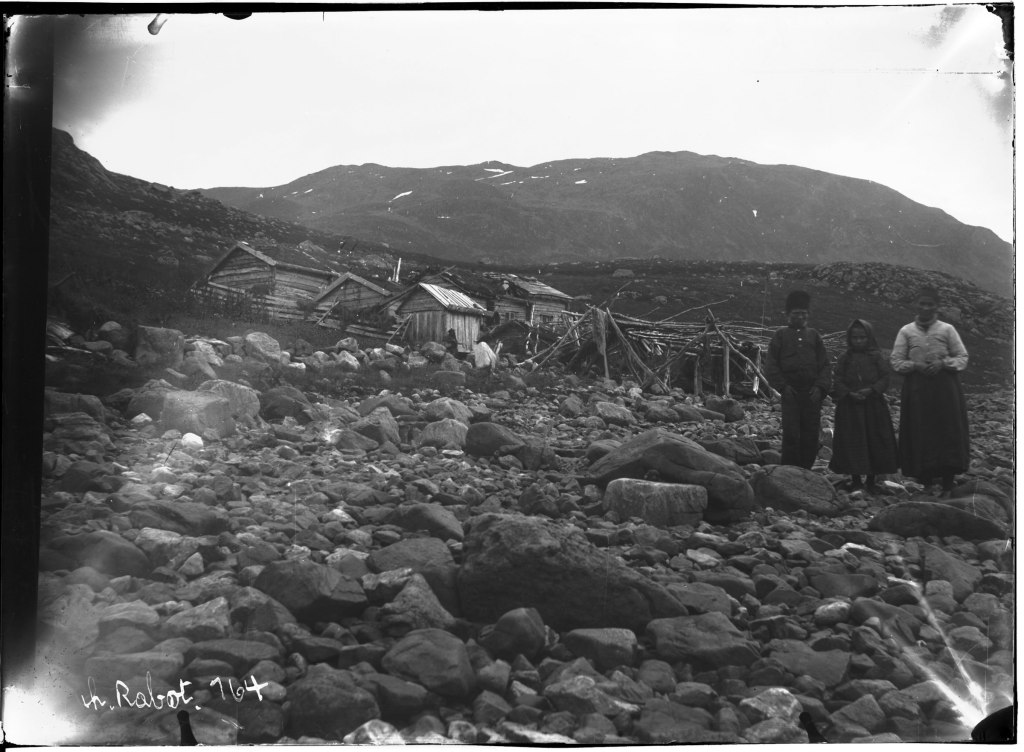
The first thing to catch my attention on The Public Domain Review was this striking, slightly sinister portrait of French geographer, glaciologist, and photographer Charles Rabot. This picture led me to a stupendously readable essay about Rabot by Erica X Eisen (whose other work I’m going to consume with gusto). Rabot had a ‘particular affinity for Norwegian culture…’ and his awe of ‘boral landscapes’ and ‘nostalgic yearning’ for the north is something I strongly identify with:
‘They are so beautiful, so magnificent, those deathly solitudes, so strange in their fleeting finery of brilliant colors, that they always leave one with a burning desire to see them again.’ – Charles Rabot
Eisen’s writing is astute and memorable – the following passage in particular ‘If there are any people to be seen in these snow-pied expanses, they are tiny afterthoughts so overwhelmed by the whiteness around them that any individuating features are obliterated completely — to the extent that these figures seem less like the protagonists of the shots and more like another accidental void bitten into the negative by the frost.’
The first person to climb Kebnekaise, Sweden’s highest mountain, in 1883, Rabot was also friends with the most swoon-worthy of Norwegian explorers, Fridtjof Nansen who’ll be much more thoroughly swooned over in another post where I’ll look at the bizarre but beguiling topic of fancying long-dead polar explorers.
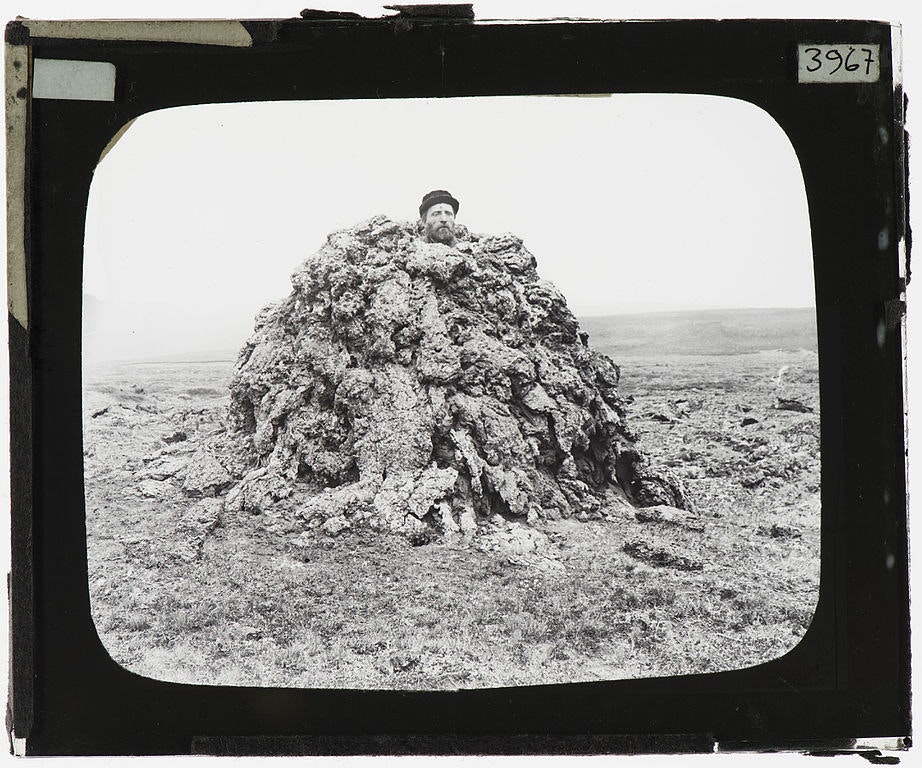
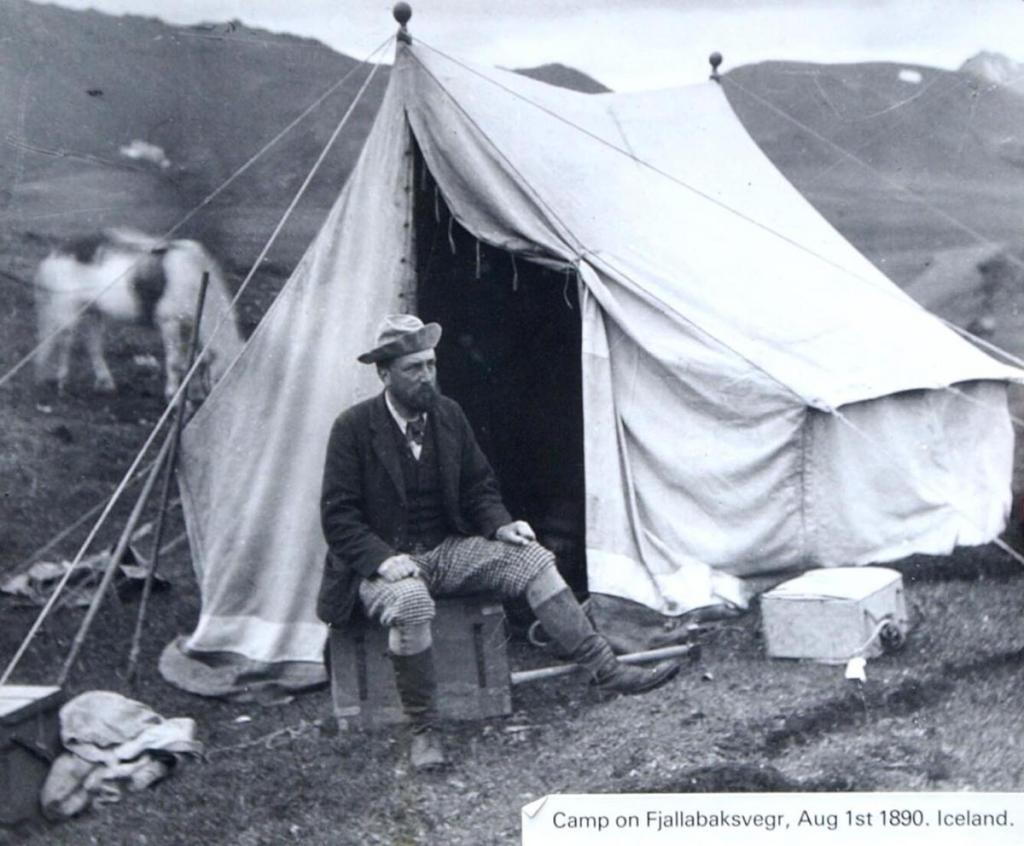
When I searched Iceland on The Public Domain Review, ‘ volcano chaser and pioneer of volcanic photography,’ Tempest Anderson showed up with one of the most gloriously surreal photographs I’ve ever seen.
Very much intrigued by the name Tempest, I was convinced there’d be a riveting origin story, so was a bit put out to find it was simply inspired by a prominent West Yorkshire family.
Yet there’s no doubt the man led a life not dissimilar to a windstorm—his list of occupations and accomplishments is…extensive. York-born and bred Anderson was a leading eye surgeon as well as a photographer, an inventor of photography equipment, a consulting physician to a lunatic asylum, a prison medical officer, a Sheriff of York… the list ploughs on. At 43, unmarried and restless, Anderson decided he’d use his spare time to study volcanology and chase volcanic eruptions. The photographs he shot in Iceland were taken using one of the earliest panoramic cameras, which, unsurprisingly, Anderson had developed himself.
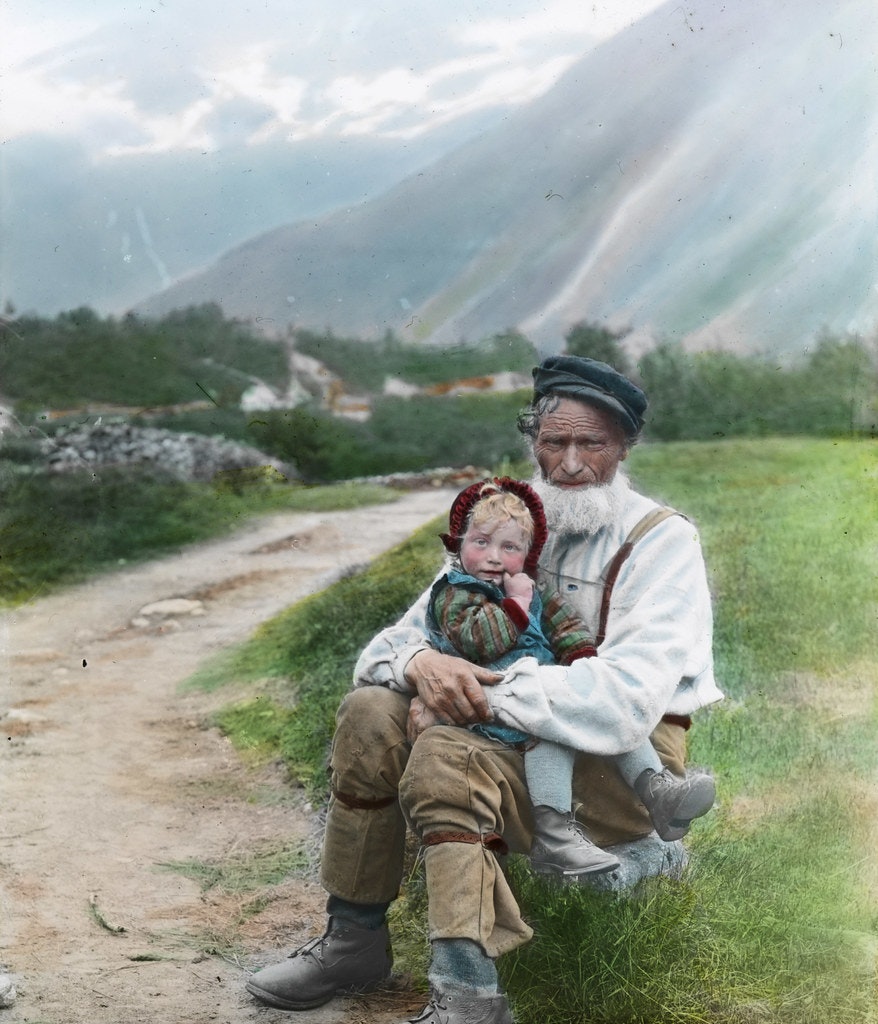
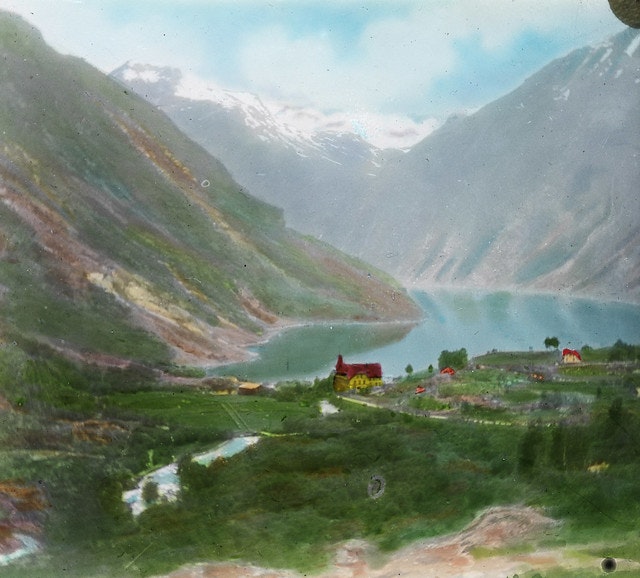
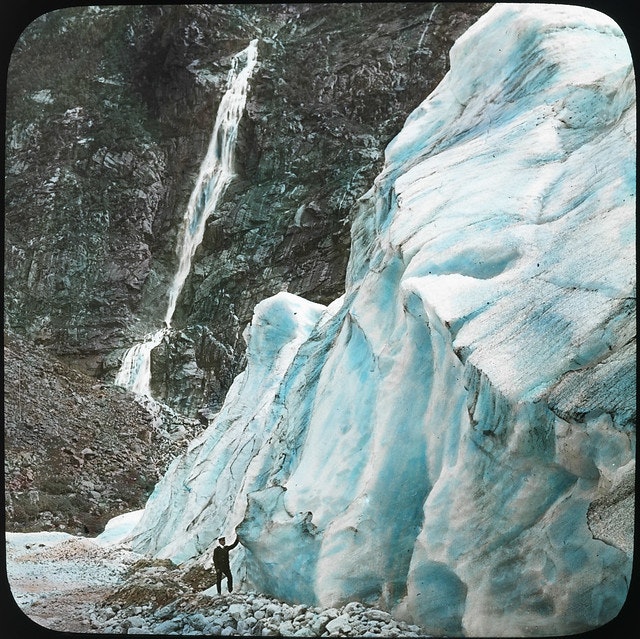
I’ll keep coming back to look at these lantern slides depicting Norway from the early 20th century, and I know each time I do, they’ll thrill me all over again. By the way, for full disclosure, I had to Google what a lantern slide is.
Lantern slides are positive, transparent photographs made on glass and viewed with the aid of a “magic lantern,” the predecessor of the slide projector. Lantern slide plates were commercially manufactured by sensitizing a sheet of glass with a silver gelatin emulsion. The plate was then exposed to a negative and processed, resulting in a positive, transparent image with exceptional detail and a rich tonal range. – Constance McCabe (National Gallery of Art.)
Produced by British photographers Samuel J. Beckett and P. Heywood Hadfield in my favourite part of Norway – Sogn og Fjordane (now known as Vestland) – these bold, crazily vivid lantern slides are held at the county archives in the fjord village of Leikanger, somewhere I’m going to absolutely seek out when I’m next over by way of the Sognefjord. Right now though, I’d very much like to know what the woman on the steps was thinking when this picture was made. Also, image 4 – haunted to my core.
Hadfield was a surgeon on a ship cruising the Norwegian fjords and an amateur photographer in his free time. Little is known about Beckett, but copies of books by both men (The Fjords and Folk of Norway by Beckett and Fjords of Norway A Cruise On The SS Ophir by Heywood) are available on Abebooks and eBay and are very kindly priced for books printed well over a hundred years ago.
More Recommended Reading From The Public Domain Review
I’ve always found the frenzy of New Year’s Eve overwhelming. The relentless din of fireworks, the roaring countdown, the gargantuan pressure to have THE BEST TIME EVER. It’s just too much. Most of my New Year’s Eves have been spent in bed with my journal, picking over the past year in minute detail.
My perfect NYE would be in a forest cabin, hours from the closest town, where I’d experience absolute stillness well before and after midnight. If there did have to be noise, I’d much prefer to hear the pattering of hail, or a tree cracking in the cold or a raven cawing rather than fireworks and the deafening screams of HAPPY NEW YEAR!
But, this year, I was elated to be involved in the celebrations, which included fireworks and hugging at midnight, though thankfully no screaming. My Icelandic boyfriend invited me to spend the evening (though the evening lasts most of the day, with only four hours of light in Iceland at this time of year) with his family and girlfriend (our relationship is open).
I happily jumped head first into their traditions and felt much more upbeat than usual because the weather was suitably wintery – as it should be at the end of December. It was cold (-6.5 at times), and there was plenty of snow. (In a post on my blog, A Wyrd of her Own, I wrote about how out of sync I felt with the UK’s weather and the gigantic impact this had on my mood over Christmas.) In the UK, on NYE, it was wet, cloudy and blustery, with the temperature well into double figures.
It’s tradition in Iceland to meet for a family meal between 6pm and 7pm. (We met at 6.30pm), and our meal was made up of typical Jól fare, including caramel-glazed potatoes, red cabbage, Waldorf salad (bound together with an incredible amount of whipped cream), endless bottles of Appelsín (orange soda) and cans of Malt og Appelsín (non-alcoholic malt beer mixed with aforementioned orange soda. Apparently it’s the taste of an Icelandic Christmas in a can.) There was also Toblerone ice cream. Curiously, decades ago in Iceland it became extremely popular as a festive dessert, and after snaffling down two helpings I can absolutely understand why.
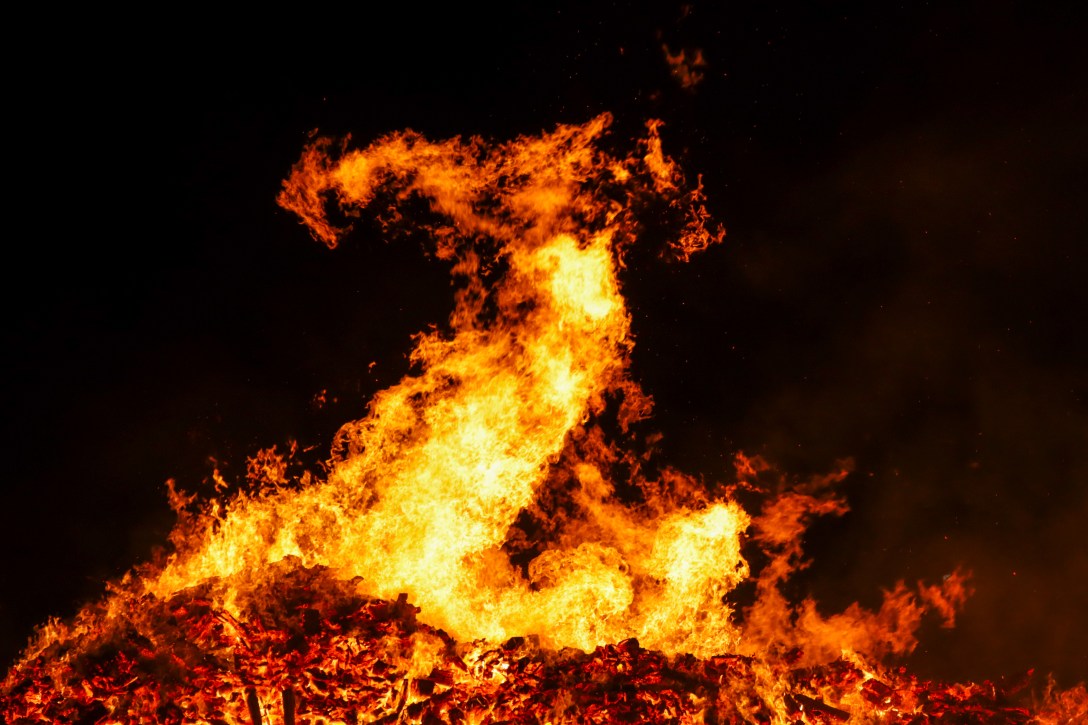
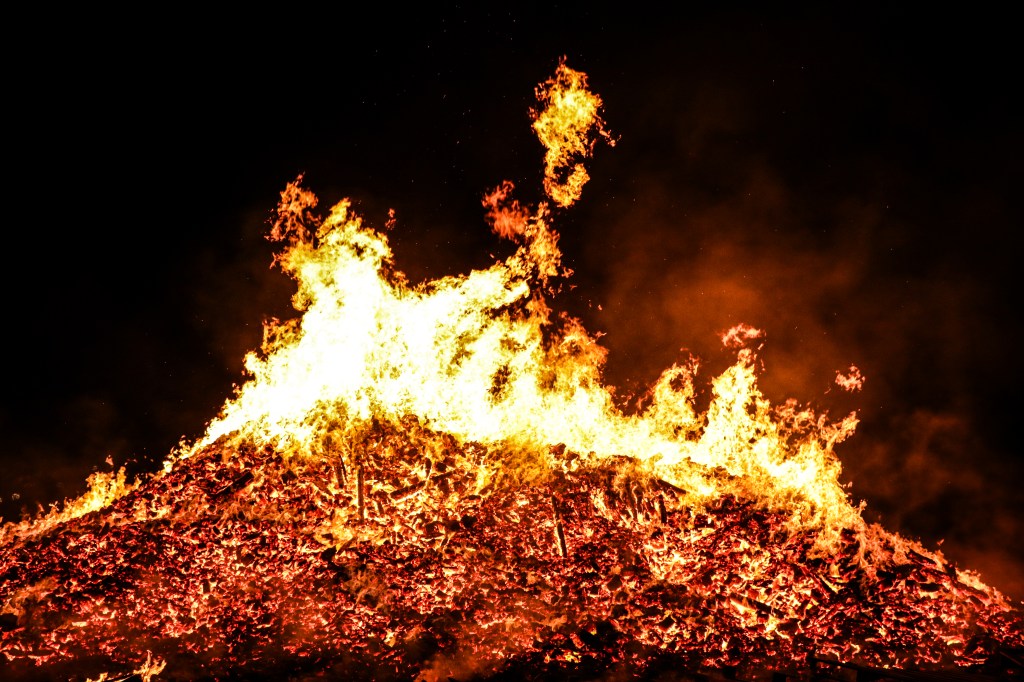
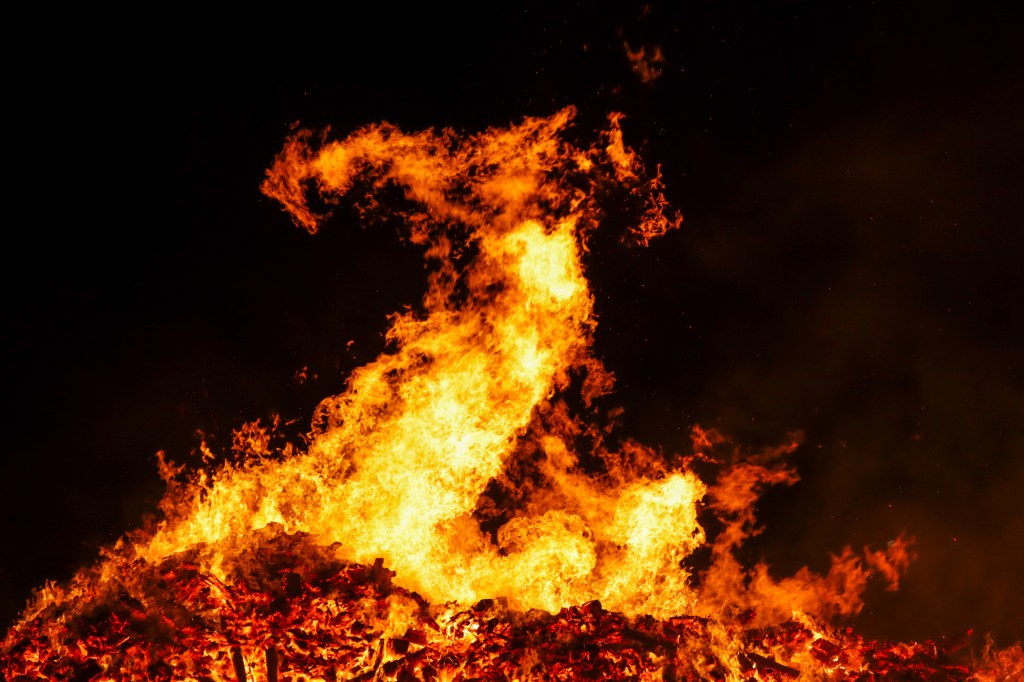
After dinner and heartfelt debates about the existence of elves (according to my boyfriend’s uncles it’s simply not true that 54% of the population believes in them), we tramped across a field of deep snow to wonder at a gigantic communal bonfire. Known as Áramótabrennur, these fires have burned on NYE in and around Reykjavik since the 18th Century and originated from the belief that to have a clean start in the new year, you had to burn away the old year and all that it represented. We went to the bonfire at Geirsnef (you can ogle some of my photographs below), though we had several places to choose from in the Greater Reykjavik area. Across Iceland, around 90 bonfires are ignited on NYE.
There’s heaps of folklore linked to NYE in Iceland, and the folk tales of Jón Árnason, compiled in the 19th Century, talk of New Year’s Eve as the time when Hidden Folk would relocate their homes and become visible to people. Women would make the home spotless and light a candle in every corner. Once clean, the mistress of the house would walk around it and welcome any passing elves inside by saying, ‘Those who want to come may come, those who want to leave may leave, without harm to myself and my people.’ Leaving candles outside to guide the Hidden Folk was also customary.
Following the fire, we watched the annual comedy show, Áramótaskaupið (New Year’s Spoof). Broadcast on TV since 1966, it’s become such an central part of NYE celebrations that in 2002, an estimated 95.5% of the population tuned in to watch it.
After the show, from which I learned that Icelanders call Tenerife Tene (I find it amusing that Icelanders flee a cold volcanic island for a warm one), it was time to bring out the fireworks. Fireworks in Iceland differ from those elsewhere. They’re sold by ICE-SAR, the Icelandic Association for Search and Rescue (a volunteer-led organisation that saves upwards of 1200 people a year), who use the profits – which can reach hundreds of millions of kronur – to update their equipment.
We watched the kaleidoscopic display from a snowy hilltop. There was no being penned in by thousands of people screaming HAPPY NEW YEAR, and, for the first time, I genuinely enjoyed watching fireworks illuminate the new year.
There was absolutely zero pressure to have THE BEST TIME EVER, which enabled me, I’m sure, to really have fun. The evening ended with me feeling not overwhelmed but grateful, loved, and calmer than I can ever say I’ve been before on what I’d always thought of as the most highly-strung night of the year.















 Northern Fever