Biting Season: Notes On A Northern Plague

Autumn and its gales may be here (rejoice!), but I’m sharing this post regardless. I started writing about mosquitoes in September, but glanced away from the page, and October blew in. You know how it is, I’m sure.  

A few years ago, I was celebrating Midsummer with family in Sweden. The weather was impeccable, the midsommarstång inspiring to behold, and the mosquitoes, for whatever reason (no repellent involved – I’d forgotten it), keeping a wide berth.

Well, keeping a wide berth from me. I was the only one not being savaged by summer’s least welcome players. My partner at the time – a man of Icelandic stock – was plagued worse than everyone and carries the scars to prove it.

Intriguingly, it may have been an odour in my sweat that was keeping them at bay. This lucky break was an isolated incident, though, as typically I’m swarmed and left with archipelagos of bites which swell to memorable heights.
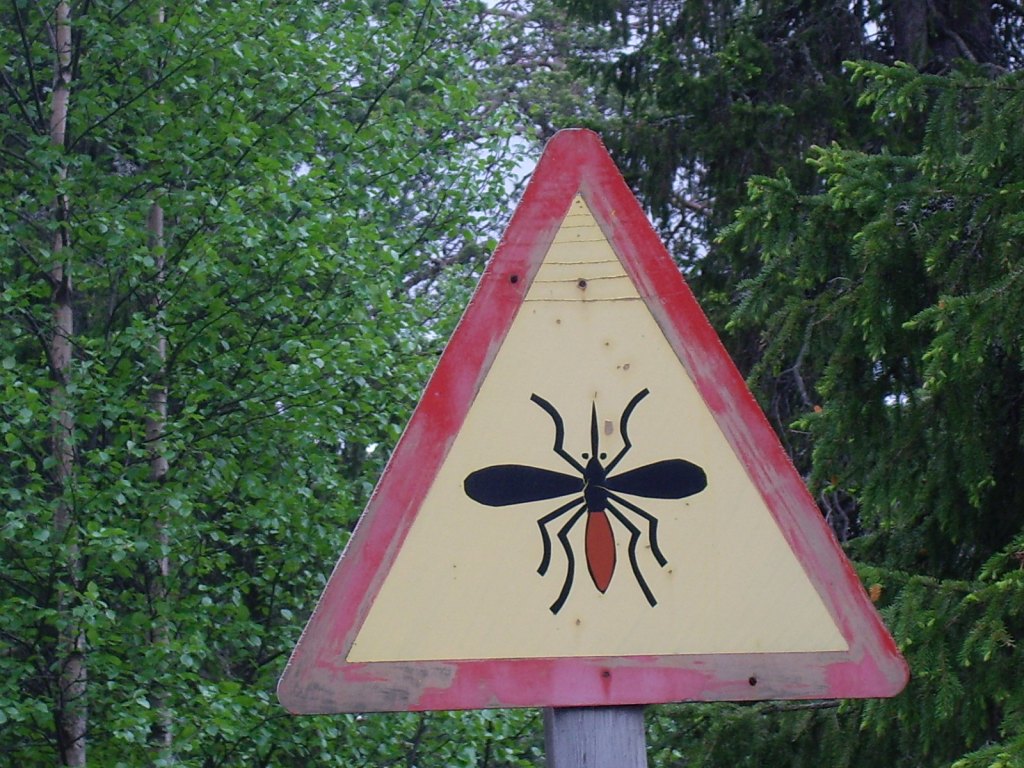
Legit mosquito sign in Finland. (Wikipedia.)

It’s a little awkward to admit that I typically try to “shoo” mosquitoes away. On the occasion I’ve been beset with rage by their assaults and have slapped them to death, I’ve felt horrible. It’s difficult to reason with yourself when your neurodivergent empathy extends to biting insects. I may have felt differently had I been in Lapland, where mosquito swarms are biblical. I read a comment on Reddit about a couple getting out of their car, only to immediately dart back inside after spotting a fast-approaching mosquito cloud.

It’s not unusual for animals to spend so much time trying to escape mosquitoes that eating becomes impossible, and they starve to death. They can also die from blood loss – a swarm can take as much as 300 ml of blood from a single caribou in a one day.
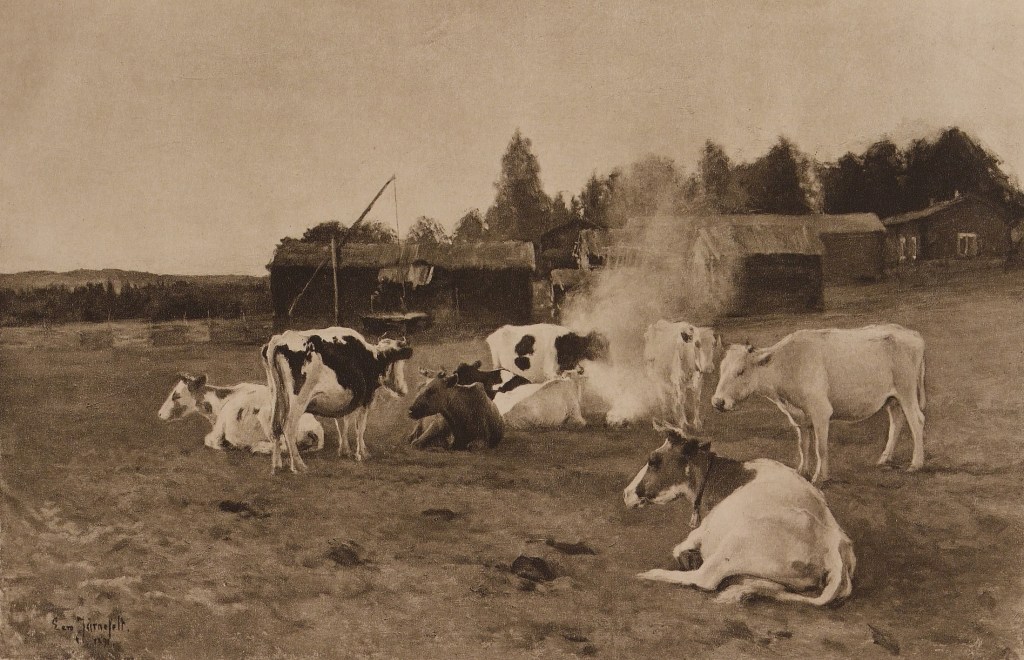
‘Smoking fire near the cows to keep off mosquitoes and other insects while the cows were milked.’
Eero Järnefelt (1891)

I’m familiar with summer in the Nordics for the most part, but I’ve only recently learned that there are 50-60 species of mosquitoes in the Nordic countries alone. (Imagine how flabbergasted I was to discover over 3,000 species of mosquitoes exist worldwide.) I was also late to learn that it’s only female mosquitoes that feed on blood, while males feed exclusively on nectar.

Any standing water – from a puddle to a gutter to a tyre track –  can host a breeding ground and then a nursery for developing larvae. Iceland’s lack of standing water is one reason mosquitoes haven’t managed to get a foothold.

…as I made my way round their boggy breeding grounds they rose up to meet me in dark, swirling clouds, insinuating themselves in my clothes, choking my mouth and smothering every inch of my skin in bites. As I  saw my hands beginning to swell, I ruefully consoled myself with the thought that at least I would not contract malaria, because my tormenters belonged to the genus Aedes which, happily, are not carriers of the disease.”

Walter Marsden, Lapland: The World’s Wild Places

*Soon after reading this – bear in mind Lapland was published in 1975 – I found out that mosquito-borne diseases such as malaria are spreading across Europe due to the climate crisis.

Early explorers of the North described mosquitoes as ‘worse than the cold,’ and ‘the one serious drawback of the north.’ I’m surely not the only one who relishes the vision of fumbling English gentry being set upon by mosquitoes, which have also been called ‘a frightful curse,’ as well as, quite fabulously, ‘…devils…armed with a lancet and a blood-pump…’    

“In the summertime in Iqaluit, the capital city of the Inuit-administered Canadian territory of Nunavut, swarms of insects hover above the inhabitants like cartoonish clouds of gloom as they go about their day-to-day lives.

Kate Press, Briarpatch Magazine

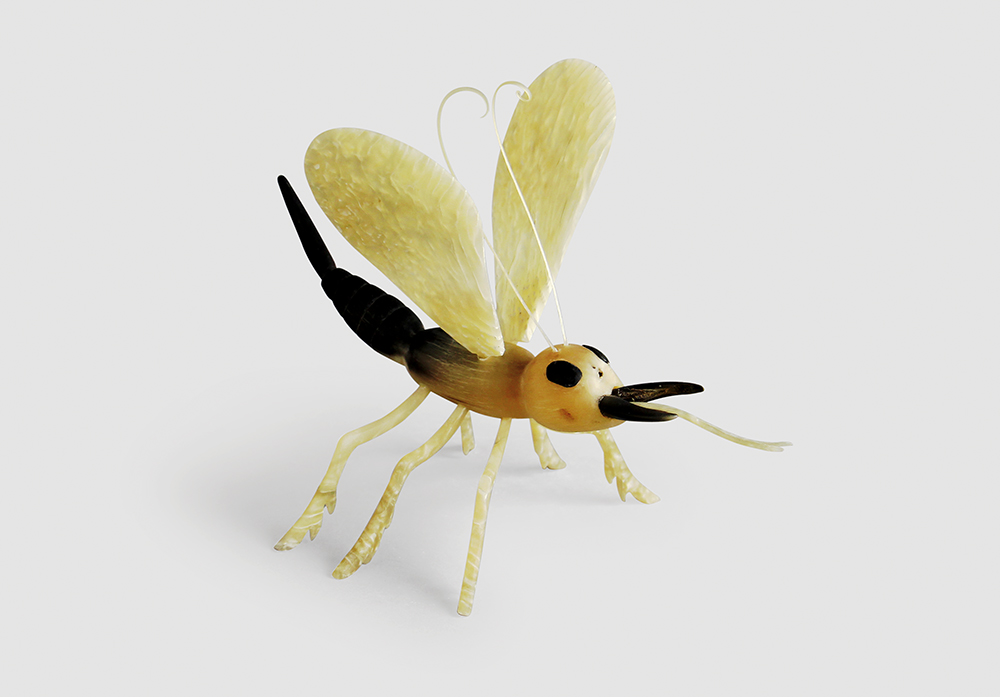
Igah Hainnu Mosquito (2016) Muskox horn, seal whiskers and seal claws 

Many indigenous peoples of the Arctic viewed mosquitoes as something sent to ‘test endurance.’ For the Sámi, enduring harassment from mosquitoes was a way of proving hardiness. Young herders and hunters were expected to tolerate swarms during migration and calving season without excessive complaint. Jonna Jinton, an artist living in northern Sweden, endures the biting plague with humour, as demonstrated in this tongue-in-cheek mosquito meditation video.

In the Swedish town of Övertorneå, the community hosts the World Championship in Mosquito Catching, where the winner is the person who catches the most mosquitoes in just fifteen minutes, earning a cash prize and being crowned world champion.   

In Finland, one of the Nordic countries I’ve yet to visit, these micro-predators have their own signs, and there’s a history of ‘mosquito bravado.’ Especially among the likes of fishermen and loggers who work amidst clouds of mosquitoes.

“We were breathing hard now, sweating in the afternoon haze and mobbed by a few thousand mosquitos each. Every square inch of exposed skin was smeared with Vietnam-issue jungle juice, stuff that dissolves plastic buttons and burns like acid in your eyes. It kept the actual blood loss down to a level that didn’t threaten death, but that wasn’t the real problem. It was the psychological warfare, airborne water torture. You felt the constant patter, and knew that your back was crawling with living grey fur, hundreds of relentless snouts probing for a chink in your armour. A hand wiped down a sleeve would come away sticky, smeared with corpses, and you strained them through your teeth.”

Nick Jans, The Last Light Breaking: Living Among Alaska’s Inupiat Eskimos

In the 1970s, the Inuk community leader Abe Opic wrote an essay called What it means to Be an Eskimo, where he, justifiably, compared white people to mosquitoes: “There are only very few Eskimos but millions of whites, just like the mosquitos. It is something very special and wonderful to be an Eskimo – they are like snow geese. If an Eskimo forgets his language and Eskimo ways, he will be nothing but just another mosquito.”

Michael Massie The Endurance Game, 2016, serpentinite, bone, birch, ebony and brass

The Inuit have several stories about how mosquitoes came to be. The one you’re about to read was told to the Greenlandic/Danish explorer Knud Rasmussmun by Inugpasugjuk, a member of the Nattilingmiut Inuit community.

There was once a village where the people were dying of starvation. At last there were only two women left alive, and they managed to exist by eating each other’s lice. When all the rest were dead, they left their village and tried to save their lives. They reached the dwellings of men, and told how they had kept themselves alive simply by eating lice. But no one in that village would believe what they said, thinking rather that they must have lived on the dead bodies of their neighbours. And thinking this to be the case, they killed the two women. They killed them and cut them open to see what was inside them; and lo, not a single scrap of human flesh was there in the stomachs; they were full of lice. But now all the lice suddenly came to life, and this time they had wings, and flew out of the bellies of the dead women and darkened the sky. Thus mosquitoes first came.

If you do head to the far North, where the waters lie still and light lingers long into the night, wear long-sleeved shirts (doubling up is advised), socks, and trousers made from dense material. Wear a head net if you have access to one and remember that repellent loses its effectiveness when you begin to sweat. If you think you can escape them by going a bit further North, I should warn you that these blighters are now appearing in places where it was once too cold for them, which is, to put it lightly, worrying as fuck. We all know the North is warming, but the migration of mosquitoes makes it ever more painfully real.

I don’t want to abandon this post without attempting to lighten the mood (for you and me), so if you’re interested in seeing what it’s like to sit in a Finnish forest during summer, this gentleman can show you.

Sources

Inuit Art Foundation

Atlas Obscura (If you want to know about the mosquito catching championship.)

Nunatsiaq News (Observations from Inuit about mosquitoes, including the story featured in this post.)

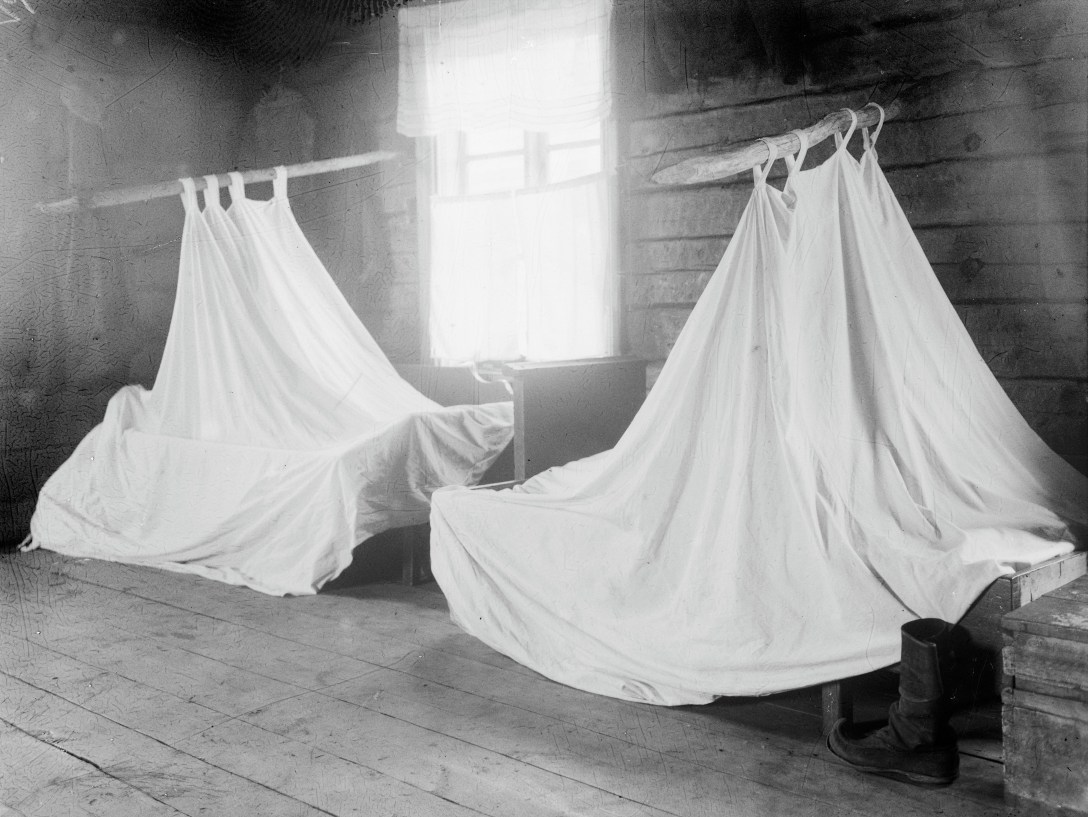
The featured image was taken by Samuli Paulaharju in 1937.

The Fox Of Cave Vatnshellir

It’s been a few months since I was in Cave Vatnshellir on the Snæfellsnes Peninsula in Iceland looking at the bones of a fox who died there hundreds of years ago. However, I’ll find that, quite often, I’ll randomly think about this fox which found itself in the Underworld, or, as it’s called in Icelandic Undirheimarnir, before its time.

I imagine what it would have been like for this animal – who weighed less than the carry-on bag I took to Iceland – not to be able to find a way out. I imagine it treading carefully through the darkness, nosing wet lava rock, hearing its own heart thump. I think about the time it would have taken for it to die in a darkness so complete it’s impossible to comprehend unless you’ve been down to where the daylight can’t reach.  

Yes, the lava formations in the cave were riveting to see, and yes, the dark was exhilaratingly absolute when the flashlights went out, but the moment we saw the bones, I was all about the fox and I wanted what our guide couldn’t possibly give me – its life story.

I want to think others have walked away from Cave Vatnshellir with the fox on their mind, that I’m not the only one preoccupied with the life and death of this Northern nomad.

The Christmas Cat Of Iceland

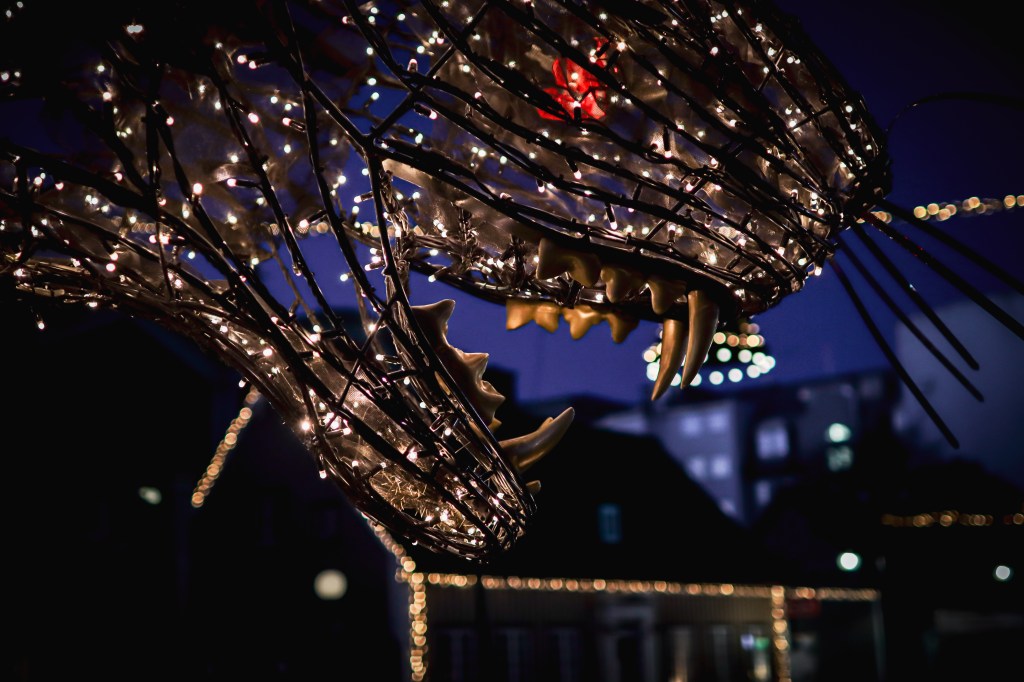
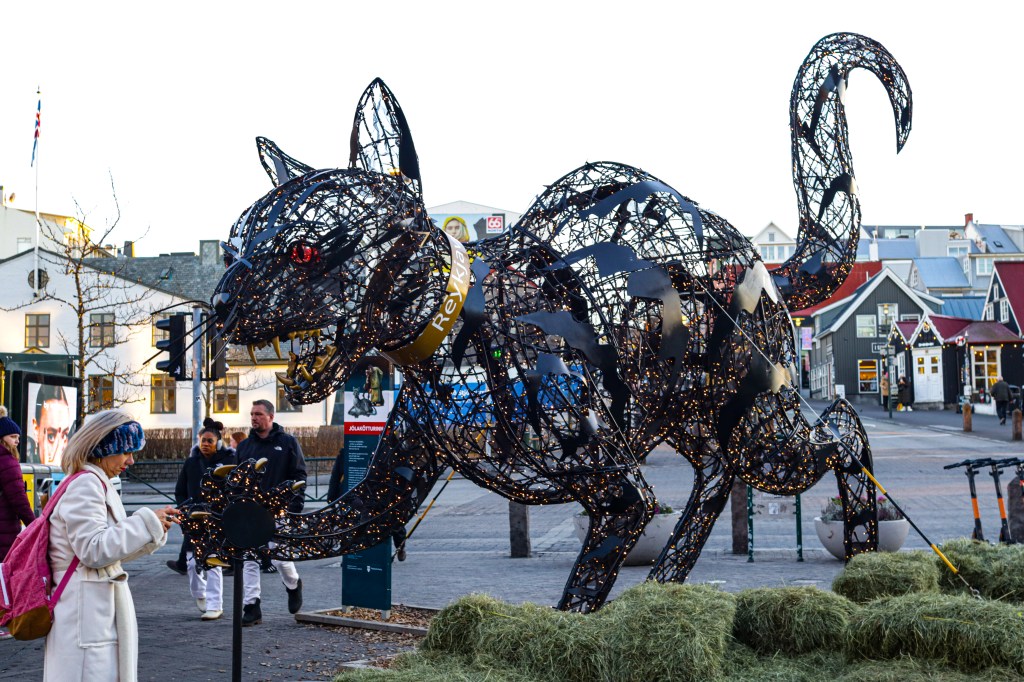
It was still dark at nine-thirty the other morning in Reykjavik (it would be well after ten before the sun shimmied up to provide the city with its scanty ration of daylight) when I bumbled outside to capture the looming Jólakötturinn (the Yule Cat) sculpture in all its ominous glory. 

Every November since 2018, a five-metre-tall iron sculpture, decked out with 6,500 LED lights, depicting Gryla’s child eating floofy familiar (some attribute the inspiration for its ‘floofiness’ from the Norwegian Forest Cat) who eats children who don’t get new clothes for Jól has materialised in the centre of Reykjavik to herald in the season the traditional Icelandic way – with foreboding.  

The sculpture cost the city a ‘sensible’ 4.4 million ISK and was fabricated by Austrian company MK Illumination. A garden centre owns it, and they lease it out each year to the city for a ‘steal’ at just over 3 million ISK.

Reykjavik’s Jól décor tends to be conventional, with the city reusing lights and garlands yearly. (Though I favour the cosy understatedness over most other cities I’ve seen ‘glowed up’ for Yuletide.) So, the sculpture’s arrival in 2018 was quite the talking point.

While the Yule Cat gathered much adoration (it was welcomed with a speech and a children’s choir), there was some backlash, too. One critic, Sanna Magdalena Mörtudóttir of the Socialists party, was critical of the city’s priorities and was furious the struggle of the city’s low-income families wasn’t brought up during the opening speech. 

While cats have held a prominent role in Nordic society since the Viking Age, it’s unknown how long the Yule Cat has been around. Though it’s theorised he’s been prowling since the Dark Ages. We do know that he’s stalked written records since the 19th Century. 

As Kathleen Hearons writes in Head Magazine, ‘Cats were the travelling companion of choice for Vikings – although not for sentimental reasons, but rather to kill mice and be skinned for their fur. Consequently, feline populations grew throughout the Nordic countries when the Vikings settled there. To this day, Reykjavik is “culturally a cat city,” according to Reykjavik Excursions. As of August 2022, there was a cat-to-human ratio of 1-to-10…

In bygone times, the threat of the Yule Cat would frighten children (and, without doubt, some adults) into finishing processing the autumn wool before Jól. By the Middle Ages, the export of wool from Iceland played a valuable role in the economy, and having a prosperous wool production was imperative. 

Though this fear-mongering technique ensured laziness was all but eradicated in the last part of the year, it was also a superb encourager of family bonding, as everyone in the family had a role to play and would gather around the fire in the evenings to prepare yarn and knit.

In an article for the Reykjavik Grapevine, Ethnologist Árni Björnsson says, ‘After 1600, there are a lot of changes in Icelandic society. Folklore often mirrors what’s happening in society. So, it makes sense that Grýla and the yuletide lads are grimmer during this difficult time for Icelanders. In 1602, the Danes banned Iceland from trading with countries other than Denmark, and this was tough because Iceland relied on many imported goods. To make matters worse, the colder period in Iceland also sets in around 1600.

 So, those things we call “jólavættir,” or supernatural beings of Christmas—including the yuletide lads, their ogress mother Grýla, and the Christmas cat—those elements were probably incorporated into the Christmas tradition to keep kids in line. Everyone was supposed to work hard to do all the things that had to be done before Christmas, and some people were lazy, you see. So it was said that if you weren’t diligent at working, the Christmas cat would come for you.’ 

In 1746, parents were banned by the King of Denmark from tormenting their children with stories of the Yule Cat, Gryla and her thirteen trouble-making lads as youngsters were becoming too afraid to leave their houses.

In 1932, a book was published by the poet Jóhannes úr Kötlum called Jólin koma (Christmas is Coming), and it featured a poem called Jólakötturinn which brings to life – though in the most family-friendly way – the goings about of the malicious moggy. An English translation was published in 2015 for the Icelandophiles out there. 

You all know the Yule Cat

And that cat was huge indeed.

People didn’t know where he came from

Or where he went.

– The first stanza from Jólakötturinn

Following the publication of Jólin koma, the Yule Cat was, in the words of Áki Guðni Karlsson, writing for Icelandicfolklore.is ‘firmly established as part of an “old Icelandic” pantheon of Christmas beings for generations of Icelanders.’

You’ve probably encountered Bjork’s dungeon synthy musical adaptation of Kötlum’s poem at some point, though I’ve only recently discovered she wasn’t the first person to put it to music. That honour lies with the late Icelandic singer Ingibjörg Þorbergs. There’s also an exquisite version created by Icelandic folk duo Ylja. 

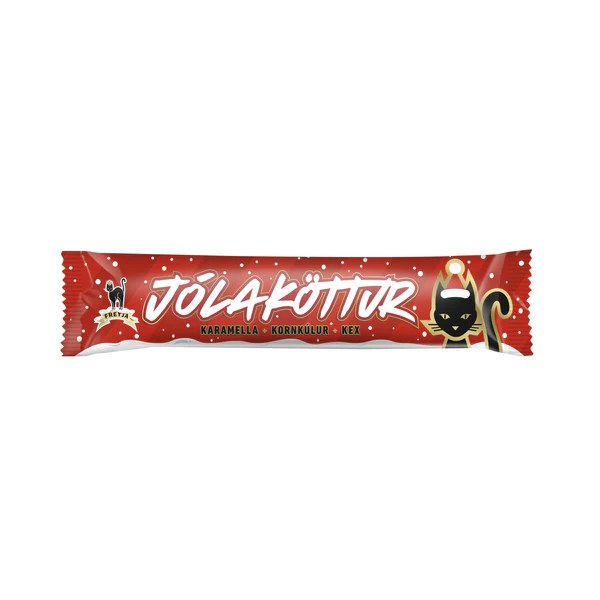
Like his mistress and her thirteen lads, the Yule Cat has long infiltrated Icelandic Christmas paraphernalia and even has his own chocolate bar, ‘Jólaköttur’ (the Christmas version of the famous chocolate bar Villiköttur), a delicious 50g beast of thick milk chocolate, caramel and biscuit all knobbled together with crisp rice.

The innovative chocolate company OmNom released a limited edition winter chocolate bar back in 2018 called Drunk Raisins + Coffee (which featured, among other things, green raisins infused with mandarin juice, cocoa beans from Tanzania, Icelandic milk and Austrian rum) in honour of the Yule Cat and in collaboration with the feral cat rescue organisation Villikettir.

On the OmNom website, Hanna Eiríksdóttir writes, ‘…stray and feral cats are neither evil nor frightening, and they definitely do not eat children. No one really knows how many cats in Iceland are feral or strays,they are thought to be in the thousands. In our minds, the Yule cat is the protector of these Icelandic stray and feral cats. The old folklore reminds us not to turn a blind eye to our little furry friends in need.’

I went back to the Yule Cat sculpture later on in the day. I saw togged-up kids catapulting themselves around in the straw pile surrounding the eternally pissed-looking puss, and now as I write this, I regret not sidling up to the parents and whispering to them, like the total weirdo I am, ‘So, do they think he eats harðfiskur now or…?’