
I initially wrote about Iceland’s child-eating ogress of Christmas in 2009, two years before I even set foot on the island. It was a mild, one-page poem for university which featured in my first poetry collection.
But Grýla never strayed far from my consciousness, so I wrote another poem about her for my upcoming collection themed on winter in Iceland. And it’s considerably more unsettling than the one I penned while still a fledgling poet.
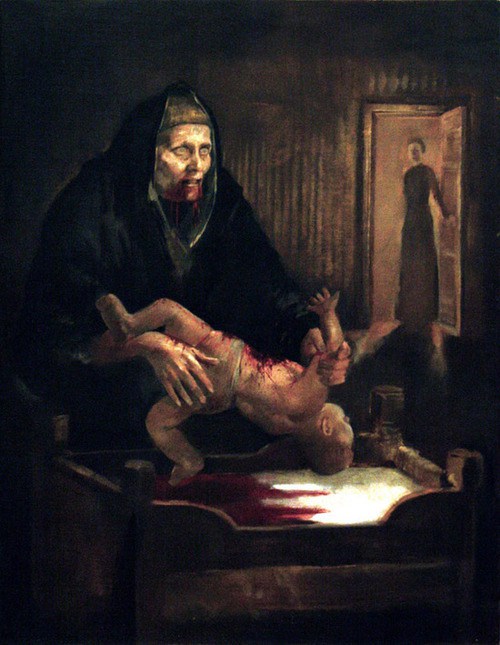
Of all the creepy Nordic folkloric beings, Grýla is, without doubt, one of THE creepiest, with her insatiable appetite for the flesh of children. Another aspect of her legend which unnerves me, and really quite profoundly, is the reaction parents were said to have about her eating their kids. Basically, they accepted it as a fact of life, something which Þrándur Þórarinsson illustrated brilliantly in his chilling painting.
I’ll readily admit that until recently, I thought this painting was OLD, so old I was confident it would be within the public domain. But it isn’t old. Not at all. Þórarinsson was born in 1978.
When a photograph of the then relatively unknown (outside of Iceland) painting was put online in 2009, it went viral and was viewed by 620,000 people thereabouts in a single day. I wouldn’t be surprised if, nowadays, it’s the best-known image of Grýla on the web.
Another artwork that depicts her in a most gloriously grim way is this inked piece* by Norwegian artist Kim Holm.

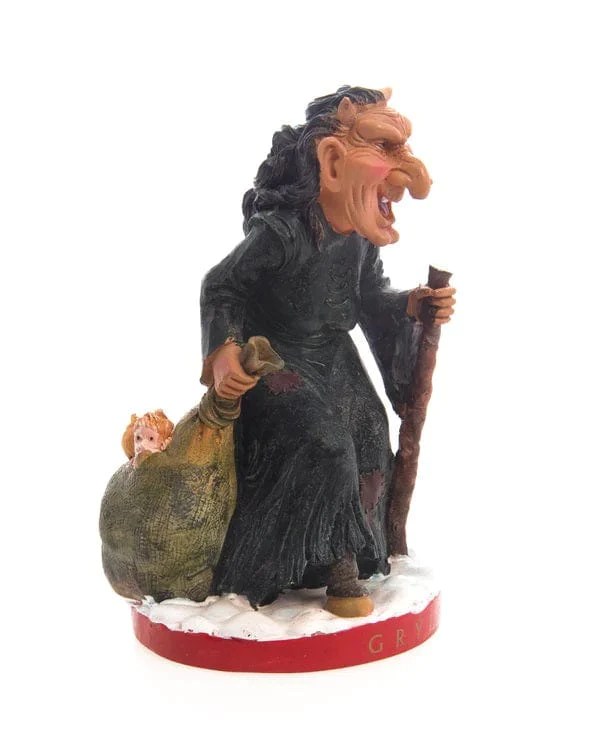
Grýla has a ‘special’ place in the hearts of Icelanders, and I’ve spoken to several about how genuinely scared they were as kids that Grýla would turn up at their home, abduct them and haul them away to the mountains where they’d end up being boiled alive in her cauldron. Though she seems to be ‘much tamer’ these years and is known mainly for being the mother of the Yule Lads. Though some keep the legend alive, as with this popular Icelandic Store sculpture of her, gleefully dragging her sack of children.
But Grýla hasn’t always been associated with Christmas. The first mentions of her appeared in The Saga of Icelanders and Sverris Saga, both 13th-century texts. She would only become connected to the festive season in the 17th Century through the Poem of Grýla.
How Grýla looks depends on who you ask, though 300 heads, fifteen tails, claws and cloven hooves are usually mentioned. Sometimes, she has a beard, sometimes she has horns. Though if you ask whoever directed the episode of Sabrina The Teenage Witch that featured Grýla, she’s quite the babe and, from what I understand about the episode (I’ve never seen it), only eats one child.
But are kids still scared of Grýla today? There is a story going around Iceland that she died of starvation. But not every parent goes along with it. The headmaster of the Elf School (an institution based in Reykjavik, devoted to Icelandic folklore), Magnus H. Skarphedinsson, told Vice in 2017 that he called home and pranked his daughter by pretending to be a Yule Lad.
He told her his mother, Grýla, was furious with her for being badly behaved. After that phone call, his daughter hid under her bed and you can guess the rest.
Terry Gunnell, a professor in Folkloristics at the University of Iceland, said in a Smithsonian Magazine article that Grýla was ‘…a personification of the winter and the darkness and the snow getting closer and taking over the land again…’ Grýla represented the threat of winter and controlled the landscape, which, way back when, the Icelandic people believed they were only ‘tenants’ of. ‘You don’t mess with Grýla,’ Gunnell went on to say. ‘She rules the roost up in the mountains.’
Below, you’ll find my poem, Grýla. I hope it does what it’s supposed to and harks back to the days when the child-eating ogress of Iceland still chilled the blood of children when Christmas came around, and they weren’t sure if they’d been well enough behaved not to be taken from their beds and boiled up for stew.
Gryla
There's not one man, woman or child
on this sterile, far-flung isle whose smile
doesn't waver at the growl of my name.

Generations of wicked children have pleaded
to uproot from houses they were born to,
bed down Skyr pale limbs and buttery heads
in places no one roams but the dead.

Pity those young minds that don't comprehend
- nowhere is safe from me.

I said, nowhere is safe from me.

Even the aged, with their crumbled minds,
and murk-filled, frightened eyes, remember Grýla.

They shit in their clothes saved for Jól,
and piss in their soft chairs and beds.

The stench overpowers the lamb and cardamom,
festivities are disrupted with thin cries for help.

Hjálpaðu mér mamma, Grýla kemur!
Help me mamma, Grýla is coming!

But their mammas are gone long ago,
their rib bones timber for Huldufólk homes.

The flames beneath my cauldron were spitting
well before Snorri dashed ink on calf vellum.

I've been watching this unclad land as long as Esja has.

Above my head, it's cooled lava dark.
Below, Reykjavík sparkles like a whore
who has stolen every star.

I remember turf houses. How easily I could
make those soft walls fall, pluck up children
crawling between the debris.

Now, I run my claws against corrugated iron walls.
This time of year, children's ears are the keenest.
They hear the slow and steady clattering
from several streets away.

Some parents appreciate my coming.
Many have seen me take their offspring.
It's how life is; I often hear them thinking.

Last Jól, a child said to me you're not real.

Boy, I replied, you're about to die in my hands,
and I'll see to it your skin is flayed off and tanned.

Then I lowered my mouth over his bobbing head,
chomped through his bird bone neck,
stuffed him, headless and silent, into my sack.

I always need a thread to sew Leppalúði's socks.
I need girls with long hair, though, if I don't take enough,
tendons do the job almost as well.

Tonight, children are waiting in terrible silence.

Some whisper, Grýla, we hail you, clutch lava stone effigies
of me, hoping I'll pass by, gift them more time.

This year, there's an odd little child,
a child so very…other.

He's gone so far as to scratch HAIL GRÝLA
on the floorboards beneath his bed.

I can read the startling thoughts he has
tied so neatly in his head.

He wants to join me, trail my gory path,
stir to the great depths of my cauldron, taste
his schoolmate's meat, pick splinters of their bones
from between his fence-like teeth.

He wants to run about after my lads,
become known for creating carnage of his own.

He wants to dig out the crusted human blood
stuck between my cat's sweet toe pads.

He's waiting in a white house
within sight of Hallgrímskirkja.

He's waiting to hear my hooves on stone,
my claws on iron. He's waiting for my face
to loom around the door to his room where he sits,
quiet as a lamb, hands in lap, patient as can be.

He'll drop to his knees. There'll be no dread,
no fear, not even a shred.

I'll beckon for him to follow me out.
Reykjavík's foundations will quake as we walk.

With my forefingers and thumbs,
I'll pinch out each maddening light.

I'll bring Jól to an end and greet again
the merciless Icelandic winter night.
*I used this artwork as the front cover for my pamphlet The Darkest Days which features my Grýla poem along with work about Jack Frost and Swiftrunner.
Related: Art of Grýla






 the High Arctic and it leaves no nerve unturned.
 Northern Fever