I recently visited Borås Museum with a friend, but due to missed buses and a long overdue catch-up (seven years overdue) in the museum café, we had only minutes to zip around before it closed.
My friend was especially eager to look inside Ramnakyrken. This quint red church had originally stood in Kinnarumma, a village about 15 kilometres from Borås. It was dismantled in 1912 and rebuilt in its current location in 1914. However, our time was up, and the church doors had been locked. An especially considerate museum employee took pity on us and offered to open the church, which she did with a key so gigantic I was, for a moment, convinced it was fake.
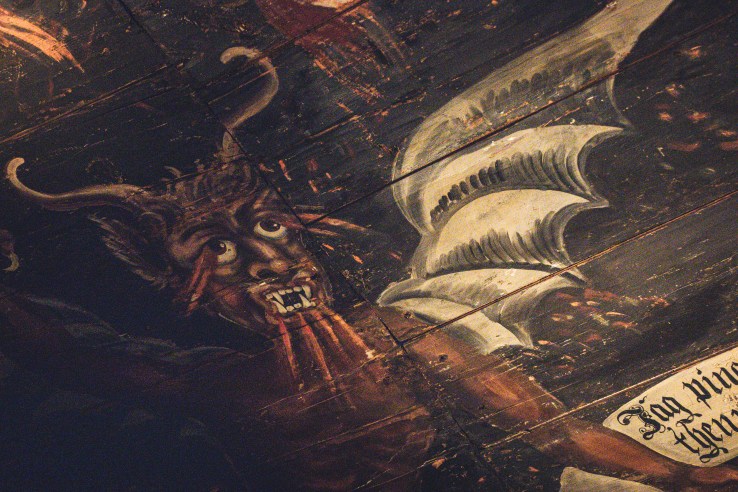
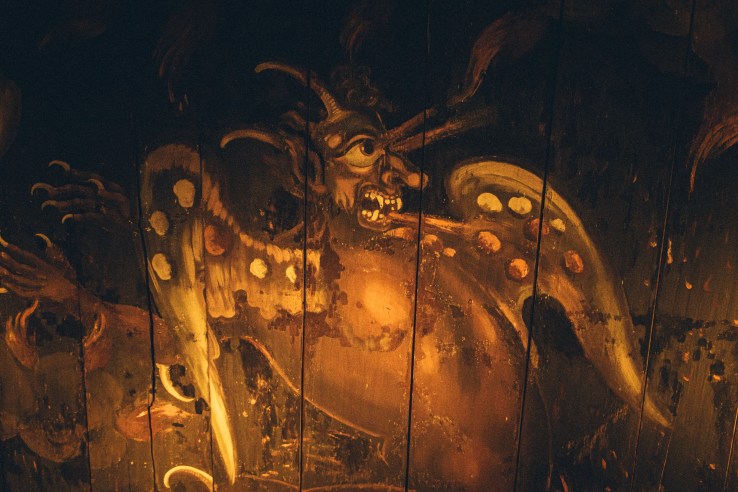
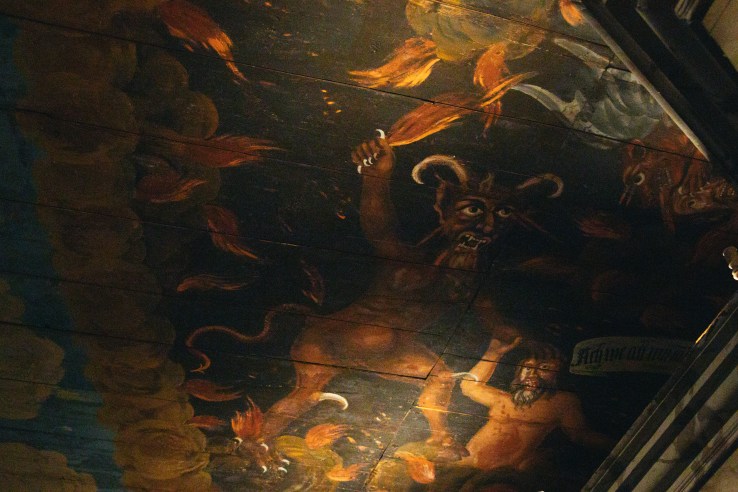
While the church was interesting, I kept my camera switched off, that was until we were making our way back out and I looked up. There was only time to snap a few shots of impressively vibrant demons before ducking back outside.
The ceiling was originally painted, with lesser diabolical depictions, in 1706 by Nicklas Berg. It was painted over (rude) between 1752 and 1753 by a man called Ditlof Ross, though you can still make out ‘echoes’ of Berg’s original work. The ceiling was whitewashed in 1869-70 during a restoration (I’d love to know who ordered that job); however, in 1930, when the church was re-consecrated due to a need for additional church spaces in Borås, the paintings were uncovered and restored. It’s been a popular church for weddings and baptisms ever since. Are you also wondering how many children have been traumatised over the years by innocently looking upwards and making eye contact with these decorative servants of Satan?
I first encountered the work of Swedish artist John Bauer as a kid. I attended a Waldorf school and was immersed in books and art inspired by Nordic nature and the folkloric beings inhabiting the landscape. A quick scan on Google suggests it may have been In The Troll Wood that snagged my ever-roving attention.
It was through discovering the music of Mortiis in 2001 that I was reintroduced to Bauer’s art. I’ve been chasing the company of shadowed pines, trolls and moose ever since. Some years ago, I wrote a piece for the website Routes North following a second pilgrimage to Bauer’s home city of Jönköping and the Jönköping Läns Museum, which houses the world’s largest collection of Bauer’s art.
Since 1995, Mortiis has used Bauer’s iconic ouroboros-inspired illustration, which first featured in Bland tomtar och troll (Among Gnomes and Trolls), a children’s anthology of stories and illustrations, in 1915. However, instead of depicting a serpent consuming its tail, Bauer’s serpent is caught in mid-attack of a sword-wielding elven knight. Mortiis has modified Bauer’s illustration throughout the years, coinciding with the eras of his music.
Mortiis has also utilised several of Bauer’s artworks for album and EP covers; for instance, the 1995 album Keiser av en dimensjon ukjent features the piece Brother Saint Martin and the Three Trolls, and the 1996 EP Stjernefødt features the artwork Guldnyckeln.
In an interview with Bardo Methodology, Mortiis explained that he didn’t know about Bauer’s art until he randomly discovered it in a Red Cross shop in Sweden. He managed to buy several framed paintings for a few euros each. I was dead set on getting the ouroboros as my first tattoo in 2007, in homage to Bauer and Mortiis. It wouldn’t be long until I regretted it though – the intricate details haven’t aged well, and the ‘great idea’ to incorporate bats into the design was an epic fail on my part.
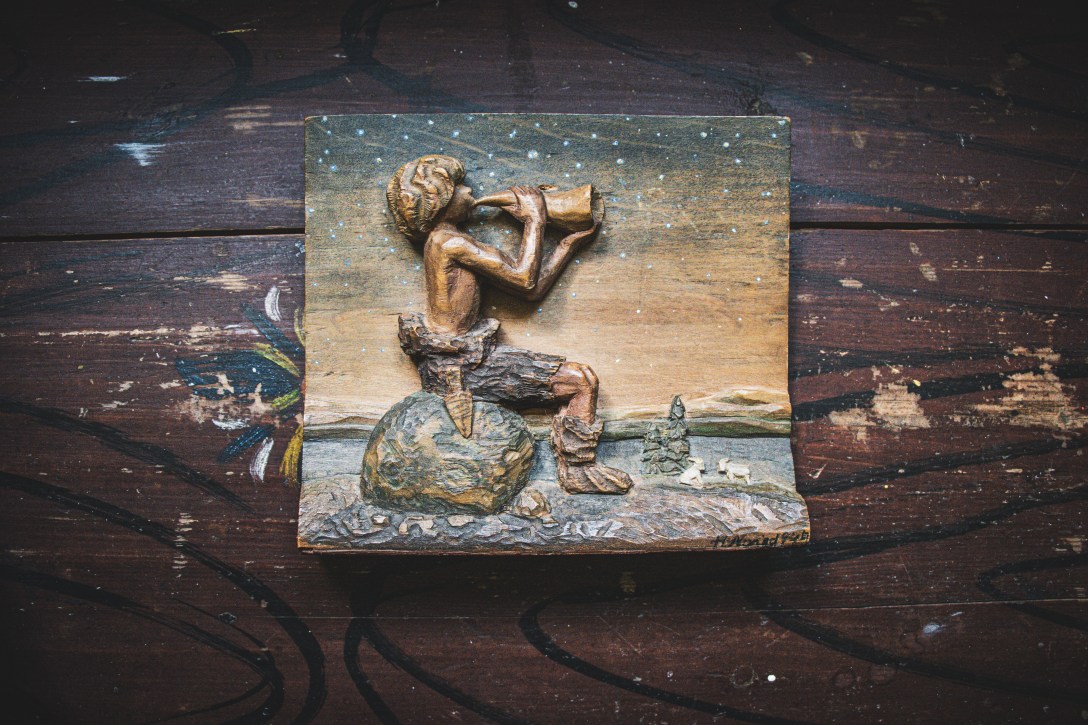
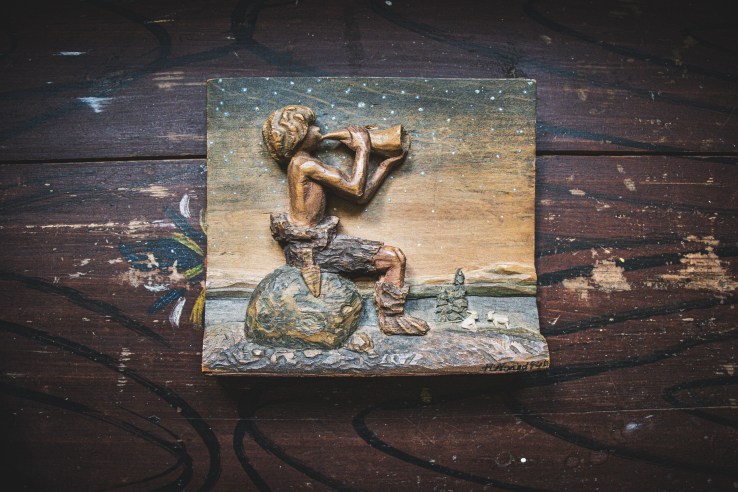
As someone deeply influenced by Bauer’s work, you can imagine how elated I was to find this painstakingly carved wooden art piece inspired by Bauer’s 1910 painting Vill Vallareman (A Fairy Shepherd) at an Airbnb I was staying at in Sweden.
When I was taking the recycling down to the bin on my final day, I saw the house owner, Maria, and asked her about the origin of the 81-year-old carving. If I’m remembering right, she said her uncle was the creator. She asked me, in an almost surprised tone, if I liked the carving. I told her I loved it. Casually and without pause, she said I could have it. Reader, my knees almost buckled.
I swaddled Vill Vallaremaneffter John Bauer like a newborn, checking on it repeatedly during my journey back to the UK, petrified it would get cracked or chipped. Blessedly, it made it back in one piece, and while I have more questions about it and its creator than I know what to do with, I’m grateful (though remain in disbelief) it’s with me. I live with the hope it’s not long until I can swaddle it up again and take it back across the sea to a forever home in a forest perhaps not too great a distance from those Bauer once wandered.
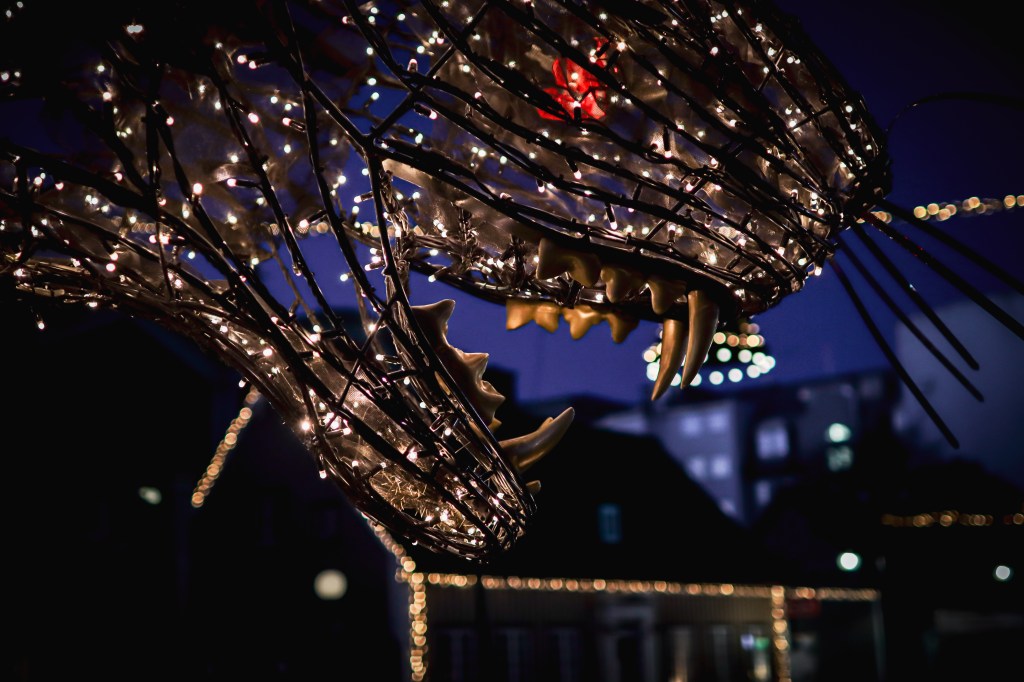
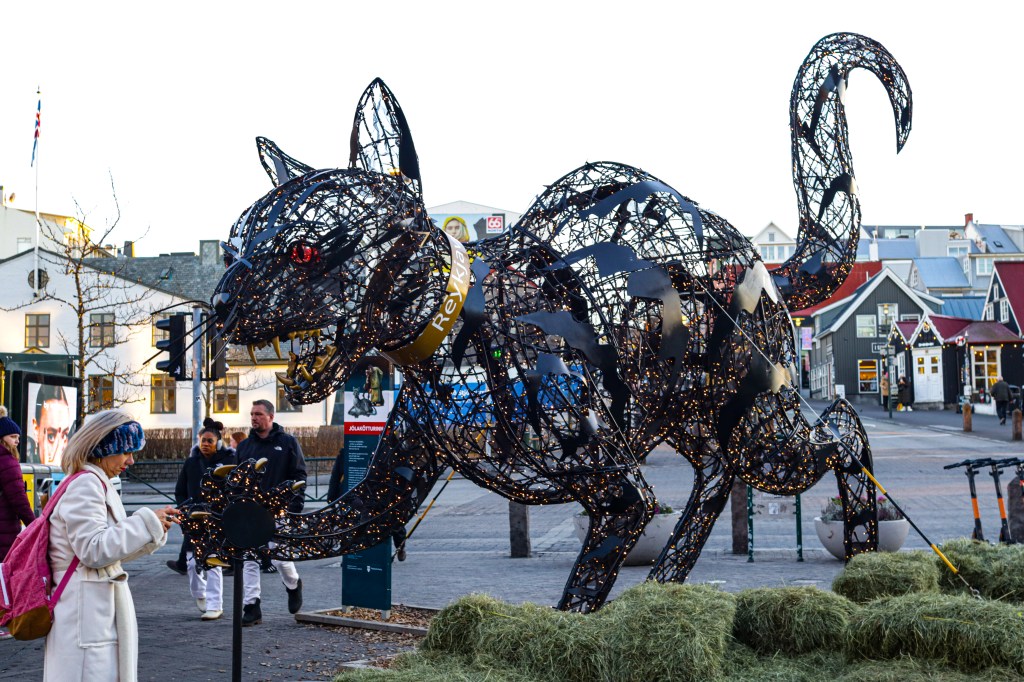
It was still dark at nine-thirty the other morning in Reykjavik (it would be well after ten before the sun shimmied up to provide the city with its scanty ration of daylight) when I bumbled outside to capture the looming Jólakötturinn (the Yule Cat) sculpture in all its ominous glory.
Every November since 2018, a five-metre-tall iron sculpture, decked out with 6,500 LED lights, depicting Gryla’s child eating floofy familiar (some attribute the inspiration for its ‘floofiness’ from the Norwegian Forest Cat) who eats children who don’t get new clothes for Jól has materialised in the centre of Reykjavik to herald in the season the traditional Icelandic way – with foreboding.
The sculpture cost the city a ‘sensible’ 4.4 million ISK and was fabricated by Austrian company MK Illumination. A garden centre owns it, and they lease it out each year to the city for a ‘steal’ at just over 3 million ISK.
Reykjavik’s Jól décor tends to be conventional, with the city reusing lights and garlands yearly. (Though I favour the cosy understatedness over most other cities I’ve seen ‘glowed up’ for Yuletide.) So, the sculpture’s arrival in 2018 was quite the talking point.
While the Yule Cat gathered much adoration (it was welcomed with a speech and a children’s choir), there was some backlash, too. One critic, Sanna Magdalena Mörtudóttir of the Socialists party, was critical of the city’s priorities and was furious the struggle of the city’s low-income families wasn’t brought up during the opening speech.
While cats have held a prominent role in Nordic society since the Viking Age, it’s unknown how long the Yule Cat has been around. Though it’s theorised he’s been prowling since the Dark Ages. We do know that he’s stalked written records since the 19th Century.
As Kathleen Hearons writes in Head Magazine, ‘Cats were the travelling companion of choice for Vikings – although not for sentimental reasons, but rather to kill mice and be skinned for their fur. Consequently, feline populations grew throughout the Nordic countries when the Vikings settled there. To this day, Reykjavik is “culturally a cat city,” according to Reykjavik Excursions. As of August 2022, there was a cat-to-human ratio of 1-to-10…‘
In bygone times, the threat of the Yule Cat would frighten children (and, without doubt, some adults) into finishing processing the autumn wool before Jól. By the Middle Ages, the export of wool from Iceland played a valuable role in the economy, and having a prosperous wool production was imperative.
Though this fear-mongering technique ensured laziness was all but eradicated in the last part of the year, it was also a superb encourager of family bonding, as everyone in the family had a role to play and would gather around the fire in the evenings to prepare yarn and knit.
In an article for the Reykjavik Grapevine, Ethnologist Árni Björnsson says, ‘After 1600, there are a lot of changes in Icelandic society. Folklore often mirrors what’s happening in society. So, it makes sense that Grýla and the yuletide lads are grimmer during this difficult time for Icelanders. In 1602, the Danes banned Iceland from trading with countries other than Denmark, and this was tough because Iceland relied on many imported goods. To make matters worse, the colder period in Iceland also sets in around 1600.
So, those things we call “jólavættir,” or supernatural beings of Christmas—including the yuletide lads, their ogress mother Grýla, and the Christmas cat—those elements were probably incorporated into the Christmas tradition to keep kids in line. Everyone was supposed to work hard to do all the things that had to be done before Christmas, and some people were lazy, you see. So it was said that if you weren’t diligent at working, the Christmas cat would come for you.’
In 1746, parents were banned by the King of Denmark from tormenting their children with stories of the Yule Cat, Gryla and her thirteen trouble-making lads as youngsters were becoming too afraid to leave their houses.
In 1932, a book was published by the poet Jóhannes úr Kötlum called Jólin koma (Christmas is Coming), and it featured a poem called Jólakötturinn which brings to life – though in the most family-friendly way – the goings about of the malicious moggy. An English translation was published in 2015 for the Icelandophiles out there.
You all know the Yule Cat
And that cat was huge indeed.
People didn’t know where he came from
Or where he went.
– The first stanza from Jólakötturinn
Following the publication of Jólin koma, the Yule Cat was, in the words of Áki Guðni Karlsson, writing for Icelandicfolklore.is ‘firmly established as part of an “old Icelandic” pantheon of Christmas beings for generations of Icelanders.’
You’ve probably encountered Bjork’s dungeon synthy musical adaptation of Kötlum’s poem at some point, though I’ve only recently discovered she wasn’t the first person to put it to music. That honour lies with the late Icelandic singer Ingibjörg Þorbergs. There’s also an exquisite version created by Icelandic folk duo Ylja.
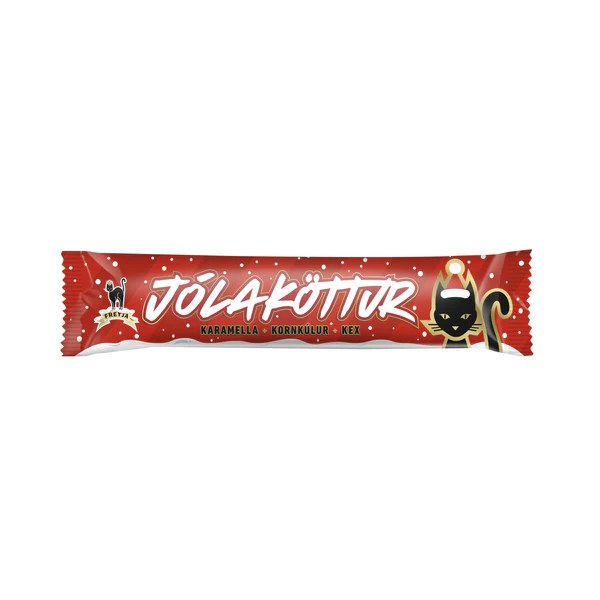
Like his mistress and her thirteen lads, the Yule Cat has long infiltrated Icelandic Christmas paraphernalia and even has his own chocolate bar, ‘Jólaköttur’ (the Christmas version of the famous chocolate bar Villiköttur), a delicious 50g beast of thick milk chocolate, caramel and biscuit all knobbled together with crisp rice.
The innovative chocolate company OmNom released a limited edition winter chocolate bar back in 2018 called Drunk Raisins + Coffee (which featured, among other things, green raisins infused with mandarin juice, cocoa beans from Tanzania, Icelandic milk and Austrian rum) in honour of the Yule Cat and in collaboration with the feral cat rescue organisation Villikettir.
On the OmNom website, Hanna Eiríksdóttir writes, ‘…stray and feral cats are neither evil nor frightening, and they definitely do not eat children. No one really knows how many cats in Iceland are feral or strays,they are thought to be in the thousands. In our minds, the Yule cat is the protector of these Icelandic stray and feral cats. The old folklore reminds us not to turn a blind eye to our little furry friends in need.’
I went back to the Yule Cat sculpture later on in the day. I saw togged-up kids catapulting themselves around in the straw pile surrounding the eternally pissed-looking puss, and now as I write this, I regret not sidling up to the parents and whispering to them, like the total weirdo I am, ‘So, do they think he eats harðfiskur now or…?’
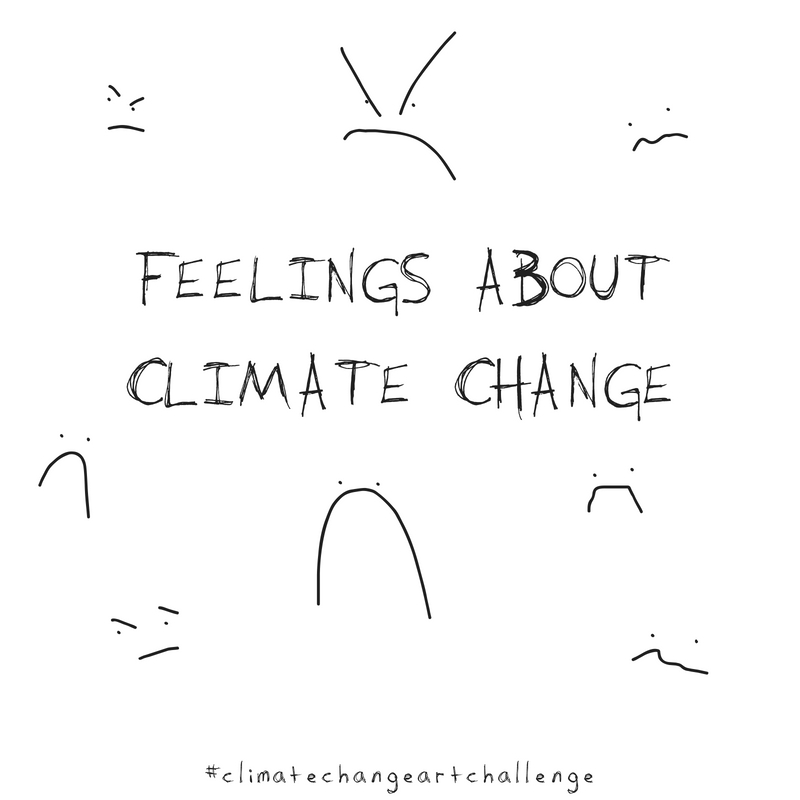
I thought it would be best for the #climatechangeartchallenge to go on indefinitely…if you want to take part, just make art whenever you have a free moment and share, share, share using #climatechangeartchallenge
This piece – along with nearly all the other art pieces – going up for sale as a print, tote bag, phone case, etc, in the MostNorthern shop.
Now, just in case you’re interested, on Patreon I have shared the text from my first children’s picture book which I was inspired to write following the catastrophic wildfires that have been burning in and around the Arctic Circle this summer.
If you’d like to read the story before anyone else, and follow the behind the scenes of the creation, hop over to Patreon where you can become a supporter of my work for just $1 a month.
One of the benefits of being a Patreon is that I will send you a copy of everything I publish. This week I’ll be sending out copies of my newest collection of poems My Father The Wendigo. You will also have a code to use in my shops to get money off any art piece you want to buy.









 Northern Fever