I first encountered the work of Swedish artist John Bauer as a kid. I attended a Waldorf school and was immersed in books and art inspired by Nordic nature and the folkloric beings inhabiting the landscape. A quick scan on Google suggests it may have been In The Troll Wood that snagged my ever-roving attention.
It was through discovering the music of Mortiis in 2001 that I was reintroduced to Bauer’s art. I’ve been chasing the company of shadowed pines, trolls and moose ever since. Some years ago, I wrote a piece for the website Routes North following a second pilgrimage to Bauer’s home city of Jönköping and the Jönköping Läns Museum, which houses the world’s largest collection of Bauer’s art.
Since 1995, Mortiis has used Bauer’s iconic ouroboros-inspired illustration, which first featured in Bland tomtar och troll (Among Gnomes and Trolls), a children’s anthology of stories and illustrations, in 1915. However, instead of depicting a serpent consuming its tail, Bauer’s serpent is caught in mid-attack of a sword-wielding elven knight. Mortiis has modified Bauer’s illustration throughout the years, coinciding with the eras of his music.
Mortiis has also utilised several of Bauer’s artworks for album and EP covers; for instance, the 1995 album Keiser av en dimensjon ukjent features the piece Brother Saint Martin and the Three Trolls, and the 1996 EP Stjernefødt features the artwork Guldnyckeln.
In an interview with Bardo Methodology, Mortiis explained that he didn’t know about Bauer’s art until he randomly discovered it in a Red Cross shop in Sweden. He managed to buy several framed paintings for a few euros each. I was dead set on getting the ouroboros as my first tattoo in 2007, in homage to Bauer and Mortiis. It wouldn’t be long until I regretted it though – the intricate details haven’t aged well, and the ‘great idea’ to incorporate bats into the design was an epic fail on my part.
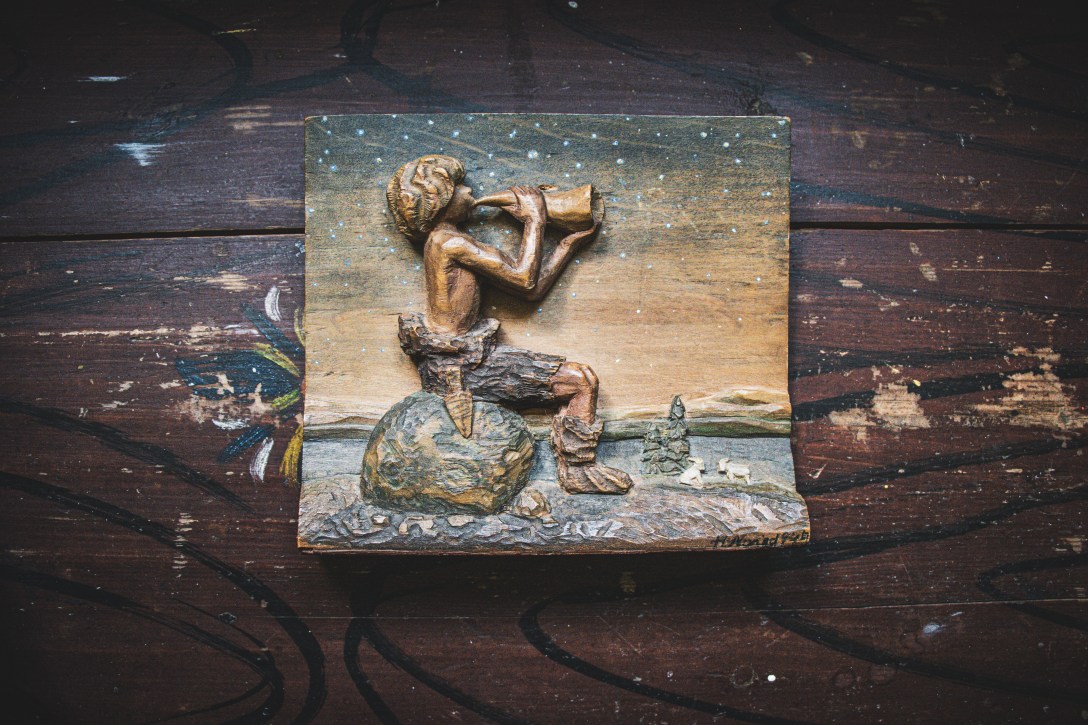
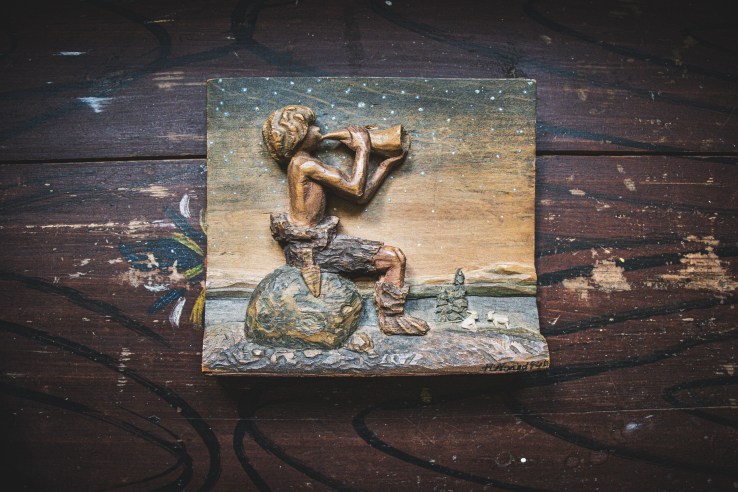
As someone deeply influenced by Bauer’s work, you can imagine how elated I was to find this painstakingly carved wooden art piece inspired by Bauer’s 1910 painting Vill Vallareman (A Fairy Shepherd) at an Airbnb I was staying at in Sweden.
When I was taking the recycling down to the bin on my final day, I saw the house owner, Maria, and asked her about the origin of the 81-year-old carving. If I’m remembering right, she said her uncle was the creator. She asked me, in an almost surprised tone, if I liked the carving. I told her I loved it. Casually and without pause, she said I could have it. Reader, my knees almost buckled.
I swaddled Vill Vallaremaneffter John Bauer like a newborn, checking on it repeatedly during my journey back to the UK, petrified it would get cracked or chipped. Blessedly, it made it back in one piece, and while I have more questions about it and its creator than I know what to do with, I’m grateful (though remain in disbelief) it’s with me. I live with the hope it’s not long until I can swaddle it up again and take it back across the sea to a forever home in a forest perhaps not too great a distance from those Bauer once wandered.
I had a beautiful comment left on my last post by a reader called Eivor, who wrote that what I’d said about the forests in Sweden resonated and that trees boost their mood and give them hope. They said they were always struck by how much they missed the trees when they were away from them, something I’m feeling ever more intensely myself these days when all I want to do is be forest wandering from sun up to sun down.
Eivor’s comment made me think of when I was living in Sweden and how lost I’d have been without the forest. I had little clue about anything when I wasn’t among the trees. I was the epitome of anxiety. In the forest, though, rambling, scrambling, slipping amidst the moss and pine, I was empowered, eager, excited. I was different from the fretful woman who would watch through the peephole before going out.
For me, the forest was my workspace and sanctuary. It was more my home than the apartment I’d return to. The forest inspired me, it nourished my exhausted soul, and, of course, it provided hope. It always provided hope.
The forest and its expanse thrilled me. I’d almost always go alone, but on the odd occasion I could show a friend my favourite haunts, I’d be giddy as a child on their birthday.
I took my camera with me most days, and while I mainly created self-portraits, I’d sometimes have a companion to shoot with. In this photo, my friend Martina is captured on a darkening autumn afternoon. Sometime after I shared it online, the Swedish-based artist Alessia Brusco @skogens.rymd.art – who I’d recently struck up a friendship with – contacted me to ask if she could recreate it in a painting.
She recreated this photo, too.
I still remember the day I took this shot and how delightedly I drank up that sunlight and then watched, rooted to the path, as the sun blazed down behind the trees and the evening crept in from all directions.
It’s been a few days since I trudged back from Scandinavia, and the withdrawal is all too real. I miss the clean air and tap water that doesn’t have a chemical aftertaste. I miss the company of the unique troop I met on my Swedish endeavour, and I miss the trees. I miss the trees a lot. Forests, especially those that stretch beyond where I can see, equip me with a sense of optimism that little else can match. There’s an uncomfortable dampness to my spirit when there isn’t a forest within sight when the trees aren’t close enough to reach out and touch.
The energy of England is troubled and distracted. There’s always an underlying tension in this country, and it’s difficult not to despair. But I’m determined to keep my renewed sense of vigour – gifted by my time in Scandinavia – alive. On this trip, I travelled to Northern Sweden to participate in Go Sollefteå, an event organised and hosted by Kalle Flodin and Sollefteå municipality.
In 2018, Kalle uprooted his life in Stockholm and moved to a sparse forest cabin in the North of Sweden to create a new life grounded in simplicity. Kalle’s videos and those of Jonna Jinton (her channel led me to Kalle’s channel) and Talasbuan (Kalle’s channel led me to their channel) regularly pour much-needed brightness and authenticity into my life. I’m one of many viewers who clutch onto the dream of having a forest home, of waking up to the rejuvenating scent of pine, and discovering moose tracks outside my front door.
It was during an ADHD burnout that I read about the Go Sollefteå event. My days were blurred together in a teary mess of trauma. Creating distressed me – my cruel inner critic shit on everything I did, which made me reluctant to work on anything at all. Eating was a chore – my diet was fuelled mainly by protein shakes. My sleep was disrupted by overthinking, nightmares and drenching night sweats. Leaving the house was an effort beyond all others. Suicidal thoughts frequently snaked through my head.
But the prospect of venturing to the sparsely populated North of Sweden – something I never did when I lived in the country – meeting the person who’d made the ‘simple cabin life’ his reality and getting to know other people ‘bound to the north’ by whatever means was too sparkling, too exhilarating, too therapeutic an opportunity not to reach out for. I submitted my application a few hours before the deadline, thinking, ‘I probably won’t get accepted…But I have to try.’
When the acceptance email came through, I teared up and scrambled to explain to my bewildered family why my mood had so suddenly and miraculously ascended from the bowels of hell.
And So To Sweden
After spending a fitful night in a converted jumbo jet parked close to Stockholm Airport, I was picked up by a lilac-haired Swede called Pernilla. She’d generously offered to pick me up on her way to Sollefteå. (She made a significant detour to get me. She doesn’t think it was that big of a deal, but it was that big of a deal.) Little did I know at the time that I was hitching a lift with a knitting phenomenon.
Pernilla and I cruised north, and five hours glided by, our chats regularly punctuated by me saying, ‘Where are the moose? I can’t believe we haven’t seen a moose yet. Do you think we’re going to see a moose?’ Pernilla told me she had seen about fifteen before she picked me up, including a mother with a calf. She’d see another one a day later close to our hotel. I’d miss it by minutes.
Almost 70% of Sweden is forest, and we drove through a good portion of that on the way to Sollefteå. Trees regulate my nervous system – they’re experts at doing so in general – and as we drove on the blissfully empty roads, I felt evermore lifted by the sight of them. I had that soothing sensation of coming home.
I’d planned to photograph the journey; I imagined myself photographing the Go Sollefteå experience from start to finish. But I didn’t. I didn’t have the energy. I was emerging from under the weighty emotional debris of my burnout. Being present in the moment was more important than trying to document it.
The main venue for the event was Hotell Hallstaberget. Built alongside one of the oldest ski slopes in Sweden, it’s been bringing together, ‘outdoor enthusiasts’ and I love this ‘fun-loving Norsemen’ since 1969.
Shortly after Pernilla and I arrived, it was time for introductions. Folk from all corners of the globe assembled in a circle and together we met Kalle, his supremely well-behaved husky Tuss and the lively, bright-eyed team behind putting the event together. It was all so easy-going, and my nerves started to dissipate. I overshared, as I have a habit of doing. But it was fine. I’m either mute, or you know my life story within minutes of meeting me for the first time; there’s no middle ground and I’m learning to accept that about myself.
Introductions were followed by an elaborate buffet dinner, after which I cornered an Australian woman called Chelsea, on her way to get a drink. She’d arrived late due to car troubles and had missed the introductions. Chelsea had moved to Sweden earlier in the year and lived on a farm with her Belgian boyfriend, Lars. ‘When I saw your profile photo on Facebook, I thought we’d get along,’ I told her, perhaps a bit too eagerly. However, my intuition was correct, and we got along as fabulously as you’d expect two neurodivergent darklings to get along.
My mood the following morning was soaring from the get-go, with the weather partly responsible because when I hauled back the curtains in my room, I was greeted with dense fog, and if you know me, you’ll know I’m quite the low-lying cloud enthusiast.
The day to come was crammed with activities: a swift, steep hike – ‘please don’t look up at the drone! – followed by a crash course in Swedish led by the sort of high-spirited folk I wish I’d met when I initially tried to root down in Sweden. Then there was fika with kanelbullar the size of my head, which I very happily and very swiftly demolished.
In the evening, we attended a yoga session led by Kalle’s neighbour and founder of Ayur Yoga, Wivi-Anne. It was perhaps the most intense and life-affirming experience of the trip. I’d been to one other yoga class in my life and I’d lasted five minutes. I stayed for the duration of this session – minus ten minutes when I went to the toilet, then couldn’t remember which room to return to.
Although I stayed until the end, I sat out most of the poses. My body was too rigid and awkward, reluctant to ease into even the most basic ones. Everything hurt. But the energy in the room was comforting, forgiving.
When the session was done, most people, myself included, were not quite ready to move from the space. The room was opened up for questions. I spoke about the realisation that I all too often forget to breathe. I talked about how my whole body hurt when I tried to follow along with the poses. I spoke about the impact of the last pose, a simple ‘hands together’ position and how it led to a single profound realisation: that I can stop apologising for being who I am.
That night my phone died – I’d left my plug adapter behind in Stockholm – so I didn’t get the message that the aurora borealis was out and dancing ecstatically in the skies above Sollefteå.
There was some confusion the next day, and I missed the second hike. So, I took myself off on my own. The hike the day before had been fun but fast paced because of scheduling. There hadn’t been the chance to get close to the forest. Well, not for me anyway, who didn’t have the gazelle-like agility and fitness of other group members.
I took the opportunity this time around to get close and spent some blissful hours appreciating mushrooms, bluebells and lichen. I watched a fox for a while, and the fox watched me. I acknowledged the croak of a solitary raven as it flew over my head and took it as a sign that this was how it was supposed to be – that I needed to soak myself in the preciousness of this experience.
Pernilla and I scoured thrift stores in the afternoon. (There was the option to look at houses for sale, but I’ve got a long way to go before I can even think of the possibility of buying something anywhere.) I narrowly missed out on scoring a pair of Fjällräven trousers. Dinner that night was a cosy, candle-lit affair in a wooden round house with Mexican inspired cuisine, as is tradition on a weekend in Sweden. There was also liquorice so thickly doused with salt that it was inedible for all but a dauntless few.
The following day, we said our goodbyes after breakfast. I lingered in Sollefteå for the rest of the day, not wanting to accept that it was over but humungously grateful for the experience and humbled by it.
I needed to repair my relationship with Sweden – there’s much trauma associated with the time I spent living there – and this trip went above and beyond in helping me do that. One of my anxieties had been about being captured on camera, and I faced this fear as fully as I possibly could. I’ve come away feeling I’ve crossed paths with some of the most thoughtful, generous, honest, creative and positive people that I’ve ever met. And even if I don’t look like I am in the photo, and despite all the unknowns that scare the shit out of me, I’m inspired, invigorated and ready for whatever’s coming next.
In 2017 I found myself hooked on the Netflix show Chef’s Table. Each beautifully shot episode focuses on one of the world’s top chefs and their (often tumultuous) rise to success. I don’t watch TV as a habit, and when I do tune in, the show has to be something that’s going to enrich my life. Chef’s Table did exactly that. Though one episode more so than others – the episode about Swedish chef, forager, hunter, and gardener Magnus Nilsson and Fäviken – one of the world’s best and most isolated restaurants.
Photo : Per-Anders Jörgensen
After just ten minutes, my heart rate was quickening with excitement, and I scribbled ‘eat at Fäviken’ on my list of ‘Things To Do In The Nordics Before I Die.’ Being who I am, a woman with a northern fever, I developed something of an obsession with this little place deep in the forests of Jämtland, and the food grown (more than half of the food diners eat at Fäviken has been grown, found or hunted in the 20,000 acres of grounds), prepared and served there.
Photo: Erik Olsson
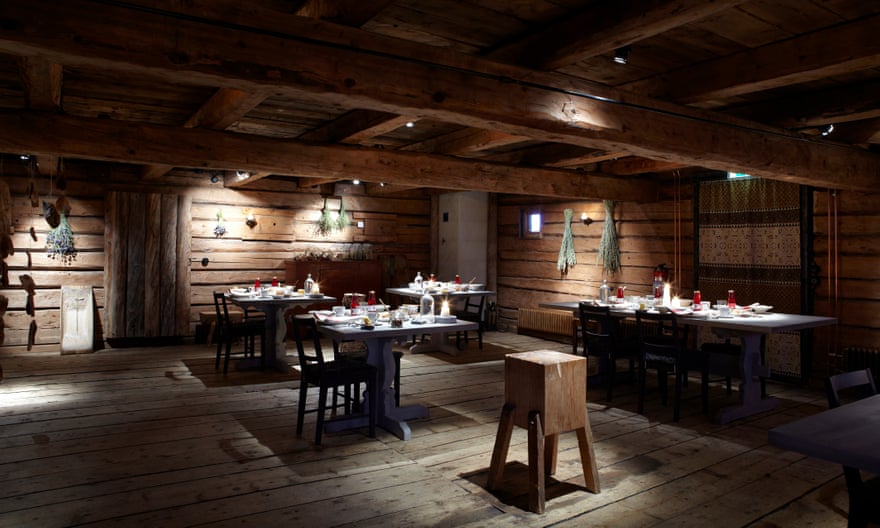
Following seasonal variations is at the heart of what Nilsson does at the 16 seat restaurant, as is keeping things rustic – the dining room is located in an old barn and is decorated with a full-length fur coat on the wall and aged cuts of meat hung from the ceiling.
Whatever is available on the day – be it carrots harvested several months ago or fish that was pulled from the river that morning – is served up as a theatrical 32-course extravaganza.
The methods Nilsson uses to prepare his menu include vegetables smoked using decomposing leaves, warm marrowbone extracted from a cow’s shinbone using a two-man saw and ice cream churned in a creaky wooden ice cream maker from the 1920s. Nilsson purposefully doesn’t take great care of the machine, as the noise it makes enhances the Fäviken experience.
We do things as they have always been done at Jämtland mountain farms; we follow seasonal variations and our existing traditions. We live alongside the community.
During the summer and autumn, we harvest what grows on our land as it reaches the peak of ripeness, and prepare it using methods we have rediscovered from rich traditions, or that we have created through our own research to maintain the highest quality of the end product.
We build up our stores ahead of the dark winter months. We dry, salt, jelly, pickle and bottle. The hunting season starts after the harvest and is an important time, when we take advantage of the exceptional bounty with which the mountains provide us. By the time spring and summer return to Jämtland, the cupboard is bare and the cycle begins again.
– Magnus Nilsson
I can remember the day after I watched Chef’s Table. I went to my Swedish class and, instead of doing online study with a Swedish language app, I sneakily waded through all of the interviews and reviews of Fäviken that I could find. I wanted to know everything. When I discovered that Nilsson had written a Fäviken cookbook, it took all of my will power not to skip class and power to the library.
An image from the cookbook.
When school was over, I practically flew to the library and went immediately to the food section, panicking that someone else would have been as enchanted about Fäviken as I had been and would have got there first. But they hadn’t. And when I found it I nearly cried. I opened it up at random and landed on a page where one of his signature dishes shone back at me – a single scallop that’s been poached in its own juices and served in a huge shell on top of a bed of moss and smouldering juniper branches. I hugged the book to my chest and hurried home to read.
Photo : Erik Olsson
I dove into the Fäviken cookbook with an enthusiasm that I’ve never before felt for any book about food. And it didn’t disappoint. The sumptuous narrative about one of Sweden’s most special places kept giving and giving and giving. As well as being a chef with the world in the palm of his hand, Magnus Nilsson can also write extraordinarily well. This isn’t just a cookbook with recipes – but oh friends, what recipes they are! – it’s a beautiful tale about a wondrous restaurant and the people and wild things that make it what it is.
Photo : Erik Olsson
Time has passed since I first heard about Fäviken and relished the cookbook (Nilsson has also written The Nordic Cookbook, a humongous tome that records the past several hundred years of Nordic cooking and contains a whopping 730 recipes), but I’ve missed my chance to eat there. I will die without having eaten at Fäviken.
Photo : Erik Olsson
You see, Fäviken shall, by the end of this year, be no more. The other day on Instagram, a post popped up from Nilsson about how this year the restaurant will close and it will never open again. He waited until the restaurant was fully booked for the year before announcing the closure. Nilsson has given one interview about the closure – to the LA Times – and that’s it.
Now, while it might seem a tad dramatic, I do feel this real sense of loss. I never doubted that I would, one day, be eating 32 courses at a barn in the far north of Sweden. But I don’t intend for my dream to die entirely…I’ll be going back to the cookbook with the goal of making every damn recipe in it.
Iceland’s relationship with books is one that, as a writer and bibliophile, has me in tears. I could move to the the land of ice and fire quite happily based solely on how passionate everyone is about literature.
It’s estimated that 1 in 10 Icelanders will write a book in their lifetime and the small, Nordic country has more writers, more books published and more books read than anywhere else in the world.
It came as no surprise to learn Iceland has a special celebration for books, one which practically the whole country participates in. It’s called jólabókaflóð which translates to the ‘Christmas Book Flood.’
The celebration actually begins in September, when the Icelandic Book Association posts a book catalogue to every home in Iceland. (The catalogue is called Bókatíðindi and you can browse this year’s edition here if you would like.)
So, from September onward there’s a book buying hysteria in Iceland, which culminates on Christmas Eve when people gift each other the books they’ve been frantically buying. The rest of the evening is then spent reading. I can’t think of anything more perfect than that.
I believe so strongly that we need to be more Icelandic when it comes to our relationship with books, that I’ve put together a list of northerly reads to inspire your own jólabókaflóð.
Icelanders give paperback books on Christmas Eve, but the ones I’ve listed here are all available on Amazon Kindle, so you can have them pretty much instantly to read. If you don’t have a Kindle, (I don’t) no stress, you can download the FREE Kindle app here for IOS, Android, Mac and PC.
Happy reading!
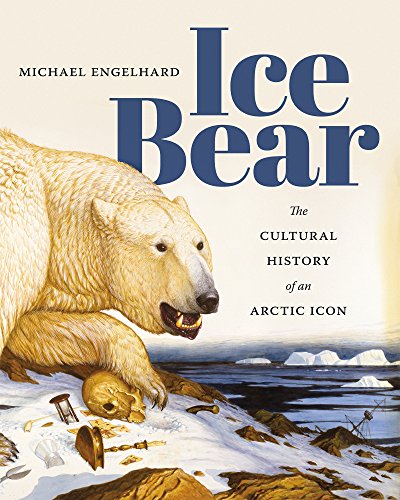
Ice Bear By Michael Engelhard
I’ve been wanting to read Ice Bear ever since it popped up on Amazon as a recommended read a month or so ago.
While it’s the priciest book on this list, with the Kindle Edition coming in at a hefty £15.21 if you’re invested in deepening your knowledge of this most important and beautiful species, it’s entirely worth it.
“From Inuit shamans to Jean Harlow lounging on a bearskin rug, from the cubs trained to pull sleds toward the North Pole to “cuddly” superstar Knut, it all comes to life in these pages.
With meticulous research and more than 160 illustrations, the author brings into focus this powerful and elusive animal. Doing so, he delves into the stories we tell about Nature–and about ourselves–hoping for a future in which such tales still matter.” – Amazon.
Dark Matter is one of my all-time favourite books, and I featured it in my Top Ten Ten Books About The North list back in February. It’s a gloriously creepy ghost story set in the High Arctic and it leaves no nerve unturned.
For years I longed for a book like Dark Matter and when it came along, it was everything I wanted and more. There’s a really good reason this book has nearly 400 reviews on Amazon and almost a full 5 stars. If you choose Dark Matter, you’ll be up all night reading, I promise.
‘January 1937. Clouds of war are gathering over a fogbound London. Twenty-eight year old Jack is poor, lonely and desperate to change his life. So when he’s offered the chance to join an Arctic expedition, he jumps at it. Spirits are high as the ship leaves Norway: five men and eight huskies, crossing the Barents Sea by the light of the midnight sun. At last they reach the remote, uninhabited bay where they will camp for the next year. Gruhuken.
But the Arctic summer is brief. As night returns to claim the land, Jack feels a creeping unease. One by one, his companions are forced to leave. He faces a stark choice. Stay or go. Soon he will see the last of the sun, as the polar night engulfs the camp in months of darkness. Soon he will reach the point of no return – when the sea will freeze, making escape impossible.
And Gruhuken is not uninhabited. Jack is not alone. Something walks there in the dark…’ – Amazon
The Nordic Theory Of Everything is another book I’ve been longing to read, and now that it’s available on Kindle for 99p I’ll be delving into it this Christmas eve. Since living in Sweden, it’s come to my attention that, actually, not everything is as rosy as the majority of literature out there would lead you to believe…so it’ll be really interesting to read, reflect and no doubt debate the theories within its 432 pages, even if I’m outnumbered 10 to 1 this Christmas time.
‘From childcare to healthcare provision for the elderly and tackling issues of homelessness, the Nordic countries are world leaders in organising society – no wonder Finland has been ranked among the happiest places in the world.
But when Finnish journalist Anu Partanen moved to America, she quickly realised that navigating the basics of everyday life was overly complicated compared to how society was organised in her homeland. From the complications of buying a mobile, to the arduous task of filing taxes, she knew there was a better way and as she got to know her new neighbours she discovered that they too shared her deep apprehensions.
The Nordic Theory of Everything details Partanen’s mission to understand why America (and much of the Western world) suffers from so much inequality and struggling social services. Filled with fascinating insights, advice and practical solutions, she makes a convincing argument that we can rebuild society, rekindle optimism and become more autonomous people by following in the footsteps of our neighbours to the North.’ – Amazon
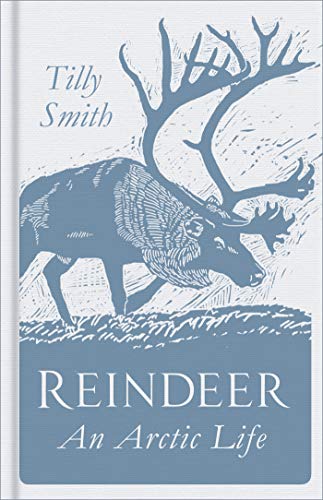
I saw the cover of this book and thought to myself, ‘if I don’t enjoy this, I’m going to be really disappointed.’ I needn’t have worried though, as I took advantage of the ‘Look Inside’ feature on Amazon, had a read of a few pages and knew it was going to be a beautiful, captivating and enlightenment little read, from which I’d come away from a more learned and inspired reindeer obsessive.
‘In this enchanting book, Tilly Smith leads the reader through the cold and extraordinary natural history of the reindeer.
A creature that is often used to adorn the winter season, the reindeer has been domesticated in Eurasia for longer than the horse while in North America it exists side by side with the humans, never tamed yet vital to the native settlements.
Despite the popularity of the image of the reindeer, they are rarely seen in real life.
This beautiful, comforting little book, peppered with anecdotes about the author’s own herd, is sure to kindle affection for one of nature’s most adaptable mammals, from fur-covered hooves to downy antlers.’ – The History Press
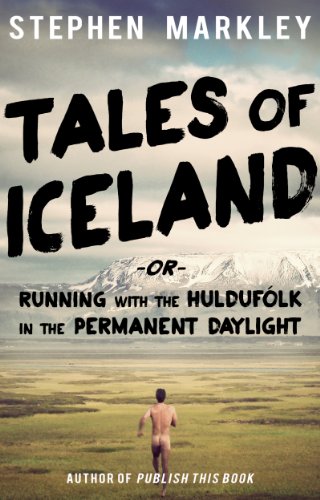
Tales Of Iceland Or Running With The Huldefolk In The Permanent Daylight By Stephen Markley
While I’ve read (very) mixed reviews about this ‘fast, fun, educational and true story’ written by a journalist from Chicago who went to Iceland with his two friends, one of whom, Matthew Trinetti, is the main character in the book, it intrigued the hell out of me. And, seen as though I can get it free on Kindle Unlimited (if you don’t have Kindle Unlimited, get it. Seriously. It’s brilliant.) I thought why not.
‘When American author Stephen Markley was a fresh-faced, impressionable university student in Ohio, he saw Quentin Tarantino describe a trip he’d taken to Iceland.
“Supermodels working at McDonald’s,” said Tarantino of the Icelandic. Markley never forgot those words.
Seven years later, Markley set out with two friends for Iceland, and adventure would ensue. The three young men found a country straddling Europe and North America, recovering from its 2008 economic crisis, struggling to regain its national identity, influenced by the entire globe yet trafficking in its singular Icelandic sagas and legends.
With Tales of Iceland, Markley delivers the fastest, funniest memoir and travelogue of an American experience in Iceland.
Beware: You will NOT learn how to say “Which way to the potato farm” in the Icelandic language. Nor will you learn how to locate the finest dining options in Reykjavik, or the best opera house. This is not that kind of travel book. Markley and his two irrepressible twenty-something American pals do not like opera, had no money to eat much besides eggs and skyr, and learned only how to say “Skál!” “Takk,” and “Skyr.” – Amazon
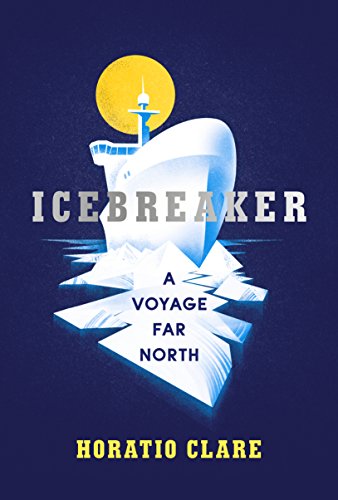
I only found out about this book and it’s author Horatio Clare today, but this book is on my ‘must read before the end of 2018 list.’
‘We are celebrating a hundred years since independence this year: how would you like to travel on a government icebreaker?’
A message from the Finnish embassy launches Horatio Clare on a voyage around an extraordinary country and an unearthly place, the frozen Bay of Bothnia, just short of the Arctic circle. Travelling with the crew of Icebreaker Otso, Horatio, whose last adventure saw him embedded on Maersk container vessels for the bestseller Down to the Sea in Ships, discovers stories of Finland, of her mariners and of ice.
Finland is an enigmatic place, famous for its educational miracle, healthcare and gender equality – as well as Nokia, Angry Birds, saunas, questionable cuisine and deep taciturnity. Aboard Otso Horatio gets to know the men who make up her crew, and explores Finland’s history and character. Surrounded by the extraordinary colours and conditions of a frozen sea, he also comes to understand something of the complexity and fragile beauty of ice, a near-miraculous substance which cools the planet, gives the stars their twinkle and which may hold all our futures in its crystals.’ – Amazon








 the High Arctic and it leaves no nerve unturned.
 Northern Fever