Grýla – The Child-Eating Ogress of Christmas (And a poem about her)

I initially wrote about Iceland’s child-eating ogress of Christmas in 2009, two years before I even set foot on the island. It was a mild, one-page poem for university which featured in my first poetry collection. 

But Grýla never strayed far from my consciousness, so I wrote another poem about her for my upcoming collection themed on winter in Iceland. And it’s considerably more unsettling than the one I penned while still a fledgling poet. 

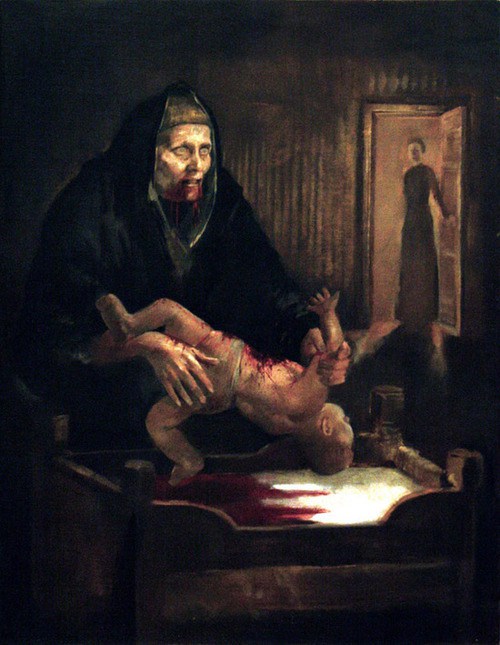
Of all the creepy Nordic folkloric beings, Grýla is, without doubt, one of THE creepiest, with her insatiable appetite for the flesh of children. Another aspect of her legend which unnerves me, and really quite profoundly, is the reaction parents were said to have about her eating their kids. Basically, they accepted it as a fact of life, something which Þrándur Þórarinsson illustrated brilliantly in his chilling painting. 

I’ll readily admit that until recently, I thought this painting was OLD, so old I was confident it would be within the public domain. But it isn’t old. Not at all. Þórarinsson was born in 1978.

When a photograph of the then relatively unknown (outside of Iceland) painting was put online in 2009, it went viral and was viewed by 620,000 people thereabouts in a single day. I wouldn’t be surprised if, nowadays, it’s the best-known image of Grýla on the web.

Another artwork that depicts her in a most gloriously grim way is this inked piece* by Norwegian artist Kim Holm.

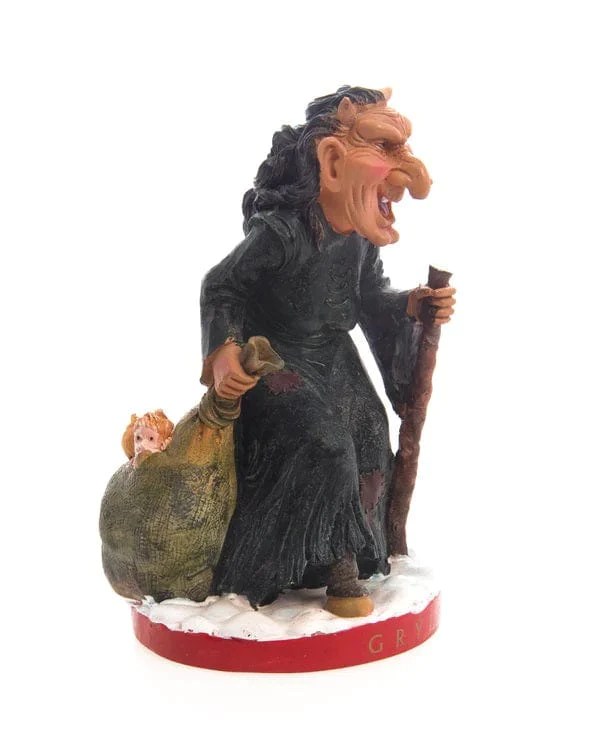
Grýla has a ‘special’ place in the hearts of Icelanders, and I’ve spoken to several about how genuinely scared they were as kids that Grýla would turn up at their home, abduct them and haul them away to the mountains where they’d end up being boiled alive in her cauldron. Though she seems to be ‘much tamer’ these years and is known mainly for being the mother of the Yule Lads. Though some keep the legend alive, as with this popular Icelandic Store sculpture of her, gleefully dragging her sack of children.
But Grýla hasn’t always been associated with Christmas. The first mentions of her appeared in The Saga of Icelanders and Sverris Saga, both 13th-century texts. She would only become connected to the festive season in the 17th Century through the Poem of Grýla.

How Grýla looks depends on who you ask, though 300 heads, fifteen tails, claws and cloven hooves are usually mentioned. Sometimes, she has a beard, sometimes she has horns. Though if you ask whoever directed the episode of Sabrina The Teenage Witch that featured Grýla, she’s quite the babe and, from what I understand about the episode (I’ve never seen it), only eats one child.

But are kids still scared of Grýla today? There is a story going around Iceland that she died of starvation. But not every parent goes along with it. The headmaster of the Elf School (an institution based in Reykjavik, devoted to Icelandic folklore), Magnus H. Skarphedinsson, told Vice in 2017 that he called home and pranked his daughter by pretending to be a Yule Lad. 

He told her his mother, Grýla, was furious with her for being badly behaved. After that phone call, his daughter hid under her bed and you can guess the rest.

Terry Gunnell, a professor in Folkloristics at the University of Iceland, said in a Smithsonian Magazine article that Grýla was ‘…a personification of the winter and the darkness and the snow getting closer and taking over the land again…’ Grýla represented the threat of winter and controlled the landscape, which, way back when, the Icelandic people believed they were only ‘tenants’ of. ‘You don’t mess with Grýla,’ Gunnell went on to say. ‘She rules the roost up in the mountains.’

Below, you’ll find my poem, Grýla. I hope it does what it’s supposed to and harks back to the days when the child-eating ogress of Iceland still chilled the blood of children when Christmas came around, and they weren’t sure if they’d been well enough behaved not to be taken from their beds and boiled up for stew.

Gryla

There's not one man, woman or child 
on this sterile, far-flung isle whose smile
doesn't waver at the growl of my name.

Generations of wicked children have pleaded
to uproot from houses they were born to,
bed down Skyr pale limbs and buttery heads
in places no one roams but the dead.

Pity those young minds that don't comprehend
- nowhere is safe from me.

I said, nowhere is safe from me.

Even the aged, with their crumbled minds,
and murk-filled, frightened eyes, remember Grýla.

They shit in their clothes saved for Jól,
and piss in their soft chairs and beds.

The stench overpowers the lamb and cardamom,
festivities are disrupted with thin cries for help.

Hjálpaðu mér mamma, Grýla kemur!
Help me mamma, Grýla is coming!

But their mammas are gone long ago,
their rib bones timber for Huldufólk homes.

The flames beneath my cauldron were spitting
well before Snorri dashed ink on calf vellum.

I've been watching this unclad land as long as Esja has.

Above my head, it's cooled lava dark.
Below, Reykjavík sparkles like a whore
who has stolen every star.

I remember turf houses. How easily I could
make those soft walls fall, pluck up children
crawling between the debris.

Now, I run my claws against corrugated iron walls.
This time of year, children's ears are the keenest.
They hear the slow and steady clattering
from several streets away.

Some parents appreciate my coming.
Many have seen me take their offspring.
It's how life is; I often hear them thinking.

Last Jól, a child said to me you're not real.

Boy, I replied, you're about to die in my hands,
and I'll see to it your skin is flayed off and tanned.

Then I lowered my mouth over his bobbing head,
chomped through his bird bone neck,
stuffed him, headless and silent, into my sack.

I always need a thread to sew Leppalúði's socks.
I need girls with long hair, though, if I don't take enough,
tendons do the job almost as well.

Tonight, children are waiting in terrible silence.

Some whisper, Grýla, we hail you, clutch lava stone effigies
of me, hoping I'll pass by, gift them more time.

This year, there's an odd little child,
a child so very…other.

He's gone so far as to scratch HAIL GRÝLA
on the floorboards beneath his bed.

I can read the startling thoughts he has
tied so neatly in his head.

He wants to join me, trail my gory path,
stir to the great depths of my cauldron, taste
his schoolmate's meat, pick splinters of their bones
from between his fence-like teeth.

He wants to run about after my lads,
become known for creating carnage of his own.

He wants to dig out the crusted human blood
stuck between my cat's sweet toe pads.

He's waiting in a white house
within sight of Hallgrímskirkja.

He's waiting to hear my hooves on stone,
my claws on iron. He's waiting for my face
to loom around the door to his room where he sits,
quiet as a lamb, hands in lap, patient as can be.

He'll drop to his knees. There'll be no dread,
no fear, not even a shred.

I'll beckon for him to follow me out.
Reykjavík's foundations will quake as we walk.

With my forefingers and thumbs,
I'll pinch out each maddening light.

I'll bring Jól to an end and greet again
the merciless Icelandic winter night.

*I used this artwork as the front cover for my pamphlet The Darkest Days which features my Grýla poem along with work about Jack Frost and Swiftrunner.

Related: Art of Grýla

The Christmas Cat Of Iceland

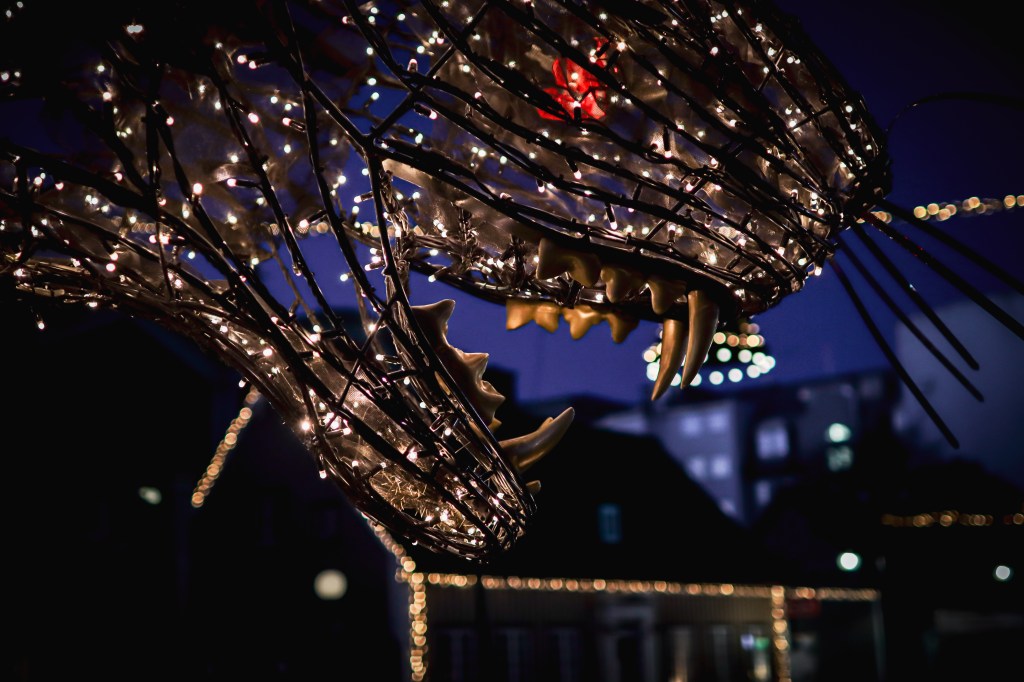
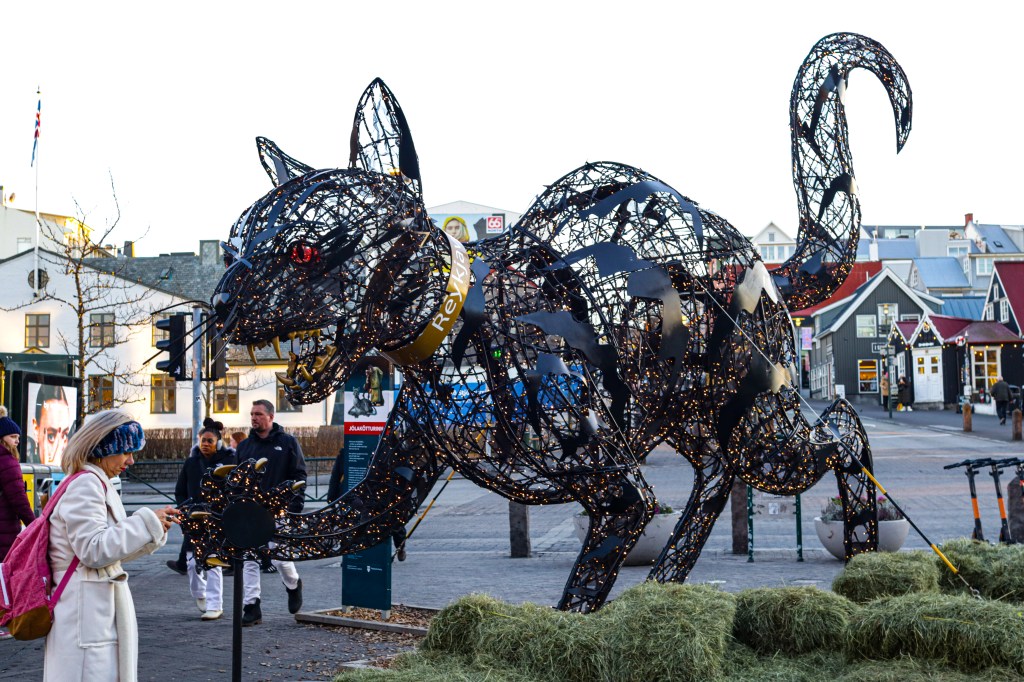
It was still dark at nine-thirty the other morning in Reykjavik (it would be well after ten before the sun shimmied up to provide the city with its scanty ration of daylight) when I bumbled outside to capture the looming Jólakötturinn (the Yule Cat) sculpture in all its ominous glory. 

Every November since 2018, a five-metre-tall iron sculpture, decked out with 6,500 LED lights, depicting Gryla’s child eating floofy familiar (some attribute the inspiration for its ‘floofiness’ from the Norwegian Forest Cat) who eats children who don’t get new clothes for Jól has materialised in the centre of Reykjavik to herald in the season the traditional Icelandic way – with foreboding.  

The sculpture cost the city a ‘sensible’ 4.4 million ISK and was fabricated by Austrian company MK Illumination. A garden centre owns it, and they lease it out each year to the city for a ‘steal’ at just over 3 million ISK.

Reykjavik’s Jól décor tends to be conventional, with the city reusing lights and garlands yearly. (Though I favour the cosy understatedness over most other cities I’ve seen ‘glowed up’ for Yuletide.) So, the sculpture’s arrival in 2018 was quite the talking point.

While the Yule Cat gathered much adoration (it was welcomed with a speech and a children’s choir), there was some backlash, too. One critic, Sanna Magdalena Mörtudóttir of the Socialists party, was critical of the city’s priorities and was furious the struggle of the city’s low-income families wasn’t brought up during the opening speech. 

While cats have held a prominent role in Nordic society since the Viking Age, it’s unknown how long the Yule Cat has been around. Though it’s theorised he’s been prowling since the Dark Ages. We do know that he’s stalked written records since the 19th Century. 

As Kathleen Hearons writes in Head Magazine, ‘Cats were the travelling companion of choice for Vikings – although not for sentimental reasons, but rather to kill mice and be skinned for their fur. Consequently, feline populations grew throughout the Nordic countries when the Vikings settled there. To this day, Reykjavik is “culturally a cat city,” according to Reykjavik Excursions. As of August 2022, there was a cat-to-human ratio of 1-to-10…

In bygone times, the threat of the Yule Cat would frighten children (and, without doubt, some adults) into finishing processing the autumn wool before Jól. By the Middle Ages, the export of wool from Iceland played a valuable role in the economy, and having a prosperous wool production was imperative. 

Though this fear-mongering technique ensured laziness was all but eradicated in the last part of the year, it was also a superb encourager of family bonding, as everyone in the family had a role to play and would gather around the fire in the evenings to prepare yarn and knit.

In an article for the Reykjavik Grapevine, Ethnologist Árni Björnsson says, ‘After 1600, there are a lot of changes in Icelandic society. Folklore often mirrors what’s happening in society. So, it makes sense that Grýla and the yuletide lads are grimmer during this difficult time for Icelanders. In 1602, the Danes banned Iceland from trading with countries other than Denmark, and this was tough because Iceland relied on many imported goods. To make matters worse, the colder period in Iceland also sets in around 1600.

 So, those things we call “jólavættir,” or supernatural beings of Christmas—including the yuletide lads, their ogress mother Grýla, and the Christmas cat—those elements were probably incorporated into the Christmas tradition to keep kids in line. Everyone was supposed to work hard to do all the things that had to be done before Christmas, and some people were lazy, you see. So it was said that if you weren’t diligent at working, the Christmas cat would come for you.’ 

In 1746, parents were banned by the King of Denmark from tormenting their children with stories of the Yule Cat, Gryla and her thirteen trouble-making lads as youngsters were becoming too afraid to leave their houses.

In 1932, a book was published by the poet Jóhannes úr Kötlum called Jólin koma (Christmas is Coming), and it featured a poem called Jólakötturinn which brings to life – though in the most family-friendly way – the goings about of the malicious moggy. An English translation was published in 2015 for the Icelandophiles out there. 

You all know the Yule Cat

And that cat was huge indeed.

People didn’t know where he came from

Or where he went.

– The first stanza from Jólakötturinn

Following the publication of Jólin koma, the Yule Cat was, in the words of Áki Guðni Karlsson, writing for Icelandicfolklore.is ‘firmly established as part of an “old Icelandic” pantheon of Christmas beings for generations of Icelanders.’

You’ve probably encountered Bjork’s dungeon synthy musical adaptation of Kötlum’s poem at some point, though I’ve only recently discovered she wasn’t the first person to put it to music. That honour lies with the late Icelandic singer Ingibjörg Þorbergs. There’s also an exquisite version created by Icelandic folk duo Ylja. 

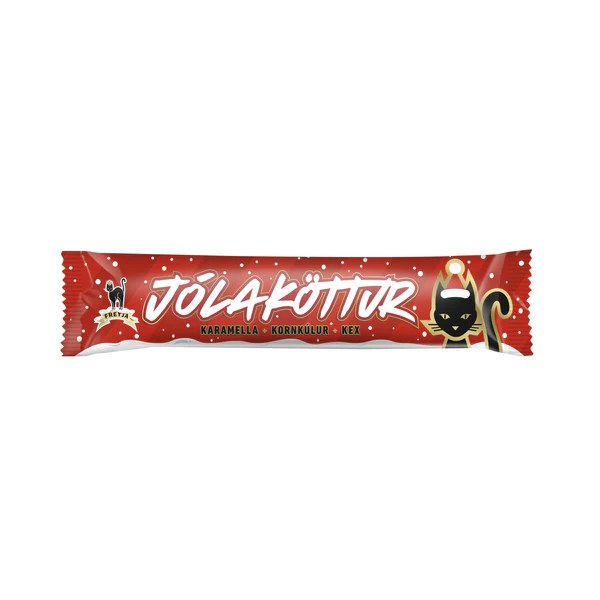
Like his mistress and her thirteen lads, the Yule Cat has long infiltrated Icelandic Christmas paraphernalia and even has his own chocolate bar, ‘Jólaköttur’ (the Christmas version of the famous chocolate bar Villiköttur), a delicious 50g beast of thick milk chocolate, caramel and biscuit all knobbled together with crisp rice.

The innovative chocolate company OmNom released a limited edition winter chocolate bar back in 2018 called Drunk Raisins + Coffee (which featured, among other things, green raisins infused with mandarin juice, cocoa beans from Tanzania, Icelandic milk and Austrian rum) in honour of the Yule Cat and in collaboration with the feral cat rescue organisation Villikettir.

On the OmNom website, Hanna Eiríksdóttir writes, ‘…stray and feral cats are neither evil nor frightening, and they definitely do not eat children. No one really knows how many cats in Iceland are feral or strays,they are thought to be in the thousands. In our minds, the Yule cat is the protector of these Icelandic stray and feral cats. The old folklore reminds us not to turn a blind eye to our little furry friends in need.’

I went back to the Yule Cat sculpture later on in the day. I saw togged-up kids catapulting themselves around in the straw pile surrounding the eternally pissed-looking puss, and now as I write this, I regret not sidling up to the parents and whispering to them, like the total weirdo I am, ‘So, do they think he eats harðfiskur now or…?’ 

What Is A Bunad?

On my first excursion to Norway in 2008, I arrived in Oslo in the very early hours of Syttende Mai, Norway’s National Day. After sleeping for a couple of hours – I was too revved up for more than that – I staggered outside and into the company of thousands of Norwegians, who’d journeyed the length and breadth of their homeland, to congregate in the capital and celebrate their country’s independence.

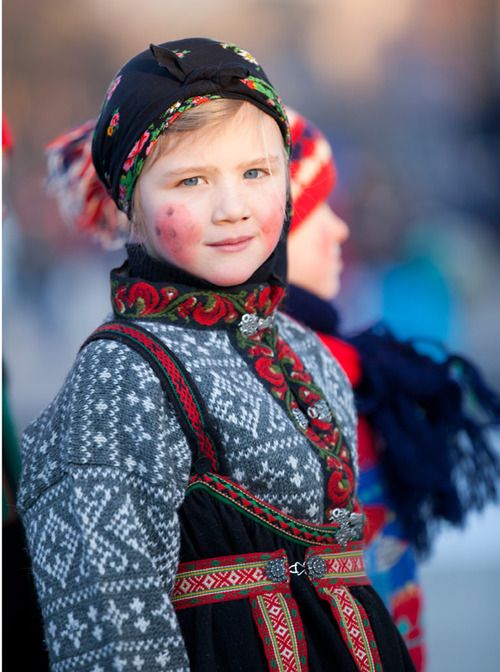
No matter which way I swivelled my head, I got an eyeful of bunad, Norway’s national costume. I’m sure I was unintentionally captured in family photographs snapped in front of the Royal Palace, wide-eyed, slack-jawed, bedecked in a Burzum shirt and a black leather jacket, looking laughably out of place amidst the radiant bunad wearers.

When someone puts on a bunad, it would seem magic happens. A bunad has the potential to transform a typically demure person into someone unrecognizably exuberant. It brings about shared feelings of togetherness, elation and pride. When I saw my first bunad, it pretty much immediatly shifted my dogged mindset – I used to recoil at the idea of wearing anything that wasn’t black – and left me with a hankering for one of my own.

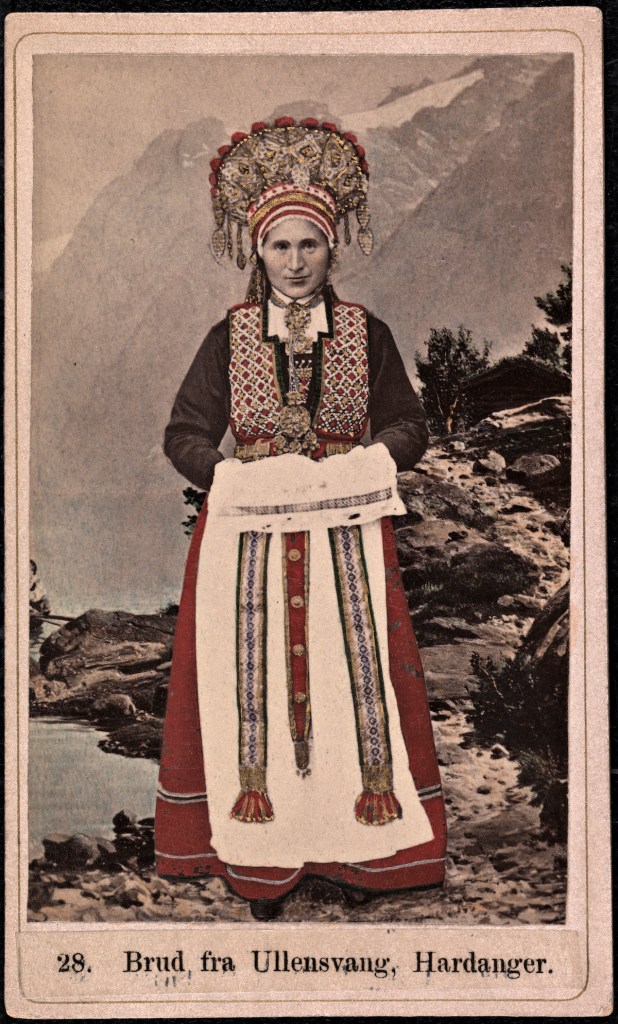
Women in Hardangerbunad bridal costumes / Photo: Nasjonalbiblioteket

“When it’s not easy to explain where you’re from, wearing a bunad shows where you’re heart is.”

Unni Irmelin Kvam

The beginnings of the bunad movement can be traced back to when, after years of rule under Denmark and Sweden, the Norwegians were in search of a national identity. Bunad – the word originates from the Old Norse búnaðr – was developed, ‘as a way to show a national mindset,’ to celebrate Norway’s freedom, and as a way of displaying Norwegian heritage.

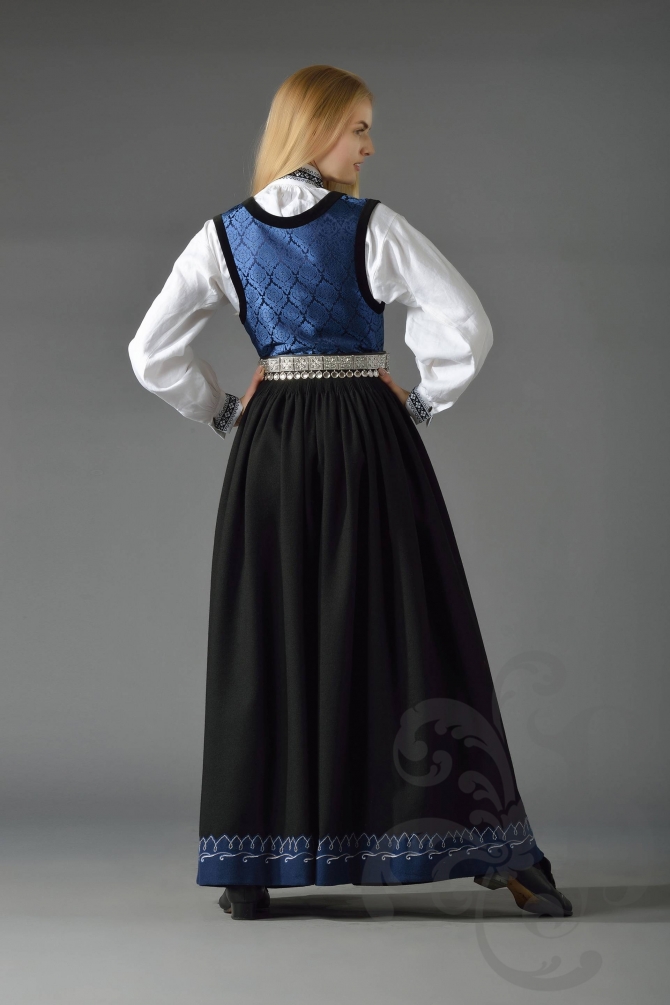
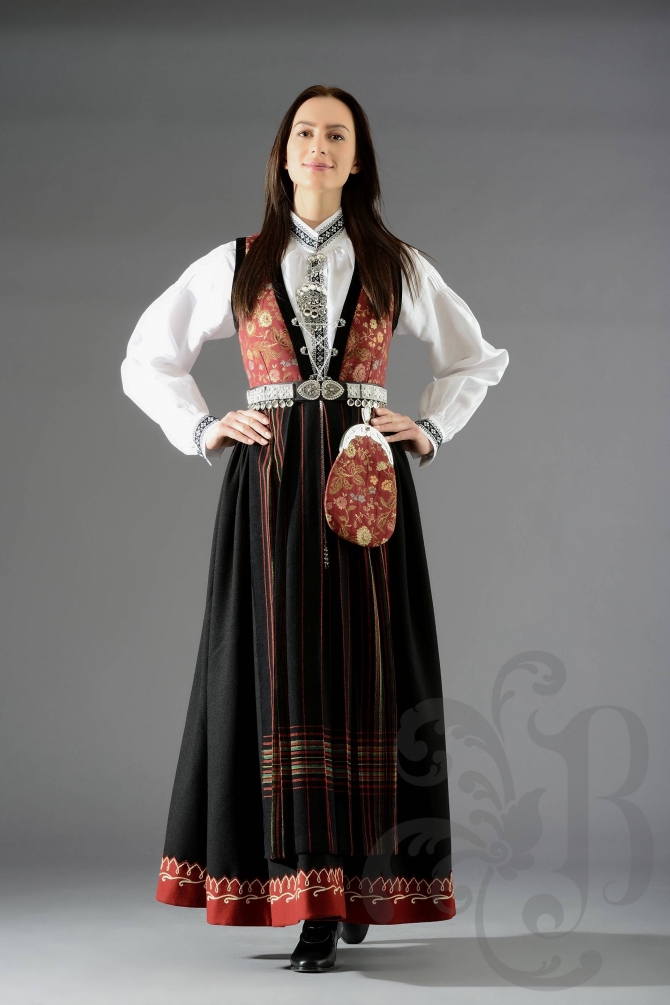
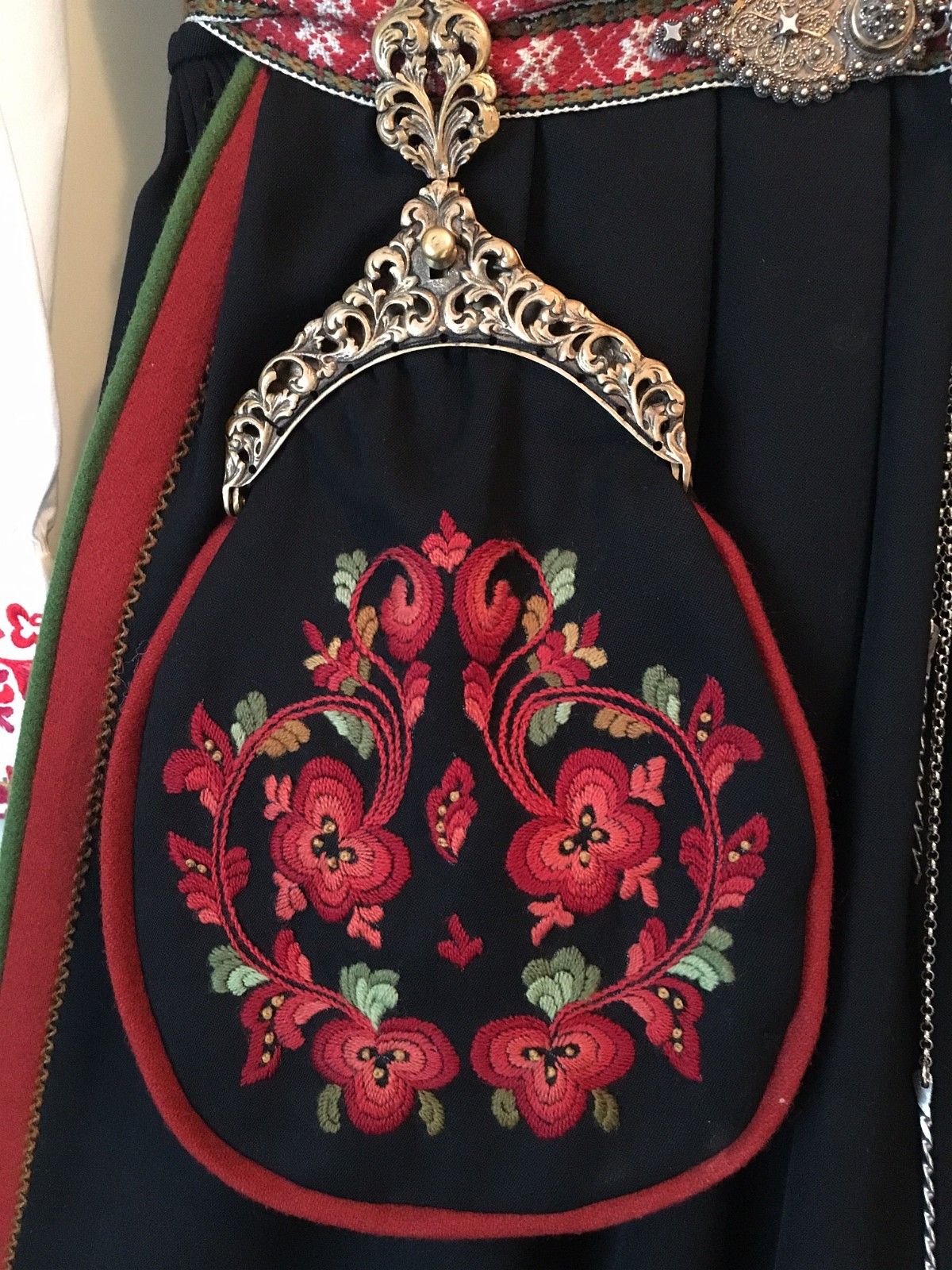
A bunad – of which there are as many as 450 regional variants – is a unique and complex piece of clothing usually consisting of a shirt, a shift, the main woolen dress, and an apron. There are accessories including bags, stockings, shoes, scarves, shawls, and hand-made silver or gold jewelry known as sølje.

Designed to last a lifetime, a bunad is typically passed down through the family. The importance of its role as a family heirloom means it’s imperative it’s kept in pristine condition. One woman who’s mother’s bunad was damaged by moths was especially innovative and transformed the costume into cushions. The intricate detailing of a bunad has a story, which, as author Unni Irmelin Kvam says in her excellent Ted Talk, The Story Of The Norwegian Bunad ‘speak volumes if you know how to read it.’

Hardanger Bunad Photo Source: familysearch.org

In Norway today, there’s a bunad to be found tucked away in practically every wardrobe or attic. The estimated value of the bunads – a completed bunad costs in the region of 50.000 Norwegian kroner, about £4000 – is said to be around 30 billion Norwegian kroner.

The cost of a bunad depends on the design, the material used, the embroidery, and jewellery, as well as who actually makes it, whether it’s a renowned company, a local sewer or the person themselves. There’s a market for bunad in China. ‘China Bunad’ are made for a fraction of the cost of a traditional bunad, but it goes without saying, as they’re ‘not the real thing,’ that they won’t last a lifetime.

Photo: Laila Duran

For someone making their own bunad, the process can take upwards of a year. It’s long been tradition for parents to gift their children with a bunad for their confirmation at the age of 15. With the dresses, there’s always extra fabric in the seams so it can be altered as the wearer grows.

Silver, a metal which in Norway is steeped in legend and superstition, is an important part of the bunad. In days gone by, Norwegians used it to protect themselves against bad weather and illness. There are also tales of silver brooches being pinned on children’s clothing so trolls wouldn’t swap them for one of their own.

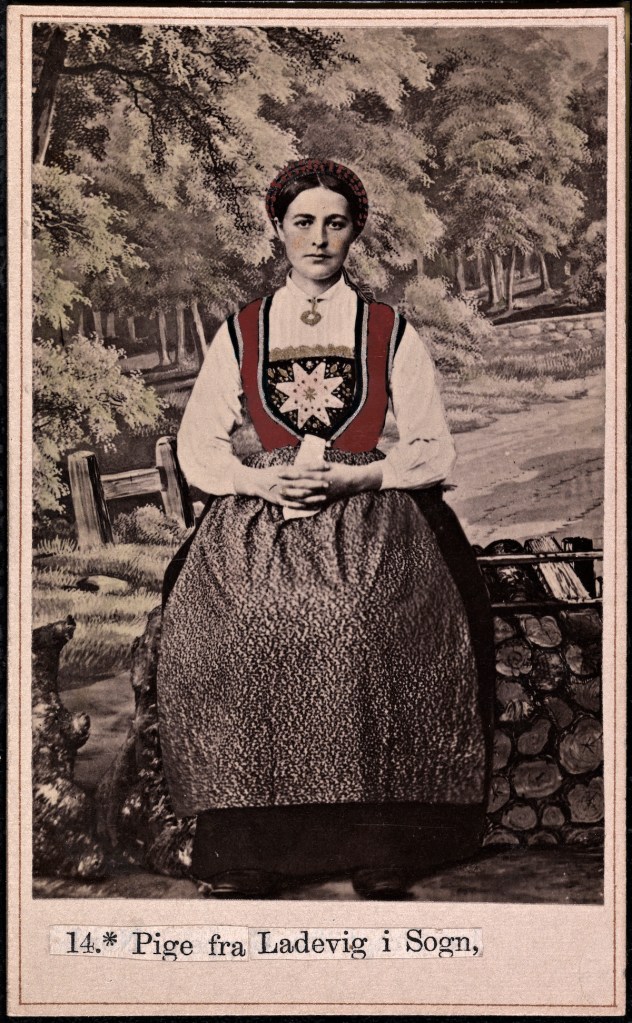
Marcus Selmer
Marcus Selmer
Marcus Selmer

It’s common, though not by any means mandatory, for bunad to be worn at weddings, baptisms, Christmases and birthdays, basically any major life event. However when Syttende Mai comes around, it’s expected the bunad will be brought out of storage and worn.

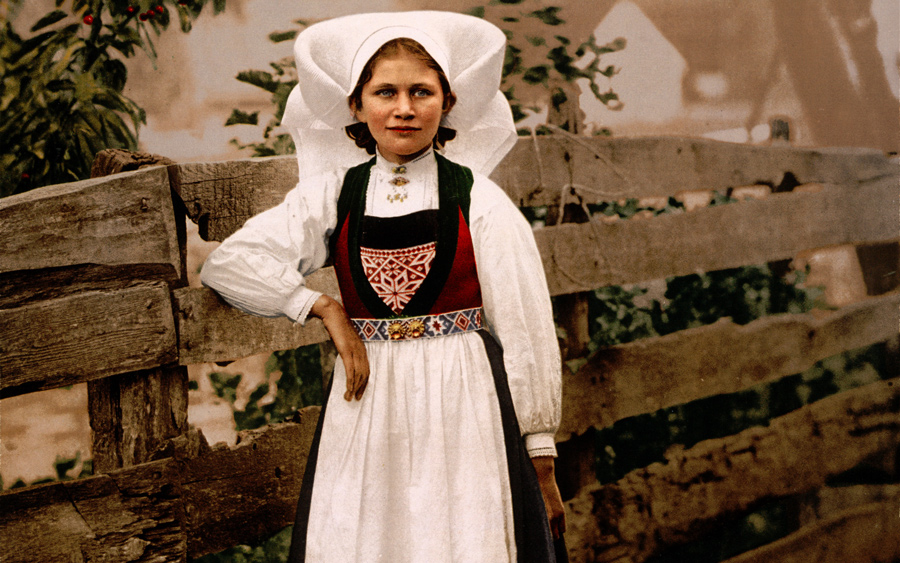
The Hardangerbunad is known as the ‘first bunad,’ and is renowned for its red body and white apron. It became known as ‘the national’ in 1905 and spread throughout the country. It was commonly used to represent Norway, but recently the East-Telemarkbunad has taken its place. Many people say Telemark has the most ‘Norwegianest’ bunads.

“If someone tells you you’re not Norwegian enough to wear a bunad that person is prejudiced and simply wrong.”

Unni Irmelin Kvam

There are dozens of ‘unwritten rules’ about the acceptable way to wear a bunad, and it’s expected that your bunad represents an area that you’re strongly connected to.

Women should accompany their dress with proper bunad shoes and purses. Sunglasses are frowned upon and heavy makeup is discouraged. There are even groups of people referred to as the ‘bunad police,’ who say bunads must be sewn and worn according to the strictness standards. To counteract this, there are folk who make ‘fantasy bunads’ by mixing and matching the styles.

Hardangerbunad.

There is much I haven’t talked about with regards to bunad, as I’m actually working on a much longer piece about its role in Norwegian culture. I haven’t for example, told you about Hulda Garborg or Klara Semb, two women who dedicated their live to bringing bunad into the Norwegian mainstream. But hopefully this post has inspired you enough that you want to go and investigate for yourself the part they played in the history and rise of bunad.

It’s been over a decade since I first went to Norway. I don’t have a bunad yet, but I have my heart set on the Sognebunad (the one in the slideshow) because, of all the places I’ve visited in Norway, whenever I go back my heart says ‘I’m home.’

Sources

Life In Norway / The Norwegian Bunad

Wikipedia / Bunad

TEDx Talks / The Story Of The Norwegian Bunad

Watching The North – Three Thousand

The other week, The Polar Museum (part of the Scott Polar Research Institute) organized a ten day online art festival called The Big Freeze. On the last night of the festival, three films by Inuit filmmakers Nyla Innuksuk, Asinnajaq and Alethea Arnaquq-Baril were shown, following a 50 minute discussion about Inuit film making and the value of historic collections and archives.

Three Thousand (2017)

Three Thousand by Asinnajaq was one of the films, and it was so powerful, so heartrending, so original – I’ve never seen anything quite like it before – that I feel it would be somewhat criminal not to talk about it.

My father was born in a spring igloo – half snow, half skin. I was born in a hospital with jaundice and two teeth.

Asinnajaq

Released in 2017 and coming in at fourteen minutes (though I wish it was doubly as long), this art film/documentary mixes dreamlike animation – there’s moments where imaginary beings in the sky play football with a walrus head, while behind them the aurora borealis dances – with engrossing archival footage of Inuit living their lives – cuddling puppies, gutting fish, cleaning pelts. In one scene, a baby pokes a fish’s eye then licks her finger.

Three Thousand (2017)

The footage bought about so many feelings I didn’t know what to do with them all. I was taken into the past of the Inuit people, their present and their future, which Asinnajaq envisions as being full of ‘hope and beautiful possibility.’

In an interview with Shameless Mag, Asinnajaq said ‘I saw a need in the world for a film that could exist that showed Inuit coming from the land, from what’s more stereotypically known, you know people still asking if you live in a igloo, people who need to know more about life and Inuit and where we come from to take us from the starting point…wind, cold snow, igloo, to contemporary times and it’s still us. We come from here but we live right now.’

What Is Brunost?

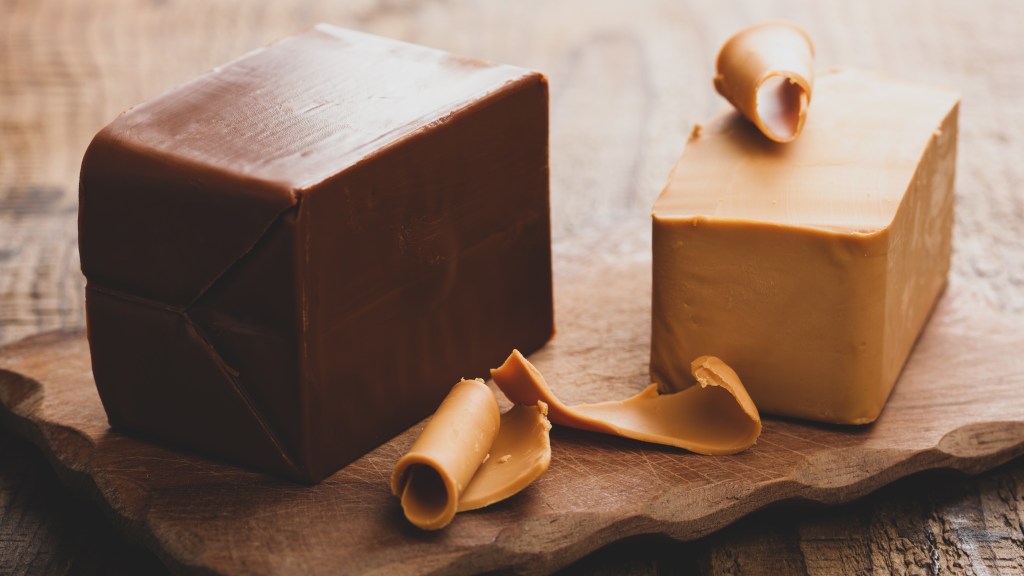
Thirteen years have hurtled by since I first went to Norway and had my first mouthful of brunost (brown cheese). From the get go, I was dead set on eating like a local. For breakfast at least. Lunch and dinner was typically pesto and pasta or cheap muesli. You know the kind – more dust than anything else. Though I found tykk-lefse med kanel (a thick flatbread spread with a sweet cinnamon butter) to be graciously affordable, so that was consumed regularly too. Perhaps too regularly. I grew sick of it after two weeks. Note: My relationship with tykk-lefse med kanel has been rekindled in recent years and we’re solid these days.

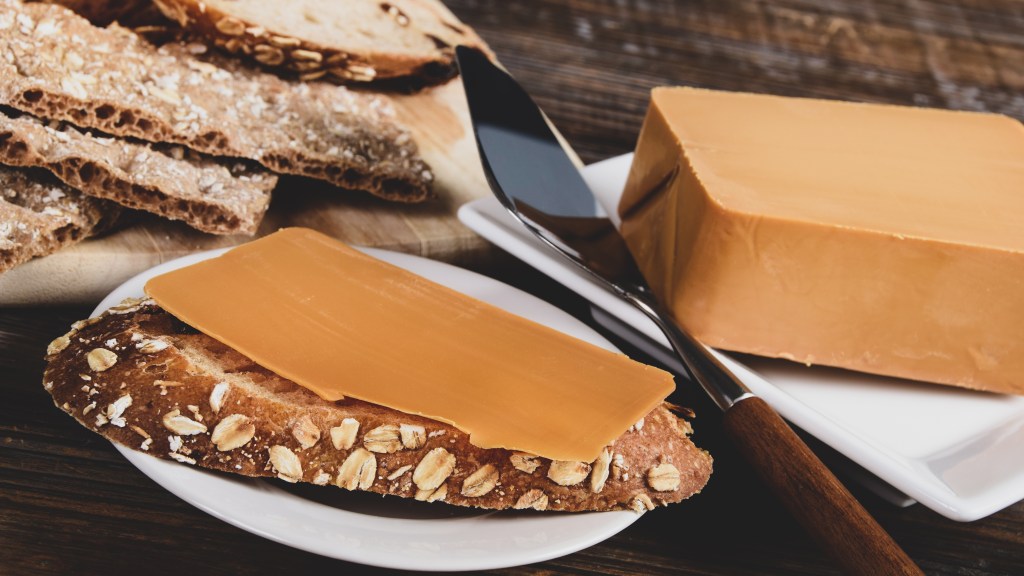
Anyway, brunost. To make Norway’s favourite cheese is straightforward and involves boiling the water from the whey of goat’s milk for several hours until the water evaporates. This caramelizes the sugar, giving the cheese its distinctive tan colour and caramel (debatable) flavour. What’s leftover from the process is left to firm up (though it isn’t massively firm, it’s akin to soft fudge) then it’s more or less ready. Like other cheese – though brunost isn’t technically a cheese – there’s no maturation needed.

I bought a block of brunost with the happy thought it would see me through the next few weeks of breakfasts and snacks. Having read about it before embarking on my Norwegian odyssey, I was certain I’d enjoy its ‘distinctive caramel flavour,’ because I love caramel. Who doesn’t love caramel? But my tastebuds had other ideas.

I ate it like the Norwegians do; thinly sliced with jam and fresh bread (though they also eat it with crispbread or waffles) but, despite its delectable creaminess, the actual taste, best described by another blogger as ‘salty goat’s fudge,’ wasn’t all that pleasing. Needless to say, I was distraught.

I tried it again later in the day, then again the next morning, determined to enjoy it, and not only because I’d paid nearly ten pounds for it. I can’t remember exactly what happened to the block – I was staying in a guest house at the time – I think I might have stuck a note on it and said anyone who wanted it could help themselves.

I haven’t given up on brunost though. Far from it. I’ve only eaten one variety – and there are many – and I’ve only tried it on bread and with jam. There are countless other ways I could eat it. I could make into a sauce for pancakes, add to gingerbread or use it in – Scandi Kitchen came up with this – mac’n’cheese.

When I was living in Sweden, I would eat something similar to brunost – though it was a soft and sticky spread instead of a firm-ish ‘cheese’ – called messmör. It was similar taste wise to brunost, just a bit sweeter and milder. After a few years of eating it, smeared almost transparently on bread, I found myself looking forward to it, and towards the end of my time in Sweden, would slather it on so thick you couldn’t see there was a slice of bread underneath.

Brunost has caused some controversy in recent years. Despite containing calcium and Vitamin B, due to its high sugar and fat content, one municipality considered banning it in schools. Whether this went ahead or not, I’m not sure, but I do like the idea of kids revolting against the banning of their salty goat’s fudge.