

In 2011, I stayed near Holavallagarður cemetery on a friend’s living room floor for a few nights. It was my first time in Iceland, and I knew nothing about Reykjavik’s ‘largest and oldest museum.’ Thus, I cruised on by its hefty iron gates and didn’t think about it again for the remainder of my three-month trip.
Ten years later, in 2021, I finally crossed into the centuries old forested cemetery – home to over 10,000 marked graves – with my enthusiastic guides, the two wraiths from Icelandic dungeon synth band Dyfliza.
One of the first things you spot when you walk into the cemetery from the main entrance is the lychgate. In bygone times, it was where the morgue stood, used for the corpses of the poor and foreign sailors. The well-off dead remained at home until it was time for their funeral. The morgue was moved in 1950, though you can still see the bell.*
*I don’t know why there was a bell in the morgue. A speedy Google search suggested it was to keep evil spirits away from the body, though this wasn’t specifically about Icelandic morgues, so I’m none the wiser really.
It’s easy to while away hours picking your way around the seven-and-a-half acres of gridded grounds. Narrow paths, slippery with moss, wind around jumbled graves. Drooping willows, spruces and poplars, birch and rowan all call Holavallagarður home, along with a type of snail found nowhere else in Iceland. (‘Found nowhere else in Iceland’ is a running theme.)
Chipper birds congregate to gossip in small, gnarled trees, and they attract cats. Lots of cats. There’s also an abundance of fungi to be discovered during autumn. The most exciting of them has to be the Common Stinkhorn or Fylubollur, which amusingly (because I’m a childish buffoon) translates as ‘stinky male genitals.’
Its odour, akin to rotting flesh, is irresistible to flies. A Common Stinkhorn looks like a penis erupting from the ground, and it was thought, once upon a time, that it was an aphrodisiac capable of providing men with ‘powerful erections.’ Common Stinkhorns aren’t actually common at all in Iceland (the first one was documented in 1990), and yes, you guessed it, the only place they’re found is Holavallagarður.
While the cemetery was ready for occupancy in the summer of 1837, it would only be in the winter of 1838 that the first person was laid to rest. In Icelandic folklore, the first person to be buried in a cemetery is bound to be its Guardian for all time, greeting the newly deceased and keeping a watchful eye on all those who come to be buried there after them.
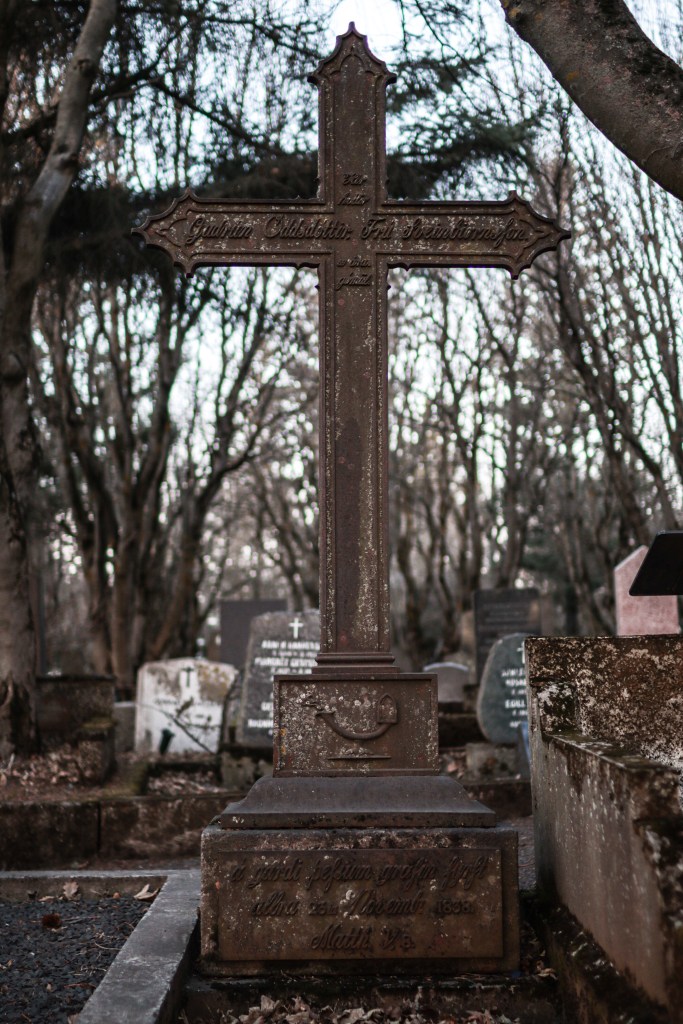
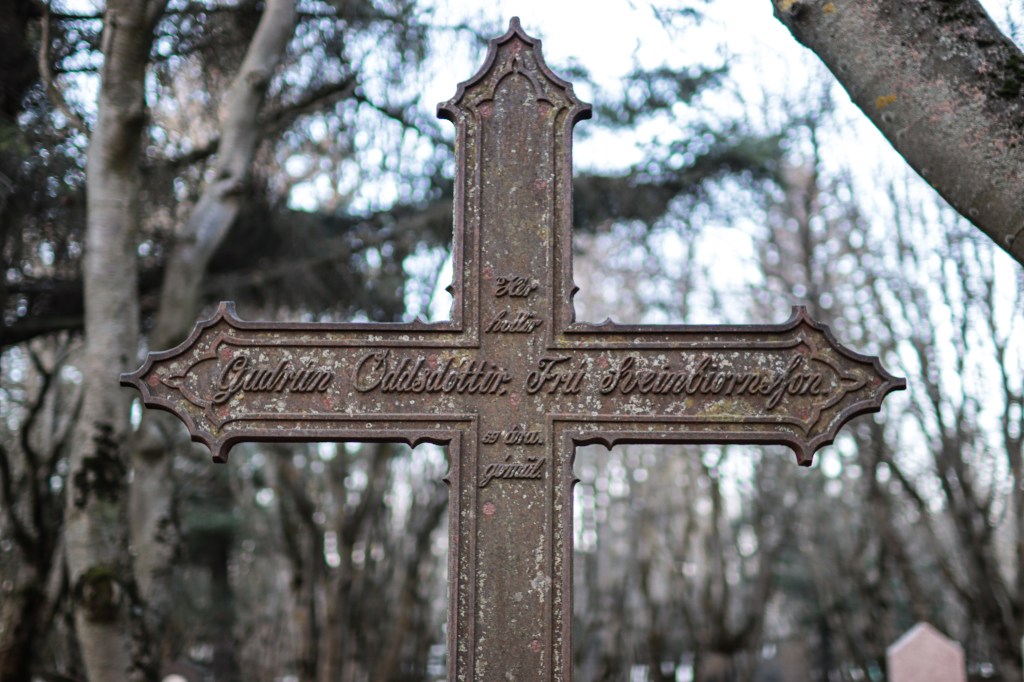
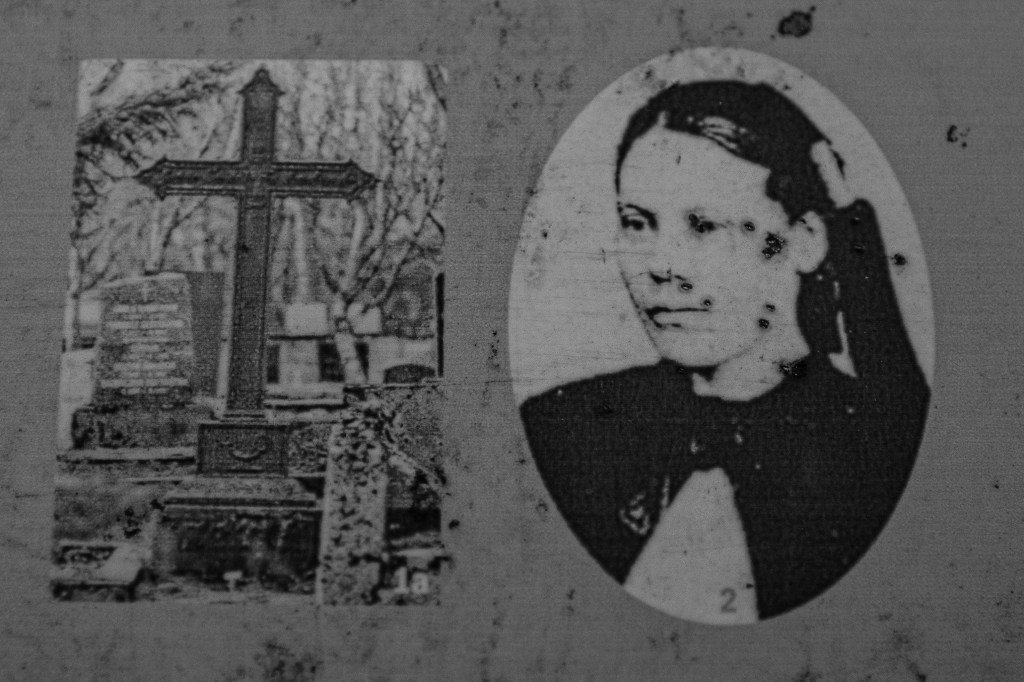
Predictably, very few people wanted to nominate their loved ones to take on this everlasting position, even if it did mean the deceased would never decay. Also, the church didn’t want just anyone to be the Guardian of Holavallagarður, and turned people down because they weren’t ‘in the right standing’ for the role. The position was eventually taken on by 59-year-old Guðrún Oddsdóttir, who was ‘offered’ to the cemetery by her husband, the Chief Justice of the National Court.
Guðrún’s imposing cast iron memorial cross (you can find it at the T-405 section of the cemetery) is the largest of its kind in Iceland. It’s engraved with a flaming lamp (the cemetery Guardian is also known as a ‘Light Bringer’ so it’s a most suitable motif) with the word Her huili husfru – Here rests the mistress of the house. The engravings remain remarkably easy to read.

Inspired by Guðrún, and the lore surrounding cemetery Guardian’s, my best friend Giorgia Sottotetti and I shot some photos in Holavallagarður. Giorgia’s dress (Ovate, in case you’re wondering) is red because, in tales of cemetery Guardians, they’re said to appear wearing red or green.


Politicians, painters and poets are lying in Holavallagarður…as well as the notorious murderess Steinunn Sveinsdóttir. In the Summer of 1802, in a two-family ‘village’ near Rauðasandur beach in the Westfjords, Steinunn Sveinsdóttir and her lover Bjarni Bjarnason murdered their respective spouses in what would go on to become one of the best known criminal cases in Iceland.
In May 1803, the couple were sentenced to death. But there was a problem. No executioner could be found in Reykjavik, or at least not one qualified enough to do the job. So, the couple were to be deported to Norway.
Sveinsdóttir died in prison of unknown circumstances before she could be deported. After numerous prison breaks and re-captures, Bjarnason was sent to Kristiansand. In a style reminiscent of medieval execution, he was put on a breaking wheel and stretching bench before having his head and hands cut off and jammed on spikes. In a differing account, he had a hand cut off and was then decapitated. Dismemberment followed, with his torso and head ending up on spikes.
Initially, Sveinsdóttir was buried where the statue of Leif Eiriksson stands today, something I learned from the excellent thesis, Haunted Reykjavik: Cultural Heritage in the form of Ghost Stories by Matthildur Hjartardóttir.
Hjartardóttir explains: ‘Since Steinunn was considered evil, she wasn’t buried in the traditional sense, and she wasn’t buried in consecrated ground, as was custom at the time. Steinunn was dysjuð, which is a grave consisting of heaped-up stones, a practice reserved for people who were not deemed worthy of a proper burial. People then started throwing rocks at the mound for various reasons. Some did it to maintain the mound; others did it because they were afraid that she would come back, and others did it so her spirit would leave them alone.’
I don’t know where she was relocated to next (I heard her remains were moved several times), but for some years, she laid in an unmarked grave in Holavallagarður. It was only in 2012 that her grave was finally given a marker, following a prolonged fight for recognition by her descendants, who were staunch in their belief in her innocence.
Speaking to the Iceland Review in an article celebrating the cemetery’s 180th anniversary, the caretaker Heimir Janusarson said: ‘The cemetery is very unique in Europe because it has never been reorganized or dug under… We have the first grave, we have the cemetery’s developmental history. You can read its planning history. You can read its vegetation history – when a [new species of] tree arrived in the country – because they were always planted in the cemetery first [because it was an] enclosed area and there [were] no sheep or horses to eat them.’
I’ve spent much time in Holavallagarður since 2021; in theory, I should know it almost as well as the back of my hand. But it proves me wrong whenever I think I’ve figured it out. Despite how well I may have studied the map beforehand, I still find it oddly special (okay, and sometimes infuriating…) that I’m never quite sure where I’m going when stepping off the main paved footpaths and onto the trails twisting through the forested garden of the departed.
Sources

 Northern Fever